
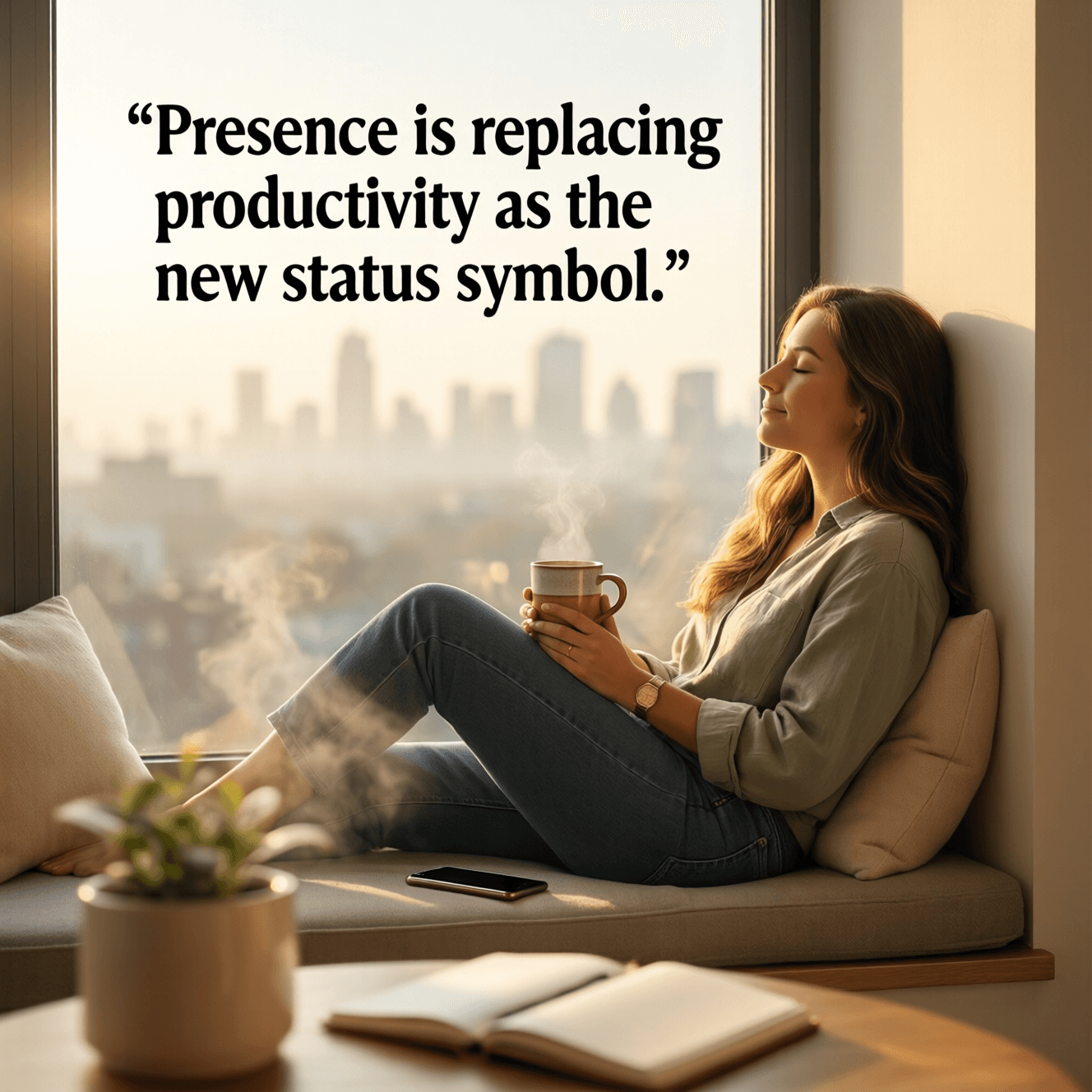
Presence is replacing productivity as the new status symbol. — Dr. Neeta Bhushan
—What lingers after this line?
From Doing More to Being More
Dr. Neeta Bhushan’s line captures a quiet cultural pivot: for decades, the most admired people looked relentlessly busy, wearing productivity like a badge of honor. Long hours, packed calendars, and constant responsiveness signaled ambition and importance, as if worth could be measured in output. Yet as the limits of hustle culture become harder to ignore, a different kind of esteem is emerging. Increasingly, the person who can slow down, pay attention, and show up fully is the one perceived as most in control—suggesting that status is shifting from what we produce to how we inhabit our lives.
Why Productivity Became a Marker of Status
To understand the replacement Bhushan describes, it helps to see how productivity gained its symbolic power. Industrialization and later corporate culture rewarded efficiency, quantification, and visible busyness; being “in demand” became shorthand for being valuable. Even language reinforced it: we “spend” time, “invest” effort, and “optimize” routines. Over time, this bled into identity. When output becomes the primary proof of worth, rest can feel like failure and attention like a luxury. In that context, productivity isn’t merely a tool—it becomes social signaling, a way of declaring relevance and competence without having to say it outright.
The Scarcity of Attention in a Noisy Age
However, the modern environment has made genuine attention rare. With constant notifications, multi-channel communication, and algorithm-driven feeds, many people live in a state of partial presence—physically somewhere, mentally elsewhere. As a result, undivided attention now feels like a scarce resource. This scarcity raises presence’s social value. When someone listens without checking a phone, holds a thoughtful pause, or maintains eye contact, it stands out as unusual—and therefore impressive. Presence becomes not only a personal practice but also a signal that one’s attention is not easily bought, borrowed, or fragmented.
Presence as Power and Choice
Presence can also read as power because it implies autonomy. If you can be fully where you are, you are demonstrating that you aren’t governed by frantic urgency or external demands. In many workplaces and social circles, that steadiness communicates confidence more effectively than speed. Moreover, presence often reflects an internal reordering of priorities. Instead of asking, “How much can I get done?” the question becomes, “What deserves my attention?” That reframing turns time from a battleground into a statement of values—and status increasingly attaches to people who appear to live by intentional choices rather than constant reaction.
Leadership, Relationships, and the New Social Signal
As this shift unfolds, presence changes how leadership and connection are perceived. In meetings, the person who synthesizes, listens, and responds with clarity can carry more authority than the one who speaks the most or sends the most emails. In friendships and families, reliability and emotional attentiveness become the new markers of “having it together.” Consequently, presence functions like a refined social signal: it conveys maturity, discernment, and emotional regulation. Where productivity once implied, “I’m needed everywhere,” presence implies, “I can be here completely”—and that completeness is increasingly what people admire and seek.
Redefining Success Without Rejecting Achievement
Importantly, Bhushan’s idea doesn’t require abandoning ambition. Rather, it suggests a recalibration in which productivity becomes the servant of a fuller life, not the proof of one’s value. The most respected achievement may be the kind that doesn’t consume the person producing it. In this light, presence replaces productivity as a status symbol because it signals a deeper form of success: the ability to create, contribute, and still remain available to one’s own experience. The ultimate prestige is not merely getting more done, but being unmistakably alive to what matters while doing it.
Recommended Reading
As an Amazon Associate, we earn from qualifying purchases.
One-minute reflection
What does this quote ask you to notice today?
Related Quotes
6 selectedIn the quiet of your own mind, you hold the power to reclaim your attention from the chaos of the world. — Thich Nhat Hanh
Thich Nhat Hanh
Thich Nhat Hanh’s words begin with a gentle but radical claim: the mind contains a quiet space that cannot be fully colonized by the world’s noise. Rather than portraying attention as something stolen forever by distract...
Read full interpretation →To find peace, you must stop trying to solve every problem at once. Sometimes the most productive thing you can do is simply breathe and be present. — Thich Nhat Hanh
Thich Nhat Hanh
At first glance, Thich Nhat Hanh’s insight challenges a habit many people mistake for responsibility: the need to solve every problem immediately. When the mind races from one worry to the next, it often creates more str...
Read full interpretation →We are human beings, not human doings. Don't forget to slow down and just be. — Shane Parrish
Shane Parrish
Shane Parrish’s line begins with a subtle but powerful reversal: we are valued not for constant output, but for our existence itself. In a culture that often rewards busyness, achievement, and visible productivity, the p...
Read full interpretation →By taking just a few extra seconds to stay with a positive experience—even the comfort in a single breath—you'll help turn a passing mental state into lasting neural structure. — Rick Hanson
Rick Hanson
Rick Hanson’s statement centers on a simple but powerful claim: positive experiences often pass through the mind too quickly to leave a deep mark unless we consciously linger with them. A pleasant breath, a moment of saf...
Read full interpretation →The most valuable thing we can do for the psyche, occasionally, is to let it rest, wander, live in the changing light of a room, not try to be or do anything whatever. — May Sarton
May Sarton
At first glance, May Sarton’s reflection seems almost subversive in a culture that equates worth with productivity. Yet her point is gentle rather than defiant: the psyche, like the body, needs intervals of stillness.
Read full interpretation →The goal is not to be constantly productive, but to be deeply present. — Pico Iyer
Pico Iyer
At first glance, Pico Iyer’s remark gently overturns one of modern culture’s strongest assumptions: that a meaningful life is measured by output. By saying the goal is not constant productivity but deep presence, he shif...
Read full interpretation →More From Author
More from Dr. Neeta Bhushan →