
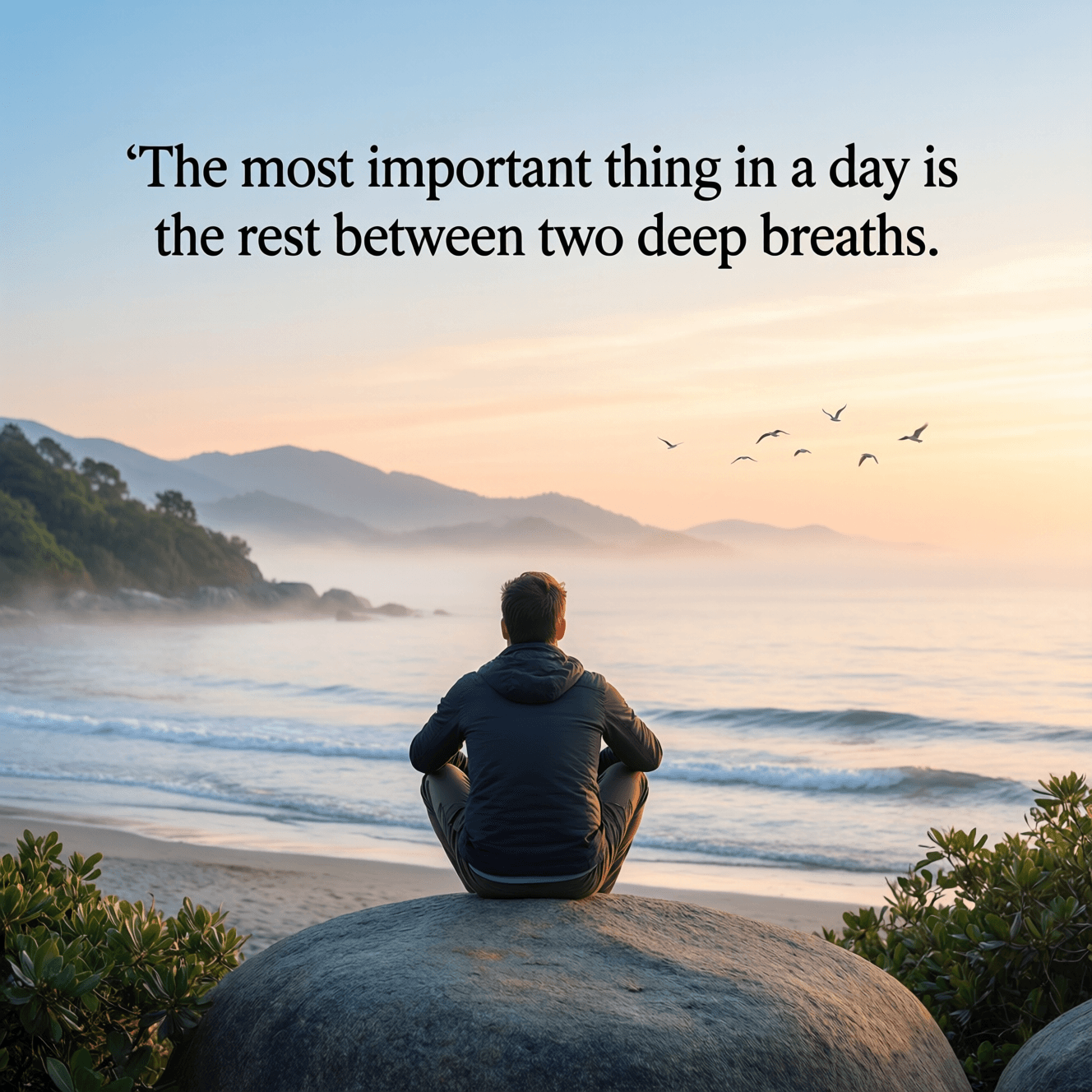
The most important thing in a day is the rest between two deep breaths. — Etty Hillesum
—What lingers after this line?
Reframing What Matters in a Day
Etty Hillesum’s line quietly overturns the usual way we measure a day—by tasks completed, hours spent, or problems solved. Instead, she points to something so small it’s easy to miss: the moment of rest between two deep breaths. In doing so, she suggests that the day’s true center isn’t necessarily an achievement, but a lived instant of awareness. From there, the quote begins to feel less like a poetic flourish and more like a practical lens. If a whole day can be anchored in a pause, then meaning becomes portable; it can be found not only in major events, but in the brief openings between them.
The Pause as a Refuge of Inner Freedom
That small interval between breaths also reads as a kind of refuge—an inward room no external circumstance can fully occupy. Hillesum’s own journals, written during the Nazi occupation and published as *Etty Hillesum: An Interrupted Life* (1941–1943), often return to the idea of cultivating an inner life even amid danger. Seen in that context, “the rest” is not laziness; it’s a claim to interior freedom. As the day presses in with urgency, the pause becomes a boundary: a moment where the self is not being demanded from, judged, or hurried. The breath turns into a doorway back to what cannot be confiscated—attention, dignity, and the ability to respond rather than merely react.
Attention: The Smallest Unit of Meaning
Once the breath-pause is recognized as important, it naturally leads to the role of attention. A deep breath is an intentional act; it marks a shift from automatic living to chosen presence. In that sense, the “rest” is where attention gathers itself, and where the day becomes legible—not as a blur, but as something felt. Philosophically, this echoes older traditions that treat mindful awareness as the ground of a good life. Marcus Aurelius’ *Meditations* (c. 170–180 AD) repeatedly returns to coming back to the present moment, as if clarity is always available—but only if we stop long enough to see it. The pause between breaths becomes that stop.
Rest That Isn’t Sleep: A Micro-Sabbath
Importantly, Hillesum does not speak of rest as retreating from life, but as a brief easing within life. This is closer to a micro-Sabbath than to escapism: a tiny cessation that restores proportion. When the nervous system is strained by constant input, the day can feel like a single unbroken demand; the pause interrupts that tyranny. Because it is small, it can happen anywhere—at a sink full of dishes, in a crowded train, before sending a difficult message. The rest between breaths is a form of humane pacing, a reminder that even in motion we can choose not to be driven.
From Breath to Response: Choosing How to Act
After creating a sliver of space, the next step is what that space allows: a different kind of action. The pause is where impulse loses its monopoly. A sharp remark can be withheld, panic can soften, compassion can re-enter the frame—not because circumstances changed, but because the person did. This is why the “rest” can be the most important thing: it is the hinge between stimulus and response. Viktor Frankl later framed a similar idea in *Man’s Search for Meaning* (1946), describing a space in which one can choose one’s attitude. Hillesum’s breath-pause is a daily, bodily way of entering that space.
A Practice for Ordinary Hours
Finally, the quote invites a simple practice: to treat the day as a series of returns. Deep breath, pause, deep breath—an ongoing rhythm of re-centering. Rather than waiting for vacations, perfect routines, or quiet mornings, Hillesum’s wisdom makes restoration available in seconds. Over time, those seconds add up not as productivity, but as presence. The day may still be full, painful, or chaotic, yet it becomes punctuated by moments that keep a person inwardly intact. In that way, the rest between two deep breaths is not merely a break in the day; it is a way of living the day.
One-minute reflection
Why might this line matter today, not tomorrow?
Related Quotes
6 selectedSometimes the most important thing in a day is the rest between two deep breaths. — Etty Hillesum
Etty Hillesum
Etty Hillesum’s line places surprising importance on something almost invisible: the brief rest between inhaling and exhaling. Rather than pointing to major achievements or dramatic turning points, she suggests that what...
Read full interpretation →Sometimes the most important thing in a day is the rest between two deep breaths. — Etty Hillesum
Etty Hillesum
Etty Hillesum suggests that what matters most may not be the obvious tasks or milestones, but a brief interval of stillness—“the rest between two deep breaths.” In that image, the day’s true center shifts from outward ac...
Read full interpretation →Sometimes the most important thing is the rest between two deep breaths. — Etty Hillesum
Etty Hillesum
Etty Hillesum’s line turns attention away from the breath itself and toward the interval that separates one inhale from the next. At first glance, the “rest” sounds almost incidental, yet she suggests it may be the most...
Read full interpretation →Sometimes the most important thing in a day is the rest we take between two deep breaths. — Etty Hillesum
Etty Hillesum
Etty Hillesum’s line shifts attention away from what we accomplish and toward how we remain human while doing it. Instead of treating rest as a reward after productivity, she places it at the center of the day, suggestin...
Read full interpretation →Pausing is not stopping; it is creating space to remember who you are. — Gary Burnison
Gary Burnison
Gary Burnison’s line begins by correcting a common fear: that slowing down equals falling behind. By insisting that “pausing is not stopping,” he separates rest from resignation and reflection from retreat.
Read full interpretation →Feelings come and go like clouds in a windy sky. Conscious breathing is my anchor. — Thích Nhất Hạnh
Thich Nhat Hanh
Thích Nhất Hạnh’s metaphor likens feelings to clouds—shifting, insubstantial, and constantly changing under the influence of life’s winds. This imagery powerfully reminds us that emotional states, whether pleasant or pai...
Read full interpretation →More From Author
More from Etty Hillesum →Wisdom is knowing when to have rest, when to have activity, and how much of each to have. — Etty Hillesum
Etty Hillesum’s insight begins with a simple but demanding idea: wisdom is not merely knowing what is good, but knowing when it is good. Rest and activity are both necessary, yet either can become harmful when taken at t...
Read full interpretation →The most productive thing you can do is often the very thing you feel most guilty for: resting. — Etty Hillesum
At first glance, Etty Hillesum’s remark sounds contradictory: how can doing less become the most productive choice? Yet that tension is exactly her point.
Read full interpretation →Sometimes the most important thing in a day is the rest between two deep breaths. — Etty Hillesum
Etty Hillesum’s line places surprising importance on something almost invisible: the brief rest between inhaling and exhaling. Rather than pointing to major achievements or dramatic turning points, she suggests that what...
Read full interpretation →Sometimes the most important thing in a day is the rest between two deep breaths. — Etty Hillesum
Etty Hillesum suggests that what matters most may not be the obvious tasks or milestones, but a brief interval of stillness—“the rest between two deep breaths.” In that image, the day’s true center shifts from outward ac...
Read full interpretation →