
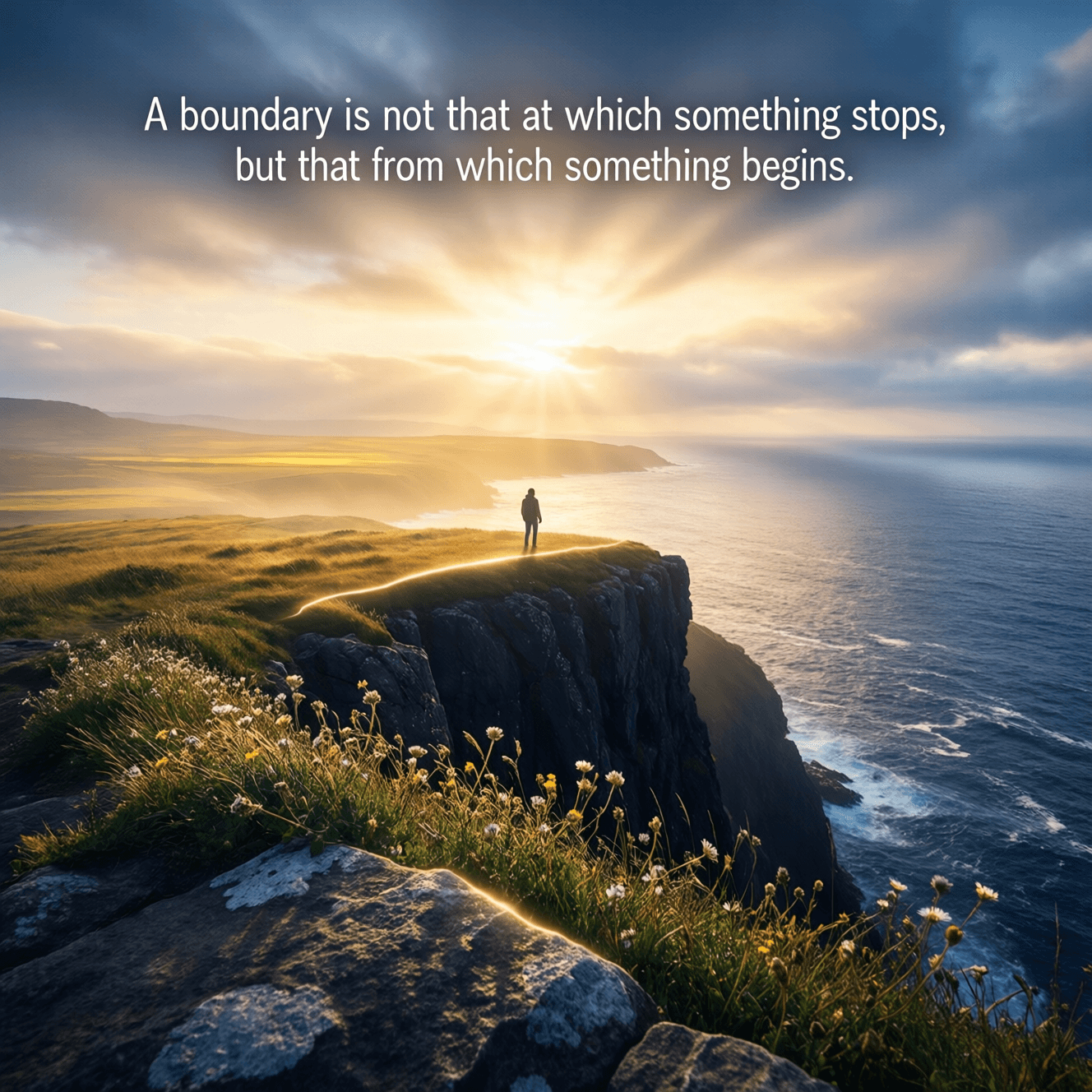
A boundary is not that at which something stops, but that from which something begins. — Martin Heidegger
—What lingers after this line?
Reversing the Usual Meaning of Limits
Heidegger flips a common assumption: we typically treat a boundary as a final line where movement, possibility, or identity must cease. By contrast, he suggests that a boundary is what grants something its emergence—what allows it to take shape in the first place. This reversal matters because it reframes limitation as formative rather than merely restrictive. Instead of asking what a boundary excludes, Heidegger nudges us to ask what it makes possible: what comes into view, what gains definition, and what becomes actionable once a line is drawn.
How Things Become What They Are
Building on that reversal, a boundary can be understood as the condition under which a thing becomes itself. A coastline, for instance, doesn’t only mark where land “ends”; it is also where a certain kind of place begins—harbors, tides, and the human life organized around them. In this sense, the edge is not an afterthought but a generator of character. Similarly, a concept gains meaning through what distinguishes it: “day” stands out because it is bounded by night; a melody becomes recognizable because it is shaped by pauses, tempo, and an ending that lets it be heard as a whole.
Beginnings Hidden Inside Definitions
From there, it becomes clearer why Heidegger ties boundaries to beginnings: definition itself is a kind of boundary-making. When we name something, we delimit it, and that delimitation is precisely what lets it appear as a coherent phenomenon rather than a blur. Aristotle’s notion of a “form” in the Metaphysics (4th century BC) similarly implies that a thing’s identity depends on determining what it is and is not. So the boundary is not merely a wall; it is an act of disclosure. It gathers scattered features into a unity, and in doing so, it inaugurates a new reality—something that can now be recognized, discussed, and lived with.
Human Life as Project and Horizon
Heidegger’s insight deepens when applied to human existence. Our lives are not experienced as an infinite field of options; they are structured by horizons—time, mortality, social roles, language, and circumstance. Paradoxically, these limits can intensify meaning, because what matters stands out against what cannot be done or cannot last. In Being and Time (1927), Heidegger argues that finitude is not an external constraint tacked onto life; it is part of how life becomes intelligible to us at all. The “boundary” of time, for example, can turn vague intentions into concrete commitments, allowing projects to truly begin.
Creative Constraints in Art and Work
Next, consider how creativity often depends on constraints. A sonnet’s strict structure—fourteen lines with patterned rhyme—doesn’t merely restrict the poet; it gives the poem a starting point and a tension to work within. In practice, many artists report that a blank canvas can be paralyzing, while a defined assignment unlocks momentum. The same holds in everyday work: a clear scope, a deadline, or a limited set of tools frequently produces better results than unlimited freedom. Here, the boundary acts like a launchpad, providing the pressure and direction needed for something new to take form.
Ethical and Political Implications of Lines Drawn
Finally, boundaries shape communal life: laws, rights, and norms define what a society is willing to permit and protect. While boundaries can certainly be abused—used to exclude unjustly—they also establish the conditions for trust and cooperation. A right, after all, is a boundary around a person that others are not meant to cross. Seen this way, the task is not to eliminate boundaries but to scrutinize them: which ones enable flourishing and which ones merely shut possibilities down? Heidegger’s sentence becomes a practical test—if a boundary never allows a beginning, it may be a barrier; if it opens a space for something to exist, it may be the source of a world.
One-minute reflection
What does this quote ask you to notice today?
Related Quotes
4 selectedA journey of a thousand miles begins with a single step.
Unknown
This quote emphasizes the importance of taking the first step, no matter how small, towards achieving a long-term goal. Every major achievement starts with an initial action.
Read full interpretation →A journey of a thousand miles begins with a single step.
Unknown
This quote emphasizes the importance of taking the first step towards achieving a long-term goal or embarking on a significant endeavor. Without that initial action, progress cannot be made.
Read full interpretation →Language is the house of Being; in its home man dwells. — Martin Heidegger
Martin Heidegger
Heidegger’s claim shifts language from a mere instrument to the very habitat in which human existence takes place. In the Letter on Humanism (1947), he writes that “language is the house of Being,” suggesting that we do...
Read full interpretation →Believe in the magic of beginnings. — Meister Eckhart
Meister Eckhart
This quote encourages individuals to embrace new opportunities and beginnings with an open heart and mind. It highlights the potential and promise inherent in starting something new.
Read full interpretation →More From Author
More from Martin Heidegger →