
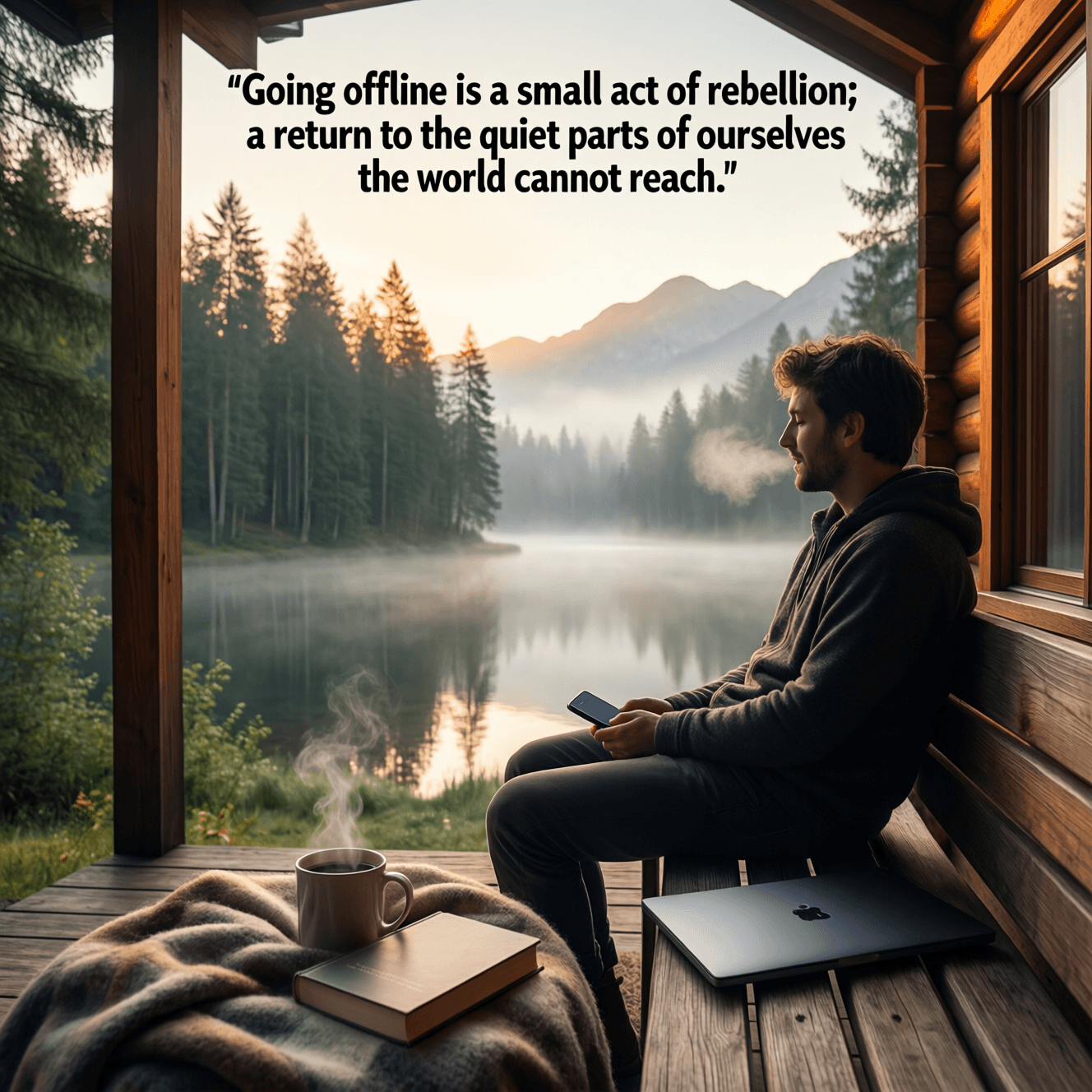
Going offline is a small act of rebellion; a return to the quiet parts of ourselves the world cannot reach. — Unknown
—What lingers after this line?
Reclaiming Attention in a Noisy Age
The quote begins by framing “going offline” not as a mere lifestyle tweak, but as a conscious refusal of constant availability. In a culture that rewards rapid replies and perpetual updates, disconnecting becomes a way to take your attention back from systems designed to keep it captured. This is why it feels like rebellion: it quietly disrupts expectations that your mind should always be open for business. From there, the idea widens beyond personal convenience into an ethical stance. If attention shapes what we value and become, then choosing where it goes is a form of self-governance, a subtle insistence that your inner life is not public property.
The Politics of Being Unreachable
Calling it rebellion also hints at power. Being reachable at all times benefits employers, platforms, and social norms that equate responsiveness with worth. When you go offline, you challenge the assumption that silence is negligence. Instead, silence becomes intentional—an assertion that you can set terms for access to you. This reframes absence as presence: you are not “missing,” you are elsewhere on purpose. The act may look small, yet it resists a modern kind of soft coercion—the pressure to perform visibility—by choosing privacy, delay, and deliberate pacing.
Returning to the Quiet Self
The second half shifts from resistance to restoration: a “return to the quiet parts of ourselves.” Offline time is depicted as homecoming, suggesting that constant input can estrange us from our own thoughts. When the stream stops, subtler signals reappear—fatigue, curiosity, grief, desire—emotions that often get edited out by distraction. This return is not necessarily blissful; quiet can initially feel uncomfortable because it removes the buffer between us and our inner weather. Yet that discomfort is part of the point: it is evidence that something private and true has been waiting underneath the noise.
What the World Cannot Reach
The phrase “the world cannot reach” draws a boundary around an interior sanctuary. Even in healthy connection, there is a portion of the self that should remain uncolonized by commentary, metrics, and constant comparison. Going offline protects that space from the subtle shaping force of being watched—whether by algorithms, audiences, or imagined judgment. In this light, disconnection is not antisocial but preservative. It safeguards a core where identity is formed before it is displayed, where values are clarified before they are broadcast, and where you can be unoptimized—simply human.
Silence as a Form of Care
Once inner quiet is recognized as valuable, the act becomes a kind of care practice. Offline intervals resemble closing a door to sleep, reflection, or prayer: they acknowledge limits and restore capacity. Rather than treating rest as a reward for productivity, the quote implies rest is a right—and that protecting it may require defying norms that treat busyness as virtue. As a result, the rebellion becomes gentle but durable. It is less about dramatic renunciation and more about repeated, ordinary choices that keep your nervous system from living in perpetual alert.
A Sustainable Way Back to Ourselves
Finally, the quote suggests that the payoff of going offline is not escape, but reintegration. When you return from quiet, you often come back with sharper discernment: what matters, what doesn’t, and what you actually believe when the chorus quiets. This makes reconnection healthier, because you re-enter the world with a self that has been consulted, not bypassed. In that sense, the rebellion is sustainable precisely because it is small. By stepping away in regular, intentional ways, you keep open a path to the parts of you that cannot be quantified, monetized, or hurried—and that is where a fuller life tends to begin.
One-minute reflection
Where does this idea show up in your life right now?
Related Quotes
6 selectedDepth is the new status symbol. Be so well-read and well-rested that people think you've gone offline for good. — Unknown
Unknown
The quote reframes status away from conspicuous consumption and toward something quieter: depth. Instead of broadcasting busyness, it proposes that the most enviable life is one marked by substance—clear thinking, cultiv...
Read full interpretation →Disconnection from technology is not a rebellion, it is a regulation of time. — Unknown
Unknown
The quote opens by challenging a common assumption: that stepping away from devices is inherently a dramatic, anti-tech stance. By saying disconnection is “not a rebellion,” it reframes the choice as practical rather tha...
Read full interpretation →The greatest luxury in a modern world is not things, but the ability to disconnect and reclaim your own attention. — Cal Newport
Cal Newport
At first glance, Newport’s statement overturns the traditional idea of luxury as something material. Instead of wealth being measured by rare objects, he suggests it is now measured by the freedom to step away from noise...
Read full interpretation →The real flex is not looking busy. It is having the audacity to enjoy silence without reaching for your phone. — Pema Chödrön
Pema Chödrön
At first glance, the quote challenges a modern status symbol: busyness. In many workplaces and social circles, looking overloaded can seem like proof of importance.
Read full interpretation →Something really helpful for stress reduction is to simply consume less — less news, less social media, less information, less noise, less screen time. — Valentina Ogaryan
Valentina Ogaryan
Valentina Ogaryan’s statement begins with a deceptively simple idea: stress often grows not only from what happens to us, but from how much we continuously take in. By recommending less news, less social media, and less...
Read full interpretation →Sometimes you need to disconnect to reconnect with what truly matters. — Emma Green
Emma Green
At first glance, Emma Green’s quote sounds like a simple call to unplug, yet it carries a deeper truth about attention and meaning. To disconnect is not merely to withdraw from devices, noise, or obligations; rather, it...
Read full interpretation →More From Author
More from Unknown →The language is the substrate. The architecture is the contract.
The line sets up a deliberate pairing: language lies beneath everything, while architecture governs everything above it. In other words, what you can express determines what you can build, and what you commit to structur...
Read full interpretation →A scroll is not a break; it is a trap disguised as rest. — Unknown
The quote begins by challenging a familiar story we tell ourselves: that a brief scroll is a harmless pause between tasks. On the surface, it looks like recovery—no effort, no decision, no commitment.
Read full interpretation →Don't let your ice cream melt while you're counting someone else's sprinkles. — Unknown
The quote uses ice cream as a simple stand-in for life’s fleeting pleasures: what you have is delicious, but it won’t last forever if you ignore it. Meanwhile, “counting someone else’s sprinkles” captures the habit of mo...
Read full interpretation →If your absence doesn't affect them, your presence never mattered. — Unknown
The quote frames absence as a revealing experiment: remove yourself, and the reaction—concern, curiosity, indifference—becomes a kind of data. If nothing changes when you’re gone, it suggests your role was never integrat...
Read full interpretation →