
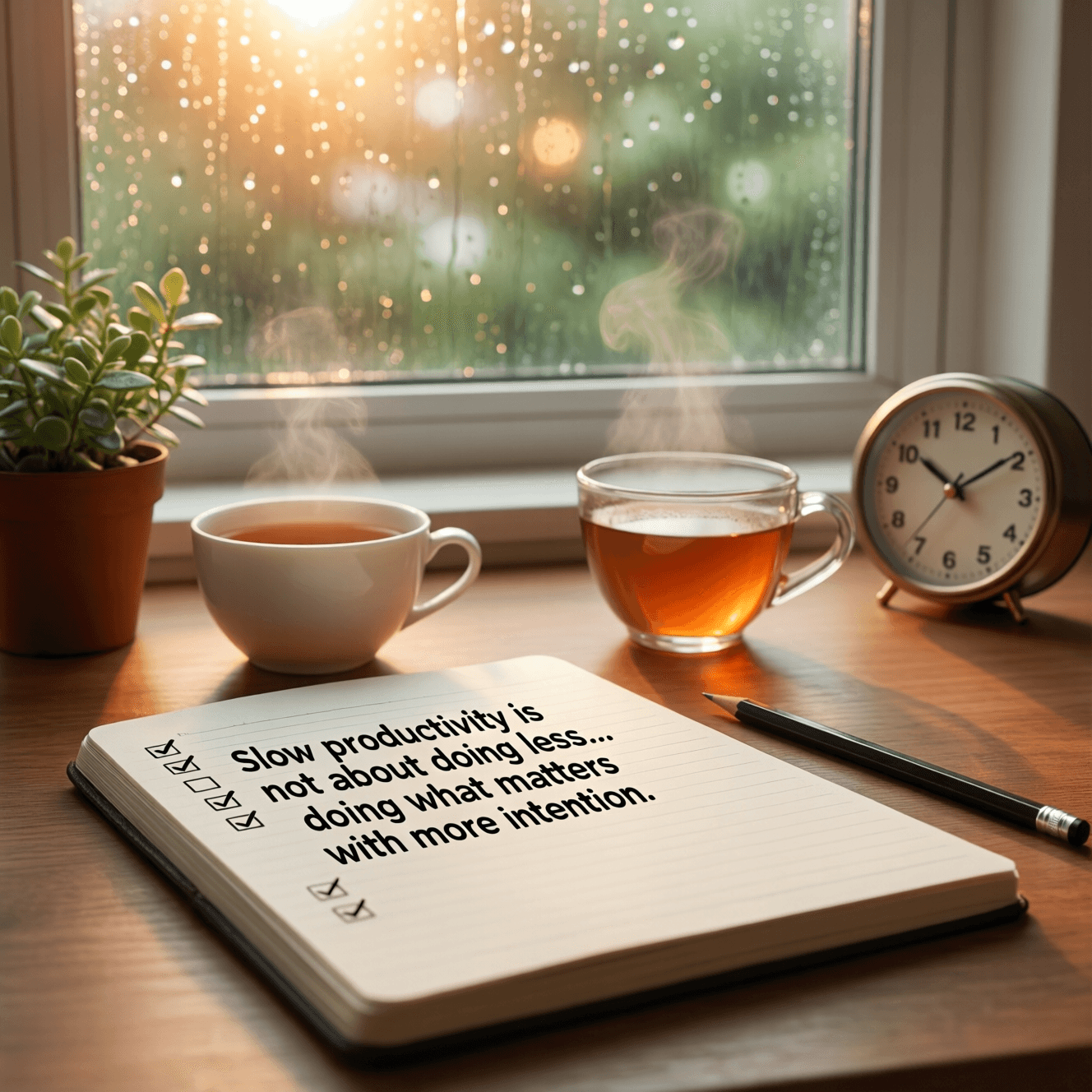
Slow productivity is not about doing less. It is about doing what matters with more intention. — Unknown
—What lingers after this line?
Reframing “Slow” as Deliberate
The quote begins by challenging a common misunderstanding: “slow” sounds like “less,” as if productivity must shrink to become gentler. Instead, it reframes slowness as deliberateness—an approach where pace is chosen to support quality and clarity rather than to satisfy urgency. From there, the statement implies a quiet critique of speed-as-a-virtue culture. If fast work is automatically praised, then slow productivity becomes a corrective lens, asking whether the tempo of our days reflects thoughtful choice or merely reactive momentum.
Doing Less vs. Doing What Matters
Next, the quote draws a sharp boundary between reduction and prioritization. “Not about doing less” rejects the idea that the goal is minimal effort or fewer responsibilities; the issue is not volume alone, but value. In other words, a full calendar can still be “slow” if it is filled with meaningful, well-chosen commitments. This naturally leads to the deeper question: what counts as “what matters”? The line suggests a hierarchy of tasks—some that move life and work forward, and many that merely maintain the illusion of progress.
Intention as the Missing Ingredient
Then the quote introduces its central mechanism: intention. Intention is what separates purposeful effort from reflexive busyness; it is the moment of choosing, before doing. By emphasizing “more intention,” the quote implies that modern productivity often fails not because people don’t work hard, but because they work without enough deliberate direction. This idea echoes themes in Viktor Frankl’s *Man’s Search for Meaning* (1946), where meaning and conscious choice become pivotal to how we endure and shape our lives. Intention, similarly, turns tasks into aligned actions rather than scattered outputs.
Depth Over Velocity in Knowledge Work
With intention established, slow productivity aligns naturally with depth: work that benefits from focus, incubation, and careful iteration. This is especially true in creative and analytical fields, where haste can produce churn—documents, meetings, and messages—without producing insight. Cal Newport’s *Deep Work* (2016) popularized the argument that concentrated effort creates disproportionate value. Slow productivity complements that view by suggesting that the “right” pace is the one that protects depth, even when it looks less frantic from the outside.
Practical Discipline: Saying No and Finishing
Because intention requires trade-offs, slow productivity quietly demands a harder skill than speed: restraint. It becomes easier to see that many tasks are not truly important, and therefore not worth immediate response. The practice is less about perfect planning and more about continually choosing what to ignore so that attention can remain intact. A familiar anecdote illustrates this: a team that replaces daily status meetings with two weekly check-ins often reports fewer interruptions and more completed projects. The work did not disappear; it simply regained continuity, allowing people to finish what mattered rather than constantly restarting.
A Sustainable Definition of Success
Finally, the quote points toward a healthier metric for productivity: not how much gets done, but whether the right things are being done in a way that can last. “More intention” implies a pace compatible with learning, reflection, and recovery—elements that preserve judgment over time. In that sense, slow productivity is not a retreat from ambition but a refinement of it. By choosing meaningful goals and working with steady care, the outcome can be both higher quality and more humane—a form of progress that doesn’t require perpetual urgency to prove its worth.
One-minute reflection
What's one small action this suggests?
Related Quotes
6 selectedDo nothing which is of no use.
Unknown
“Do nothing which is of no use” compresses an entire philosophy into a single command: let utility be the filter through which actions pass. It does not merely warn against laziness; rather, it challenges the subtle habi...
Read full interpretation →The only way to do great work is to love what you do.
Unknown
The quote frames greatness not as a matter of raw talent or luck, but as the natural output of deep attachment to one’s craft. When you love what you do, effort stops feeling like mere compliance and starts feeling like...
Read full interpretation →We are wired for connection, but we must be intentional about how we bridge the gap. — Vivek H. Murthy
Vivek H. Murthy
Vivek H. Murthy’s words begin with a simple truth: human beings are not designed for isolation.
Read full interpretation →Whatever you are doing, do it with a sense of purpose, not merely to pass the time. — Seneca
Seneca
Seneca’s counsel begins with a simple but demanding idea: life should not be treated as something to be spent carelessly. For the Stoics, time was not a disposable background to action but the very material of character.
Read full interpretation →It is not about what can I accomplish? but what do I want to accomplish? — Brené Brown
Brené Brown
Brené Brown’s line redirects attention from external capacity to internal intention. At first glance, asking “What can I accomplish?” seems practical and ambitious; however, it often keeps a person trapped within expecta...
Read full interpretation →You get to decide what you make room for. Start there. — Julia Cameron
Julia Cameron
Julia Cameron’s line begins with a quiet but powerful reminder: our lives are shaped not only by what happens to us, but by what we choose to accommodate. To “make room” for something is to give it time, attention, and v...
Read full interpretation →More From Author
More from Unknown →The language is the substrate. The architecture is the contract.
The line sets up a deliberate pairing: language lies beneath everything, while architecture governs everything above it. In other words, what you can express determines what you can build, and what you commit to structur...
Read full interpretation →A scroll is not a break; it is a trap disguised as rest. — Unknown
The quote begins by challenging a familiar story we tell ourselves: that a brief scroll is a harmless pause between tasks. On the surface, it looks like recovery—no effort, no decision, no commitment.
Read full interpretation →Don't let your ice cream melt while you're counting someone else's sprinkles. — Unknown
The quote uses ice cream as a simple stand-in for life’s fleeting pleasures: what you have is delicious, but it won’t last forever if you ignore it. Meanwhile, “counting someone else’s sprinkles” captures the habit of mo...
Read full interpretation →If your absence doesn't affect them, your presence never mattered. — Unknown
The quote frames absence as a revealing experiment: remove yourself, and the reaction—concern, curiosity, indifference—becomes a kind of data. If nothing changes when you’re gone, it suggests your role was never integrat...
Read full interpretation →