
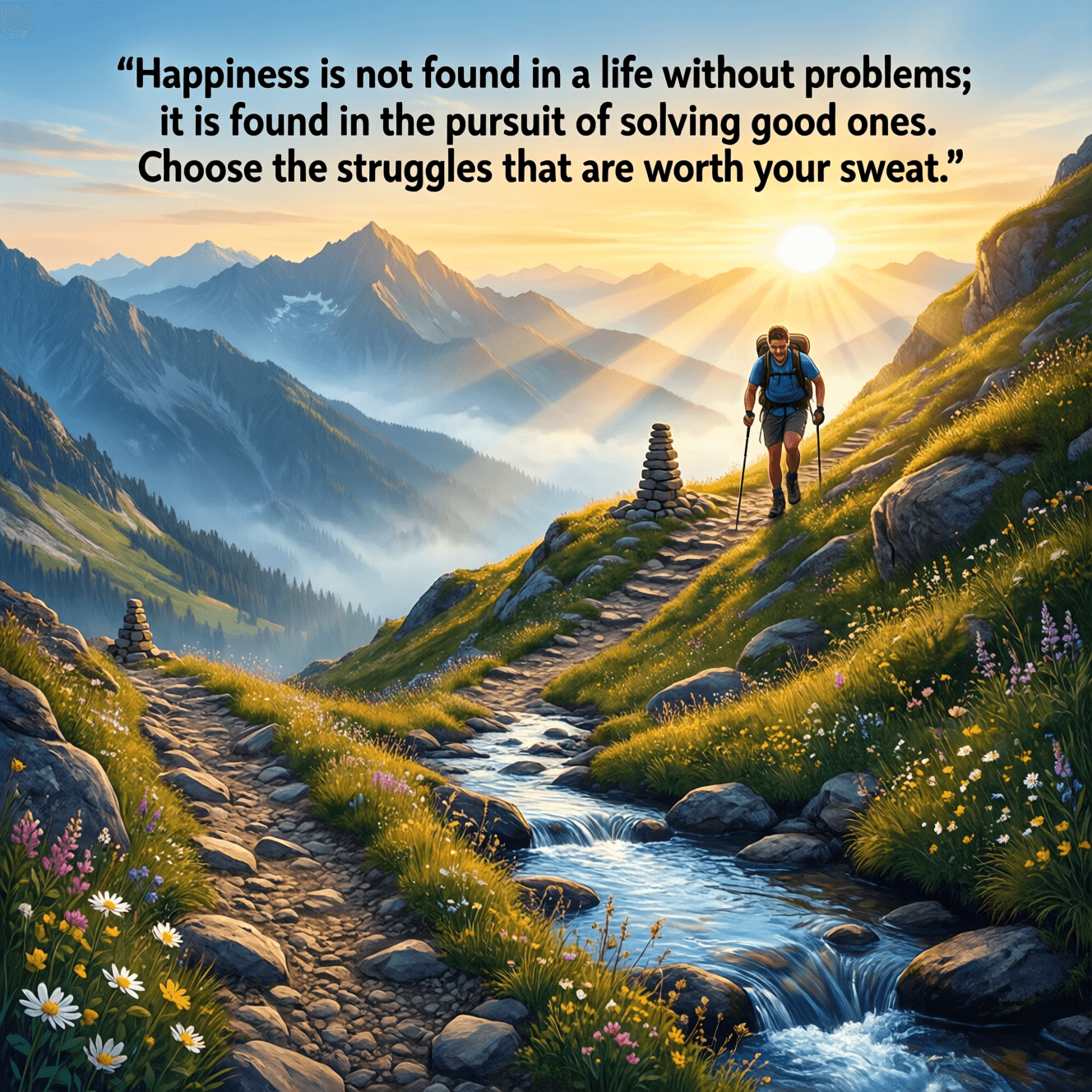
Happiness is not found in a life without problems; it is found in the pursuit of solving good ones. Choose the struggles that are worth your sweat. — Mark Manson
—What lingers after this line?
Reframing Happiness Away From Comfort
Mark Manson’s line begins by dismantling a common fantasy: that happiness arrives when life finally becomes smooth. Instead, he argues that a “life without problems” is not a realistic destination, and even if it were, it would likely feel empty rather than joyful. By shifting the focus from avoiding discomfort to engaging it, he reframes happiness as something active—less like a reward you receive and more like a practice you sustain. This opening move matters because it changes what we aim for. Rather than treating problems as failures of planning or mindset, Manson treats them as the raw material of a meaningful life, implying that the goal is not problem-free living but better problem selection.
The Pursuit: Progress as a Source of Joy
From that reframing, the quote pivots to “the pursuit of solving good ones,” emphasizing process over outcome. Happiness here is not the moment a problem disappears; it’s the felt sense of moving, learning, and improving while facing a challenge that matters. This aligns with ideas in positive psychology, where Mihaly Csikszentmihalyi’s concept of “flow” (1990) describes deep satisfaction arising when skill and challenge are well matched. In other words, the quote suggests that well-chosen problems create a kind of energizing friction. You may still feel strain, doubt, and fatigue, but those experiences can coexist with purpose because each step forward signals growth rather than mere survival.
What Makes a Problem “Good”
Next comes the crucial filter: not all problems are equal, and many are self-inflicted or inherited without consent. A “good” problem is one that aligns with your values and moves you toward the person you want to become—building a craft, repairing a relationship, improving health, creating something useful. By contrast, “bad” problems often offer motion without meaning, like chasing status to impress people you don’t respect or fighting the same avoidable fires because boundaries never change. This distinction makes the quote less motivational and more strategic. It implies that satisfaction isn’t about being busy; it’s about directing your limited time and emotional bandwidth toward difficulties that pay you back in pride, competence, or contribution.
Choosing Struggles Instead of Inheriting Them
The line “Choose the struggles” underscores agency: you may not control whether challenges appear, but you often control which ones you commit to, amplify, or repeatedly revisit. This is where the quote becomes a quiet argument for intentional living—deciding what to tolerate, what to fix, what to leave, and what to pursue. Even saying no is a form of struggle, because it invites disappointment and uncertainty, yet it may be the struggle that protects your deeper priorities. Seen this way, happiness becomes linked to authorship. A life that feels good is not one where hardship vanishes, but one where hardship is, as much as possible, self-endorsed rather than passively accepted.
Effort as a Meaning Filter: “Worth Your Sweat”
Then Manson grounds the idea in the body: sweat, effort, and sacrifice. “Worth your sweat” is a test of value—if something demands you, it should also dignify you. This echoes the ancient notion that character is formed through chosen hardship; Aristotle’s *Nicomachean Ethics* (4th century BC) frames virtue as something cultivated through repeated practice, not granted by ease. A simple anecdote illustrates this: two people train for months—one for a marathon they care about, another because they feel shamed into it. Both sweat, but only one experiences the struggle as meaningful. The difference isn’t the difficulty; it’s the ownership and purpose behind it.
Practical Alignment: Picking Problems That Build a Life
Finally, the quote invites a practical habit: evaluate your recurring frustrations and ask whether they are leading somewhere worthwhile. If a problem keeps returning, either it is a meaningful project requiring patience, or it is a signal that your commitments, environment, or boundaries need to change. Over time, this becomes a compass: choose challenges that develop skill, deepen relationships, or produce work you respect, and reduce those that only drain you. The result is not a life without strain, but a life with coherent strain—effort that adds up. In that coherence, Manson suggests, is a durable form of happiness: not the absence of problems, but the presence of problems you would choose again.
One-minute reflection
What's one small action this suggests?
Related Quotes
3 selectedAction isn't just the effect of motivation; it's also the cause of it. — Mark Manson
Mark Manson
Mark Manson’s line challenges a familiar assumption: that we must first feel inspired, confident, or ready before we can act. Instead, he argues that action can be the spark rather than the reward.
Read full interpretation →The key to a good life is not giving a fuck about more; it's giving a fuck about only what is true. — Mark Manson
Mark Manson
Mark Manson’s quote grabs attention by using blunt language to make a careful distinction: the problem isn’t caring, but caring indiscriminately. In everyday life, people often equate a “good life” with maximizing concer...
Read full interpretation →Embrace each challenge as a stepping stone, for it is through the moments of struggle that we uncover our true strength and illuminate the path to our brightest triumphs.
Unknown
This quote encourages individuals to view challenges not as obstacles but as opportunities for personal growth. Each struggle is a chance to develop resilience and discover inner strength.
Read full interpretation →More From Author
More from Mark Manson →Action isn't just the effect of motivation; it's also the cause of it. — Mark Manson
Mark Manson’s line challenges a familiar assumption: that we must first feel inspired, confident, or ready before we can act. Instead, he argues that action can be the spark rather than the reward.
Read full interpretation →The key to a good life is not giving a fuck about more; it's giving a fuck about only what is true. — Mark Manson
Mark Manson’s quote grabs attention by using blunt language to make a careful distinction: the problem isn’t caring, but caring indiscriminately. In everyday life, people often equate a “good life” with maximizing concer...
Read full interpretation →