
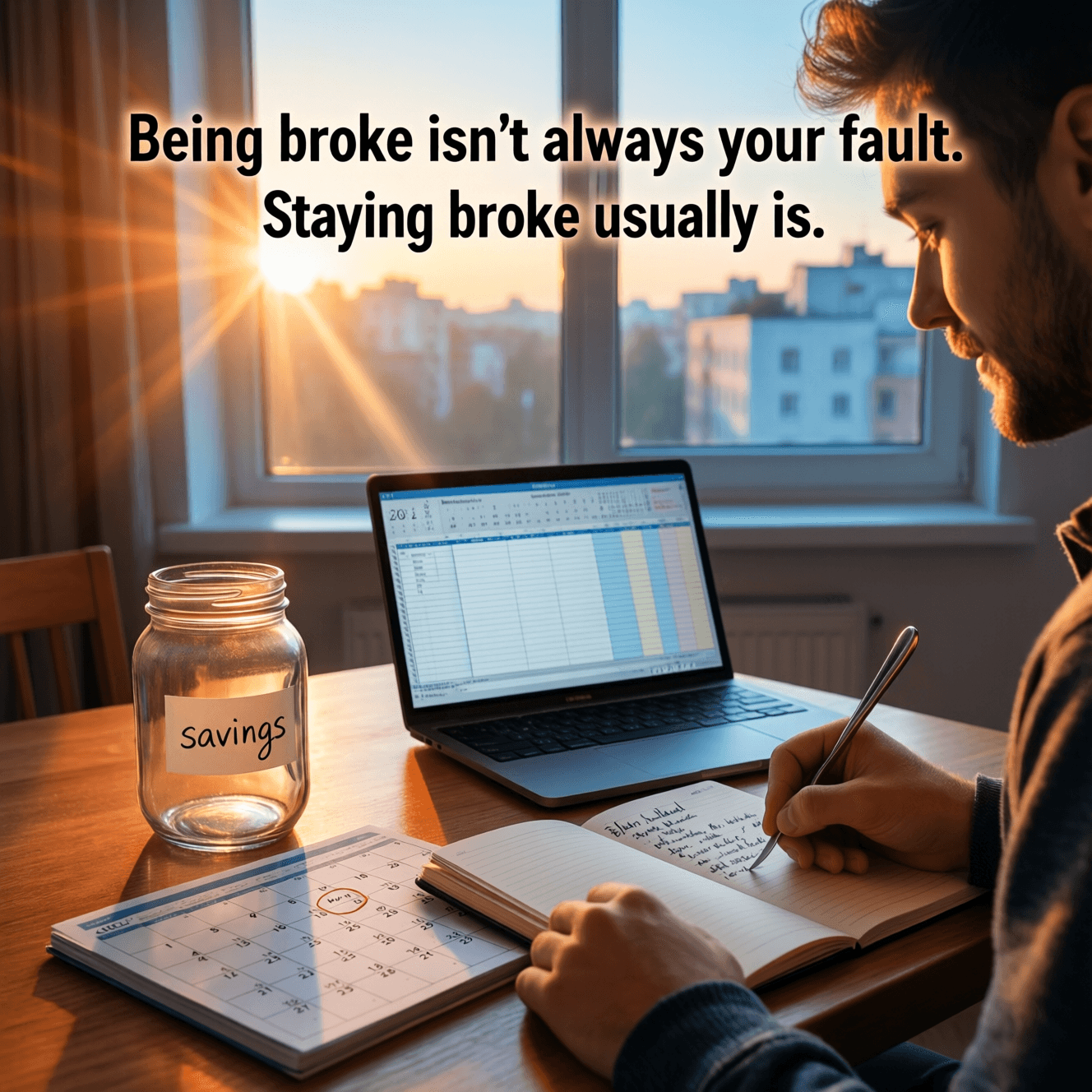
Being broke isn't always your fault. Staying broke usually is. — Unknown
—What lingers after this line?
Distinguishing Circumstance from Responsibility
The quote begins by separating two realities that often get blurred: the forces that push someone into financial hardship and the choices that determine what happens next. Being broke can arrive through layoffs, illness, family obligations, predatory lending, or a local economy that simply doesn’t offer stable wages. In that sense, the statement grants moral clarity—misfortune is not the same as failure. Yet it pivots to a tougher claim: while entry into hardship may be involuntary, remaining there is frequently influenced by controllable behaviors. The underlying message is not that anyone can instantly escape poverty, but that agency matters once the crisis moment passes and patterns take over.
Structural Barriers That Create “Broke” Moments
To understand the first half, it helps to acknowledge how strongly environment shapes outcomes. A single medical emergency can wipe out savings; the U.S. Consumer Financial Protection Bureau has repeatedly documented how fees and high-cost credit products disproportionately harm low-income households (e.g., CFPB reports on payday lending and overdraft practices). Similarly, wage stagnation and housing costs can make even full-time work insufficient. Because of these constraints, “fault” is often the wrong lens. The quote implicitly argues for compassion before judgment: you can do many things right and still end up short on rent, late on a bill, or unable to absorb an unexpected expense.
The Feedback Loops That Keep People Stuck
The second half points to the mechanics of staying broke: interest, fees, and stress compound over time. When cash is tight, people pay more—late fees, higher APRs, overdraft charges—creating a financial gravity that pulls them back down after each attempt to climb. Behavioral research also notes how scarcity narrows attention; Sendhil Mullainathan and Eldar Shafir’s Scarcity (2013) describes how urgent needs can tax cognitive bandwidth, making planning and long-term tradeoffs harder. As a result, staying broke isn’t always about laziness; it can be about systems and psychology reinforcing each other. Still, recognizing those loops is precisely what can make them interruptible.
Agency as a Series of Small, Unromantic Decisions
Where the quote becomes practical is in its emphasis on “usually.” It suggests that for many people, the path out is less about one dramatic windfall and more about repeated, disciplined choices: tracking spending, reducing high-interest debt, building a small emergency buffer, or learning a marketable skill. The agency here is incremental, not heroic. For example, someone who starts broke after a job loss may remain broke if they avoid budgeting out of shame, keep using expensive credit to soothe stress, or postpone training because it feels overwhelming. Conversely, even modest changes—calling creditors to negotiate, automating savings of $10 a week, taking a free certification—can shift the trajectory over months, not days.
When “Staying Broke” Is Not Truly a Choice
A fair reading also admits limits. Some people face chronic illness, caregiving burdens, discrimination, unstable immigration status, or regional job scarcity that makes “staying broke” less about personal habits and more about missing realistic options. In those cases, the quote can sound accusatory if it’s used to dismiss legitimate hardship. However, even then, the idea of responsibility can be reframed: responsibility may mean seeking assistance, using community resources, or making the best possible decisions under constraint rather than achieving an ideal financial outcome. The quote is strongest when it motivates action, not when it assigns blame.
A Productive Takeaway: Compassion First, Then Strategy
Taken as a whole, the statement encourages a two-step mindset. First, release unnecessary guilt about how financial hardship began; shame often paralyzes people who need clarity. Then, shift attention to the controllable levers—skills, spending choices, debt terms, and networks—because those levers, however limited, are where momentum is built. In that way, the quote functions like a bridge between empathy and empowerment. It insists that bad luck is real, while also insisting that long-term change usually requires intentional habits, repeated course corrections, and the willingness to do uncomfortable, practical work long after the initial crisis fades.
One-minute reflection
What feeling does this quote bring up for you?
Related Quotes
6 selectedNo one is coming to save you. This life is 100% your responsibility. Stop waiting for a hero and start being the adult you needed. — Unknown
Unknown
The quote begins with a jolt: “No one is coming to save you.” It isn’t meant to deny kindness or community, but to strip away the comforting fantasy that a single rescuer—an employer, partner, government, or perfectly ti...
Read full interpretation →The work doesn't care about your mood. It only cares if it gets done. Stop waiting for inspiration to do what you already know is required. — Unknown
Unknown
The quote begins with a blunt reminder: the work itself has no sensitivity to how we feel about it. A report, a workout, an exam, or a creative draft doesn’t become easier because we’re energized, nor does it pause becau...
Read full interpretation →Your happiness is your responsibility. If you don't like something, change it. — Unknown Author.
Unknown Author
This quote emphasizes the importance of taking ownership of one's own happiness. It suggests that individuals have the power to influence their own emotional state and overall well-being.
Read full interpretation →We are not victims of our impulses or emotions; we have the power to control them. It is time to relinquish the excuses. — Allie Brosh
Allie Brosh
At its core, Allie Brosh’s quote rejects the comforting idea that emotions and impulses are irresistible forces. Instead, it insists that human beings possess agency: the ability to pause, choose, and act deliberately ev...
Read full interpretation →My will shall shape my future. Whether I fail or succeed shall be no man's doing but my own. — Elaine Maxwell
Elaine Maxwell
At its core, Elaine Maxwell’s statement is a declaration of personal agency. By saying that her will shall shape her future, she rejects the idea that destiny is merely handed down by circumstance, luck, or the judgments...
Read full interpretation →You cannot build a life of meaning on a foundation of excuses. Your circumstances are the starting point, not the excuse for staying still. — David Goggins
David Goggins
At its core, David Goggins’s statement redraws the map between hardship and identity. He does not deny that circumstances can be painful, unfair, or limiting; instead, he insists they are only the opening conditions of a...
Read full interpretation →More From Author
More from Unknown →The language is the substrate. The architecture is the contract.
The line sets up a deliberate pairing: language lies beneath everything, while architecture governs everything above it. In other words, what you can express determines what you can build, and what you commit to structur...
Read full interpretation →A scroll is not a break; it is a trap disguised as rest. — Unknown
The quote begins by challenging a familiar story we tell ourselves: that a brief scroll is a harmless pause between tasks. On the surface, it looks like recovery—no effort, no decision, no commitment.
Read full interpretation →Don't let your ice cream melt while you're counting someone else's sprinkles. — Unknown
The quote uses ice cream as a simple stand-in for life’s fleeting pleasures: what you have is delicious, but it won’t last forever if you ignore it. Meanwhile, “counting someone else’s sprinkles” captures the habit of mo...
Read full interpretation →If your absence doesn't affect them, your presence never mattered. — Unknown
The quote frames absence as a revealing experiment: remove yourself, and the reaction—concern, curiosity, indifference—becomes a kind of data. If nothing changes when you’re gone, it suggests your role was never integrat...
Read full interpretation →