
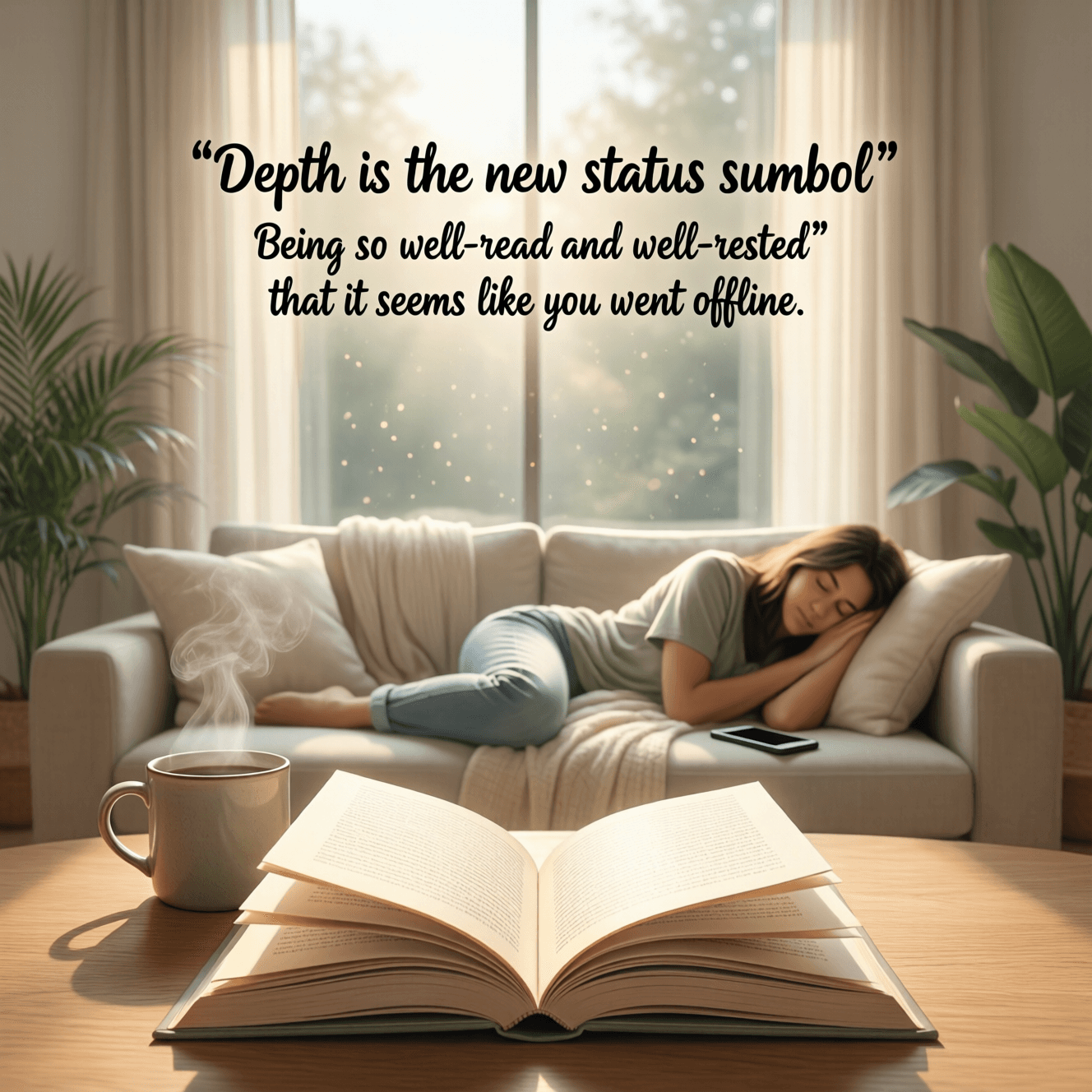
Depth is the new status symbol. Be so well-read and well-rested that people think you've gone offline for good. — Unknown
—What lingers after this line?
A New Kind of Social Currency
The quote reframes status away from conspicuous consumption and toward something quieter: depth. Instead of broadcasting busyness, it proposes that the most enviable life is one marked by substance—clear thinking, cultivated taste, and a steady inner life. In that sense, “depth” becomes a form of social currency precisely because it’s hard to counterfeit. From here, the line pivots to the striking image of being “well-read and well-rested,” implying that real prestige now lies in having the time, attention, and discipline to develop both mind and body. The brag is not that you’re in demand, but that you’re not perpetually depleted.
From Visibility to Deliberate Absence
Where older status games often relied on being seen—events attended, purchases displayed, achievements posted—this quote suggests an inversion: absence signals autonomy. If people “think you’ve gone offline for good,” your life appears full enough not to require constant proof. That perceived self-sufficiency becomes the flex. This idea echoes the long-standing suspicion of performative living. Henry David Thoreau’s *Walden* (1854) frames retreat not as failure to participate but as a strategy for recovering attention and intention. In a culture of continuous updates, deliberate invisibility can read as confidence rather than neglect.
Being Well-Read as Inner Architecture
“Well-read” here isn’t a checklist of titles; it implies a mind shaped by sustained encounter with ideas. Reading widely builds context, nuance, and the ability to hold competing truths—qualities that look like depth in conversation and decision-making. Over time, this becomes a kind of inner architecture: not loud, but structurally obvious. The transition from mere information to wisdom has classical roots. Seneca’s *Letters to Lucilius* (c. 65 AD) warns against scattering oneself across too many texts without digestion, arguing for reading that changes how one lives. The quote’s status symbol is not literacy as display, but understanding as presence.
Being Well-Rested as Quiet Power
Pairing “well-read” with “well-rested” widens the definition of depth: it’s not just intellectual, it’s physiological. Rest suggests boundaries, rhythm, and a refusal to treat exhaustion as proof of importance. In modern workplaces that reward responsiveness, sleep becomes a visible indicator of hidden advantages—time, control, and self-respect. This isn’t merely poetic; it’s practical. Matthew Walker’s *Why We Sleep* (2017) compiles evidence linking sleep to memory, emotional regulation, and long-term health. When you’re rested, your attention sharpens and your reactions soften, and that calm competence can appear almost like a luxury good.
The Aesthetics of “Offline for Good”
The phrase “gone offline for good” is intentionally extreme, turning disconnection into a kind of mythic disappearance. It hints at a person who has moved beyond the churn of updates and hot takes, choosing instead the slower tempo where insight accumulates. The allure lies in scarcity: if your attention isn’t constantly available, it seems more valuable. Yet the quote also critiques how online life can flatten identity into performance. By stepping back, you regain the conditions for depth—solitude, boredom, long-form thought. Cal Newport’s *Digital Minimalism* (2019) similarly argues that selective disengagement isn’t anti-technology; it’s pro-intentionality.
Depth as a Practice, Not a Pose
Finally, the quote implies that depth can’t be purchased; it must be lived. Being well-read requires patience with difficulty, and being well-rested requires choices that may look unambitious to a culture addicted to urgency. The status symbol is therefore ethical as much as aesthetic: it signals values. The challenge is to avoid turning “depth” into another performance metric. The most convincing version is often private—long walks, unhurried mornings, fewer opinions delivered with more care. Paradoxically, when you stop trying to look impressive and start building a spacious life, people may indeed assume you’ve vanished—because your attention has finally returned to you.
One-minute reflection
What feeling does this quote bring up for you?
Related Quotes
6 selectedGoing offline is a small act of rebellion; a return to the quiet parts of ourselves the world cannot reach. — Unknown
Unknown
The quote begins by framing “going offline” not as a mere lifestyle tweak, but as a conscious refusal of constant availability. In a culture that rewards rapid replies and perpetual updates, disconnecting becomes a way t...
Read full interpretation →Disconnection from technology is not a rebellion, it is a regulation of time. — Unknown
Unknown
The quote opens by challenging a common assumption: that stepping away from devices is inherently a dramatic, anti-tech stance. By saying disconnection is “not a rebellion,” it reframes the choice as practical rather tha...
Read full interpretation →The greatest luxury in a modern world is not things, but the ability to disconnect and reclaim your own attention. — Cal Newport
Cal Newport
At first glance, Newport’s statement overturns the traditional idea of luxury as something material. Instead of wealth being measured by rare objects, he suggests it is now measured by the freedom to step away from noise...
Read full interpretation →The real flex is not looking busy. It is having the audacity to enjoy silence without reaching for your phone. — Pema Chödrön
Pema Chödrön
At first glance, the quote challenges a modern status symbol: busyness. In many workplaces and social circles, looking overloaded can seem like proof of importance.
Read full interpretation →Something really helpful for stress reduction is to simply consume less — less news, less social media, less information, less noise, less screen time. — Valentina Ogaryan
Valentina Ogaryan
Valentina Ogaryan’s statement begins with a deceptively simple idea: stress often grows not only from what happens to us, but from how much we continuously take in. By recommending less news, less social media, and less...
Read full interpretation →Sometimes you need to disconnect to reconnect with what truly matters. — Emma Green
Emma Green
At first glance, Emma Green’s quote sounds like a simple call to unplug, yet it carries a deeper truth about attention and meaning. To disconnect is not merely to withdraw from devices, noise, or obligations; rather, it...
Read full interpretation →More From Author
More from Unknown →The language is the substrate. The architecture is the contract.
The line sets up a deliberate pairing: language lies beneath everything, while architecture governs everything above it. In other words, what you can express determines what you can build, and what you commit to structur...
Read full interpretation →A scroll is not a break; it is a trap disguised as rest. — Unknown
The quote begins by challenging a familiar story we tell ourselves: that a brief scroll is a harmless pause between tasks. On the surface, it looks like recovery—no effort, no decision, no commitment.
Read full interpretation →Don't let your ice cream melt while you're counting someone else's sprinkles. — Unknown
The quote uses ice cream as a simple stand-in for life’s fleeting pleasures: what you have is delicious, but it won’t last forever if you ignore it. Meanwhile, “counting someone else’s sprinkles” captures the habit of mo...
Read full interpretation →If your absence doesn't affect them, your presence never mattered. — Unknown
The quote frames absence as a revealing experiment: remove yourself, and the reaction—concern, curiosity, indifference—becomes a kind of data. If nothing changes when you’re gone, it suggests your role was never integrat...
Read full interpretation →