
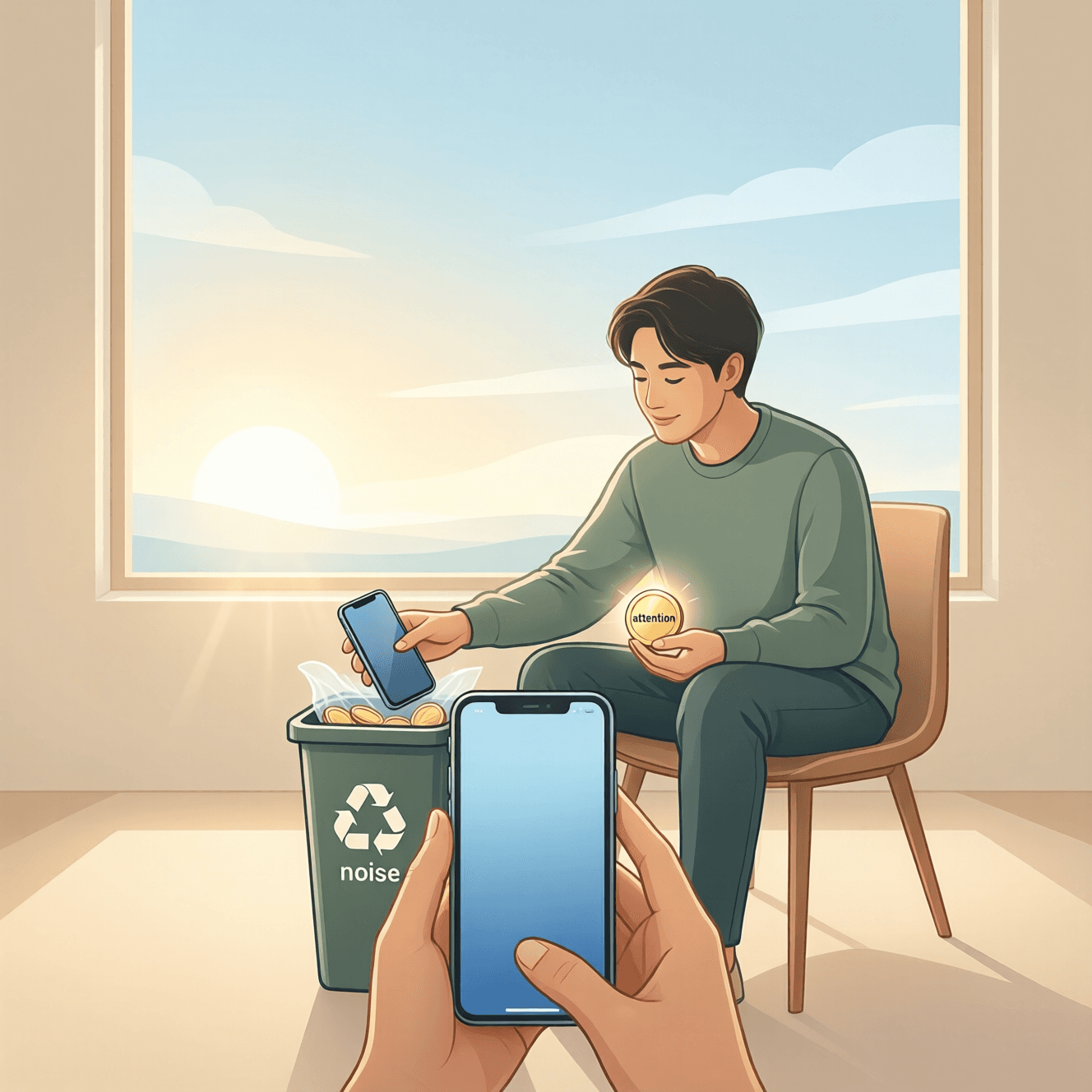
Your attention is your life's currency. Stop donating it to platforms that profit from your distraction. Delete the noise and buy back your peace. — Unknown
—What lingers after this line?
Attention as a Spendable Resource
The quote opens with a sharp reframing: attention isn’t just a mental habit, it’s a form of currency. Like money, it is finite, easily misspent, and deeply tied to what your life becomes—because what you repeatedly notice, you eventually build around. By calling it “your life’s currency,” the line implies a moral claim as well: you own this resource, and how you allocate it is an act of self-governance. From there, the message naturally sets up a question of budgeting. If attention is spendable, then daily scrolling, compulsive checking, and ambient notifications aren’t neutral pastimes—they’re purchases. The real cost isn’t only time, but clarity, emotional steadiness, and the ability to choose your next thought without interference.
How Platforms Monetize Distraction
With that premise established, the quote pivots to motive: some platforms profit precisely when you are pulled away from your own priorities. This aligns with the well-known “attention economy” critique, in which engagement metrics reward designs that keep users clicking, watching, and reacting. In other words, your distraction is not a side effect; it can be a business model. This is why the phrase “stop donating it” lands so strongly. Donation suggests a gift given freely, yet the quote implies the exchange is lopsided: you hand over focus and calm, while the platform captures data, ad revenue, and influence. The call is not anti-technology so much as anti-extraction—an insistence that your mind should not be treated as a mine.
The Hidden Tax of Constant Input
Once you see the profit incentive, the next step is recognizing the felt experience: “noise.” Noise here is broader than sound—it’s the constant influx of updates, opinions, alerts, short videos, and algorithmic prompts that fragment thought. Even when the content is harmless, the switching cost accumulates until sustained attention becomes difficult to access. As a result, your inner life can start to feel crowded. You may notice symptoms that look like personal weakness—restlessness, irritability, inability to read deeply—but the quote suggests a different interpretation: you are living under conditions engineered for interruption. Naming it “noise” validates the exhaustion and makes decluttering feel like a rational response rather than an overreaction.
Deletion as a Form of Self-Defense
The quote doesn’t recommend mild reform; it urges decisive action: “Delete the noise.” Deletion is symbolic and practical at once. Symbolically, it’s a boundary—an announcement that your attention is not open-access. Practically, it reduces triggers, removes default pathways, and breaks the loop where boredom automatically becomes consumption. This is also where the message becomes empowering rather than scolding. Instead of relying on willpower in the moment, deletion changes the environment. In the same way someone might remove junk food from the house to eat differently, removing high-distraction apps can make it easier to return to deliberate choices without constant internal negotiation.
Buying Back Peace Through Intentional Living
The closing line, “buy back your peace,” completes the economic metaphor with a personal payoff. Peace is portrayed as something you already possessed but gradually traded away—often in tiny, forgettable transactions. Reclaiming it may require a cost: missing out, tolerating boredom, or sitting with silence long enough for the mind to settle. Yet the quote implies the return is worth it because peace is not merely the absence of content; it is the presence of agency. As attention stabilizes, you can choose deeper work, more meaningful relationships, and rest that actually restores. In that sense, the quote isn’t just about deleting apps—it’s about converting reclaimed attention into a life that feels like it belongs to you.
From Abstinence to a New Attention Budget
Still, the argument doesn’t have to end at total abstinence; it can mature into a sustainable attention budget. After the initial “delete the noise” phase, the next step is deciding what deserves access to your mind and when. This might mean scheduled checks, turning off nonessential notifications, or keeping certain platforms only on a desktop to reduce impulse use. Ultimately, the quote is a call to treat attention with the seriousness usually reserved for finances. When you become the one who sets the terms—rather than an algorithm optimizing your reactions—you aren’t just escaping distraction. You’re practicing a daily form of freedom: choosing what you give your life to, minute by minute.
One-minute reflection
Why might this line matter today, not tomorrow?
Related Quotes
6 selectedYou are allowed to be hard to reach. Peace is the new status symbol, and an empty inbox is a hallucination. — Unknown
Unknown
The quote opens by granting permission: “You are allowed to be hard to reach.” In a culture where responsiveness is often treated as basic politeness or professional competence, choosing limited access can feel like defi...
Read full interpretation →You cannot expect an app designed to be addictive to respect your time and attention. — Cal Newport
Cal Newport
Cal Newport’s line begins with a blunt premise: if an app is engineered to be addictive, it cannot simultaneously be trusted to honor your time and attention. The problem isn’t primarily moral failure on the user’s part,...
Read full interpretation →The language is the substrate. The architecture is the contract.
Unknown
The line sets up a deliberate pairing: language lies beneath everything, while architecture governs everything above it. In other words, what you can express determines what you can build, and what you commit to structur...
Read full interpretation →A scroll is not a break; it is a trap disguised as rest. — Unknown
Unknown
The quote begins by challenging a familiar story we tell ourselves: that a brief scroll is a harmless pause between tasks. On the surface, it looks like recovery—no effort, no decision, no commitment.
Read full interpretation →Don't let your ice cream melt while you're counting someone else's sprinkles. — Unknown
Unknown
The quote uses ice cream as a simple stand-in for life’s fleeting pleasures: what you have is delicious, but it won’t last forever if you ignore it. Meanwhile, “counting someone else’s sprinkles” captures the habit of mo...
Read full interpretation →If your absence doesn't affect them, your presence never mattered. — Unknown
Unknown
The quote frames absence as a revealing experiment: remove yourself, and the reaction—concern, curiosity, indifference—becomes a kind of data. If nothing changes when you’re gone, it suggests your role was never integrat...
Read full interpretation →More From Author
More from Unknown →The language is the substrate. The architecture is the contract.
The line sets up a deliberate pairing: language lies beneath everything, while architecture governs everything above it. In other words, what you can express determines what you can build, and what you commit to structur...
Read full interpretation →A scroll is not a break; it is a trap disguised as rest. — Unknown
The quote begins by challenging a familiar story we tell ourselves: that a brief scroll is a harmless pause between tasks. On the surface, it looks like recovery—no effort, no decision, no commitment.
Read full interpretation →Don't let your ice cream melt while you're counting someone else's sprinkles. — Unknown
The quote uses ice cream as a simple stand-in for life’s fleeting pleasures: what you have is delicious, but it won’t last forever if you ignore it. Meanwhile, “counting someone else’s sprinkles” captures the habit of mo...
Read full interpretation →If your absence doesn't affect them, your presence never mattered. — Unknown
The quote frames absence as a revealing experiment: remove yourself, and the reaction—concern, curiosity, indifference—becomes a kind of data. If nothing changes when you’re gone, it suggests your role was never integrat...
Read full interpretation →