
Rest as the Foundation for Future Growth
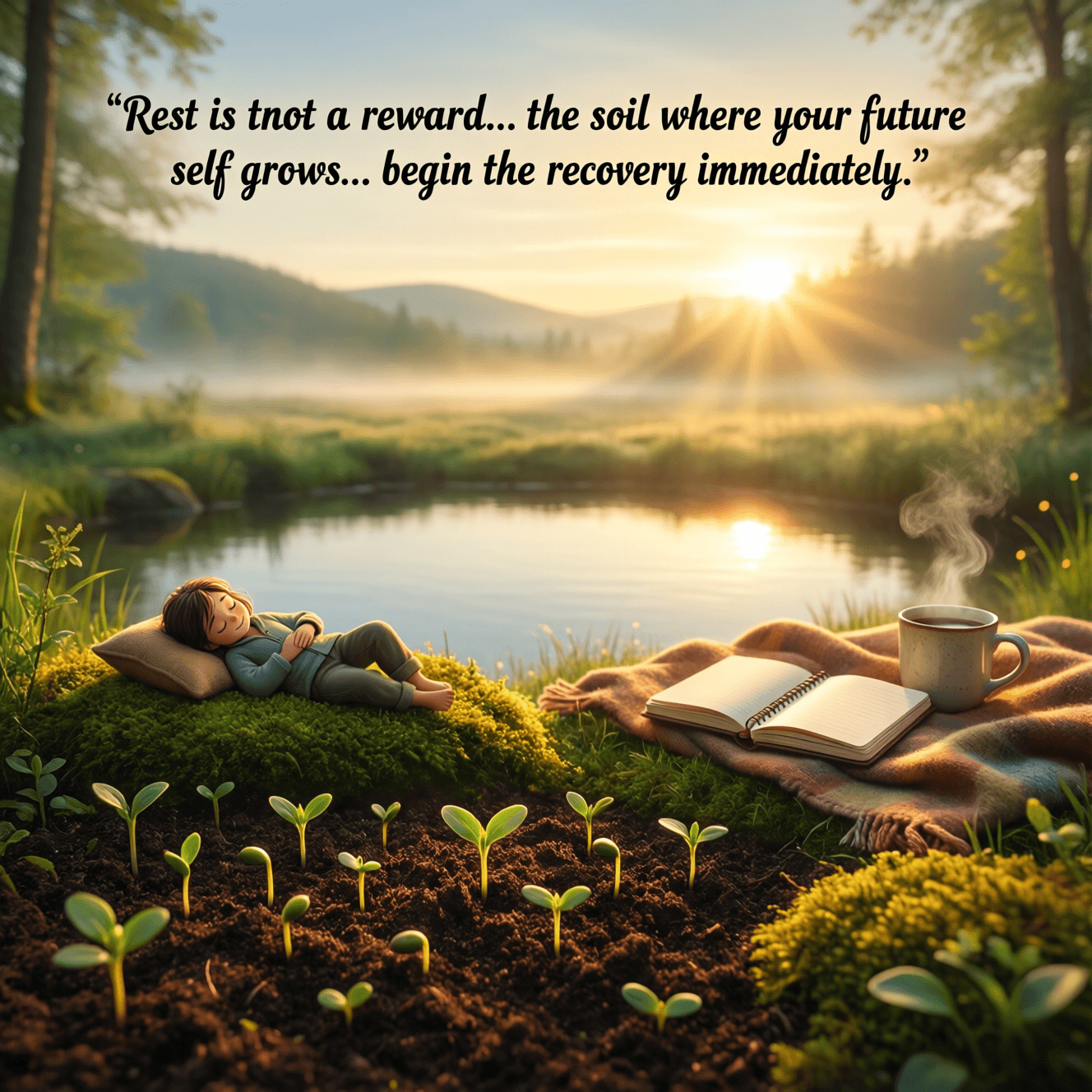
Rest is not a reward for your work. It is the soil where your future self grows. Stop running on empty and begin the recovery immediately. — Unknown
—What lingers after this line?
One-minute reflection
What feeling does this quote bring up for you?
Audio Transcript
Rest is not a reward for your work. It is the soil where your future self grows. Stop running on empty and begin the recovery immediately. — Unknown
Reframing Rest Beyond a Prize
The quote begins by challenging a familiar belief: that rest must be earned after productivity proves our worth. By rejecting rest as a “reward,” it reframes recovery as a basic condition of being human rather than a luxury granted only when tasks are finished. This shift matters because the work is rarely “done,” and if rest depends on completion, it may never arrive. From there, the message nudges us to see rest not as an interruption of progress but as part of progress itself. Once that perspective changes, the guilt attached to downtime loosens, making it easier to treat recovery as a nonnegotiable input rather than an optional output.
The Soil Metaphor and Slow Transformation
Calling rest “the soil” gives the idea a biological and patient logic: soil doesn’t look like growth, yet it enables it. Similarly, recovery can feel unproductive because it often lacks visible milestones, but it is where physical repair, emotional processing, and creative integration quietly happen. The metaphor also implies cultivation—something tended regularly, not accessed only in emergencies. That leads naturally to the notion of a “future self.” Instead of optimizing only for today’s output, rest becomes an investment in tomorrow’s capacity, clarity, and resilience. What appears like pausing is actually preparing the conditions for better work and a more sustainable life.
Why Running on Empty Distorts Thinking
The warning to “stop running on empty” points to how depletion changes not just energy levels but judgment. When people are exhausted, they often become more reactive, less patient, and more prone to mistakes; small problems feel urgent, and urgent problems feel impossible. In that state, even good habits—exercise, cooking, reaching out to friends—can collapse under the weight of fatigue. Because of this, rest isn’t merely a comfort; it’s a corrective lens. Once the body and mind recover, priorities become clearer and decisions improve, which means the quote’s advice isn’t sentimental—it is practical risk management for your time, relationships, and health.
Recovery as an Immediate Intervention
“Begin the recovery immediately” reads like a medical instruction: don’t wait until the symptoms worsen. The longer depletion persists, the more recovery tends to require—one late night turns into a week of fog, then into chronic burnout. The quote’s urgency emphasizes that rest works best when it is preventative and timely rather than a last resort. This also counters the common delay tactic of promising rest “after this busy stretch.” Busy stretches have a way of multiplying, so the instruction is to create a turning point now—however small—so the cycle of overextension doesn’t keep renewing itself.
Active Rest and True Restoration
Implicitly, the quote distinguishes between stopping work and actually recovering. True restoration may include sleep, but it can also mean quiet time, unstructured play, a slow walk, or a day without performance pressure—activities that return you to yourself rather than simply distracting you. In that sense, recovery is active in intention even if it looks passive from the outside. Once you treat rest as soil, you also begin to choose forms of rest that nourish rather than numb. The goal becomes feeling more like a whole person afterward, not merely having escaped tasks for a while.
Building a Sustainable Rhythm of Work and Rest
Finally, the quote points toward a rhythm: work that is supported by regular recovery instead of punctuated by collapse. That rhythm can be simple—consistent sleep, brief breaks, a protected day off, or boundaries around availability—but the guiding principle remains the same: you don’t delay care for the self who must carry your life forward. In the end, the message offers a humane standard for productivity. By treating rest as a foundation rather than a trophy, you create the conditions in which ambition can last—and where your future self has room to grow.