
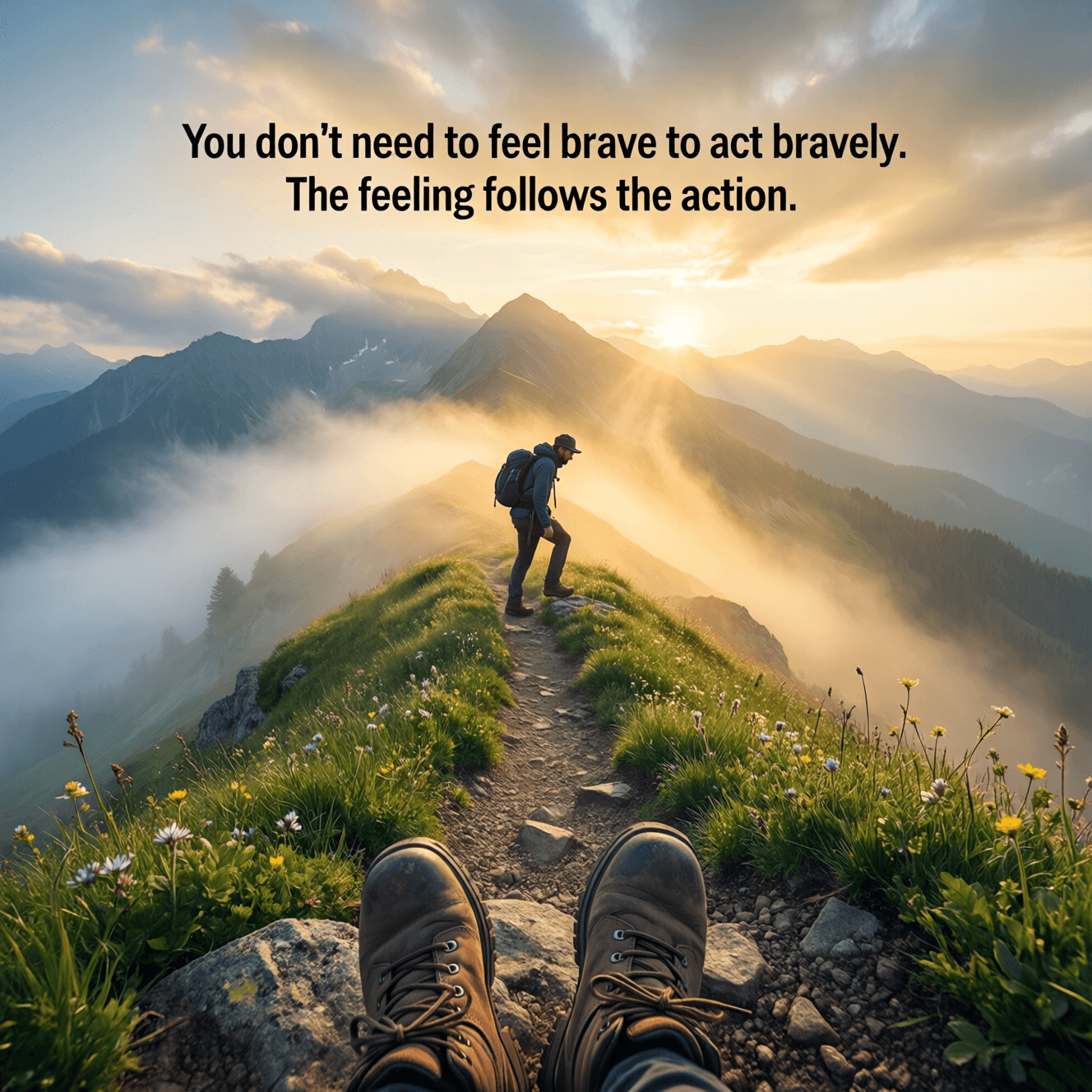
You don't need to feel brave to act bravely. The feeling follows the action, not the other way around. — Unknown
—What lingers after this line?
Reversing the Usual Story of Courage
The quote challenges a common assumption: that bravery is a feeling you must summon before you can do brave things. Instead, it argues that courageous action can come first, even while fear is still present. In that sense, bravery isn’t a prerequisite—it’s a byproduct. This reversal matters because it shifts attention from waiting for an internal green light to choosing a concrete next step. Once action begins, the mind often updates its interpretation of the situation, and the emotion of courage emerges as a response to what you have just proven you can do.
Behavior as the Engine of Emotion
Building on that idea, the quote aligns with a practical psychological insight: our emotions frequently follow our behaviors. William James proposed in “What is an Emotion?” (1884) that bodily action and experience can precede and shape the feeling we name afterward—suggesting we don’t only act because we feel; we often feel because we act. Seen this way, brave behavior becomes a form of evidence. When you speak up, step forward, or endure discomfort, you give your brain new data: “I handled this.” That evidence can soften fear and make courage feel real, not imagined.
Small Acts Create Self-Trust
From there, it becomes clear why tiny, repeatable actions are so powerful. Courage doesn’t usually appear as a sudden personality transformation; it grows as self-trust accumulates. Each time you do the difficult thing—send the honest email, make the awkward phone call, ask for help—you build a track record. Over time, that record changes your self-concept: you start to see yourself as someone who can move while afraid. The feeling of bravery then stops being a rare mood and becomes a familiar outcome of practicing follow-through under pressure.
Exposure to Fear, One Step at a Time
Next, the quote connects naturally to how people reduce anxiety in real life: gradual exposure. In cognitive-behavioral therapy, exposure techniques help individuals approach feared situations in manageable doses, allowing the nervous system to learn that discomfort can be tolerated without catastrophe (see Edna Foa and Michael Kozak’s emotional processing theory, 1986). As the person keeps showing up, fear often loses its authority, and a steadier kind of courage takes its place. Importantly, the goal isn’t to eliminate fear before acting; it’s to act in ways that teach fear it doesn’t get the final vote.
Anecdotes of Courage in Ordinary Life
This action-first pattern appears in everyday moments more than dramatic heroics. A new teacher may feel nervous every morning, yet walks into the classroom anyway; after a few weeks, confidence arrives not as a wish but as an earned sensation. Similarly, someone afraid of conflict might finally set a boundary—voice shaking—and later realize the relief and strength arrived only after the sentence was spoken. These stories illustrate the quote’s core message: bravery is often recognized in hindsight. People rarely feel invincible beforehand; they feel shaky, then act, and only then discover that courage has been quietly following behind.
Turning the Quote into a Practical Method
Finally, the quote invites a concrete strategy: define bravery as a behavior, not a feeling. Instead of asking, “Do I feel brave enough?”, ask, “What would a brave person do for two minutes?” That might mean walking into the meeting, pressing ‘submit,’ or initiating one honest conversation. Once you do the smallest brave action available, you create momentum and reduce the temptation to wait for perfect readiness. In time, courage becomes less like a spark you hope to catch and more like a predictable result of taking the next right step.
Recommended Reading
As an Amazon Associate, we earn from qualifying purchases.
One-minute reflection
Why might this line matter today, not tomorrow?
Related Quotes
6 selectedThe way to develop self-confidence is to do the thing you fear and get a record of successful experiences behind you. — William Jennings Bryan
William Jennings Bryan
William Jennings Bryan’s statement reverses a common assumption: people often wait to feel confident before acting, yet he argues that confidence is actually built afterward. In this view, self-belief does not appear mag...
Read full interpretation →Even when you have doubts, take that step. Take chances. Mistakes are never just mistakes—they're lessons. — Lady Gaga
Lady Gaga
Lady Gaga’s quote begins with a striking premise: doubt does not have to disappear before action begins. In fact, she suggests that uncertainty is often the very condition under which courage becomes meaningful.
Read full interpretation →Emotional strength is not about suppressing feelings, but about having the courage to feel them. — Brené Brown
Brené Brown
At first glance, emotional strength is often mistaken for stoicism—the ability to remain untouched, unreadable, and perfectly controlled. Yet Brené Brown’s quote overturns that assumption by suggesting that true strength...
Read full interpretation →We must all either wear out or rust out, every one of us. My choice is to wear out. — Theodore Roosevelt
Theodore Roosevelt
At its core, Theodore Roosevelt’s line reduces life to a vivid contrast: we either spend ourselves through action or deteriorate through inactivity. By saying he would rather “wear out” than “rust out,” he frames effort,...
Read full interpretation →To know what you want to do and to do it is the same courage. — Søren Kierkegaard
Søren Kierkegaard
At first glance, Kierkegaard’s line seems to separate thought from action, yet it quickly reunites them under a single demand: courage. To know what one truly wants is not a passive discovery, because genuine self-knowle...
Read full interpretation →We cannot do everything at once, but we can do something at once. — Calvin Coolidge
Calvin Coolidge
Calvin Coolidge’s remark begins with a sober admission: human effort is finite. We cannot solve every problem, answer every need, or complete every ambition all at once.
Read full interpretation →More From Author
More from Unknown →The language is the substrate. The architecture is the contract.
The line sets up a deliberate pairing: language lies beneath everything, while architecture governs everything above it. In other words, what you can express determines what you can build, and what you commit to structur...
Read full interpretation →A scroll is not a break; it is a trap disguised as rest. — Unknown
The quote begins by challenging a familiar story we tell ourselves: that a brief scroll is a harmless pause between tasks. On the surface, it looks like recovery—no effort, no decision, no commitment.
Read full interpretation →Don't let your ice cream melt while you're counting someone else's sprinkles. — Unknown
The quote uses ice cream as a simple stand-in for life’s fleeting pleasures: what you have is delicious, but it won’t last forever if you ignore it. Meanwhile, “counting someone else’s sprinkles” captures the habit of mo...
Read full interpretation →If your absence doesn't affect them, your presence never mattered. — Unknown
The quote frames absence as a revealing experiment: remove yourself, and the reaction—concern, curiosity, indifference—becomes a kind of data. If nothing changes when you’re gone, it suggests your role was never integrat...
Read full interpretation →