
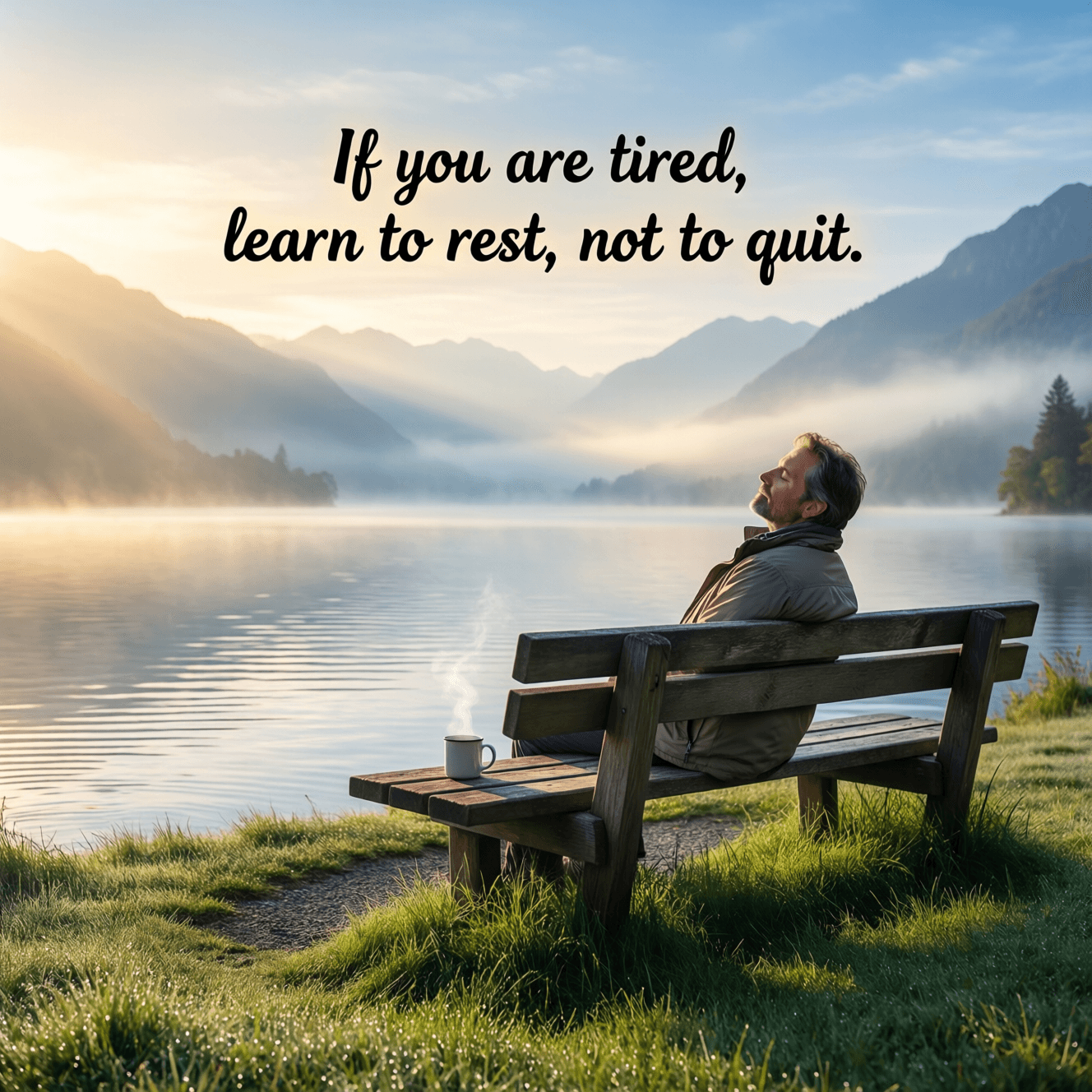
If you are tired, learn to rest, not to quit. You are a human being, not a software update that needs to run 24/7. — Unknown
—What lingers after this line?
Reframing Fatigue as a Signal
The quote opens by challenging a common misinterpretation of tiredness: that it means we are failing or falling behind. Instead, fatigue becomes a signal—information from the body and mind that resources are depleted and need replenishing. By saying “learn to rest,” it implies a skill, not a luxury, and quietly reframes recovery as part of the work rather than an escape from it. This shift matters because many people treat exhaustion as a verdict: if they feel worn out, they assume the project, career, or goal must be wrong. Yet tiredness often reflects intensity, duration, or lack of support—not the absence of purpose. Seen this way, rest is not surrender; it is a strategic response to an honest warning light.
Quitting vs. Pausing: Two Different Decisions
From there, the quote draws a clean line between quitting and resting, two actions that can look similar from the outside but lead to very different outcomes. Quitting ends engagement with a goal; resting preserves it by making continuation possible. The distinction is especially important when exhaustion blurs judgment, making temporary strain feel like permanent incapacity. In practice, many “I can’t do this” moments are actually “I can’t do this like this, right now.” A pause—an afternoon off, a protected weekend, a lighter workload—can restore perspective and competence. By contrast, quitting while depleted risks turning a solvable problem (overextension) into a life-defining conclusion (abandonment).
The Machine Metaphor and Its Trap
The line about not being “a software update” rejects the modern fantasy that humans can run continuously with only minimal maintenance. Software can execute in the background, scale on demand, and be patched overnight; human attention, mood, and creativity do not work that way. The metaphor exposes how workplace and digital culture can normalize always-on behavior—late-night messages, constant notifications, and productivity tracking that treats every idle moment as waste. By naming the comparison outright, the quote punctures it. It reminds us that the expectation of 24/7 output is not merely difficult—it is category error. People are biological and social beings with rhythms, limits, and needs that cannot be bypassed by sheer willpower.
Rest as Maintenance, Not Indulgence
Once the machine metaphor is dismantled, rest can be understood as maintenance—like sleep, meals, movement, and quiet—rather than indulgence. Research on sleep and performance consistently links adequate rest to better attention, decision-making, and emotional regulation; Matthew Walker’s *Why We Sleep* (2017), for example, synthesizes evidence that sleep loss degrades cognition and mood in ways people often underestimate. Seen through this lens, taking a break is not a moral failure or a reward that must be earned. It is basic upkeep that prevents bigger breakdowns. The quote’s insistence on “learn to rest” suggests that many of us must actively retrain ourselves to accept recovery as normal rather than as a guilty exception.
Sustainable Effort and the Long Game
The deeper promise of the quote is sustainability: you can keep going, but not by ignoring the cost. Ambition without recovery becomes fragile, because it depends on a short-lived surge of adrenaline and self-pressure. Over time, that style of effort can erode motivation and identity, making the very thing you care about feel like a threat. By advocating rest instead of quitting, the quote protects the long game—careers, relationships, learning, and health. It suggests a sturdier rhythm: push, recover, return. In that rhythm, progress becomes less dramatic but more reliable, and the goal stops competing with your well-being.
Practical Ways to “Learn to Rest”
Finally, the quote invites action, because resting well is often harder than working. Learning to rest can mean setting boundaries (no emails after a certain hour), planning real breaks (walks, naps, weekends with reduced obligations), and shifting self-talk from “I’m lazy” to “I’m replenishing capacity.” For some, it also means asking for help—delegating tasks or renegotiating deadlines—before exhaustion becomes crisis. A small anecdote captures the idea: many people find that after a full night’s sleep and a quiet morning, the problem that felt impossible the night before becomes merely difficult. That change is not magic; it is biology. The quote’s closing reminder—“You are a human being”—grounds all of these strategies in a simple truth: rest is not quitting, it is how humans continue.
One-minute reflection
What does this quote ask you to notice today?
Related Quotes
6 selectedTo heal, you must be willing to be the villain in the stories of people who benefited from your lack of boundaries. Stop apologizing for choosing yourself. — Unknown
Unknown
The quote begins with an unsettling truth: personal healing often changes the roles people assign us. When you start saying “no,” limiting access, or refusing unfair demands, others may interpret that shift as selfishnes...
Read full interpretation →Rest is not a reward for your work. It is the soil where your future self grows. Stop running on empty and begin the recovery immediately. — Unknown
Unknown
The quote begins by challenging a familiar belief: that rest must be earned after productivity proves our worth. By rejecting rest as a “reward,” it reframes recovery as a basic condition of being human rather than a lux...
Read full interpretation →Exhaustion is data, not a character flaw. Your body is simply asking for a software update. — Unknown
Unknown
The quote begins by challenging a common reflex: treating tiredness as evidence of weakness or laziness. By saying “exhaustion is data,” it reframes fatigue as a signal—something to be read rather than condemned.
Read full interpretation →Rest is not a reward; it is a prerequisite for a meaningful life.
Unknown
The quote overturns a common moral storyline: work earns rest, and rest is a prize for those who have “done enough.” Instead, it argues that rest comes first—not as indulgence, but as the basic condition that makes a lif...
Read full interpretation →Your body is the only home that cannot be replaced; treat it with reverence. — Unknown
Unknown
The quote begins with a blunt premise: unlike jobs, cities, or possessions, your body is not something you can exchange when it wears out. Even when medicine can repair, replace, or manage parts of it, the lived continui...
Read full interpretation →Lasting change comes from habits that support you, not ones that exhaust you. — Unknown
Unknown
The quote draws a simple line between change that lasts and change that collapses: the difference is whether your habits feed your life or drain it. When a routine constantly demands willpower, time, or emotional labor y...
Read full interpretation →More From Author
More from Unknown →The language is the substrate. The architecture is the contract.
The line sets up a deliberate pairing: language lies beneath everything, while architecture governs everything above it. In other words, what you can express determines what you can build, and what you commit to structur...
Read full interpretation →A scroll is not a break; it is a trap disguised as rest. — Unknown
The quote begins by challenging a familiar story we tell ourselves: that a brief scroll is a harmless pause between tasks. On the surface, it looks like recovery—no effort, no decision, no commitment.
Read full interpretation →Don't let your ice cream melt while you're counting someone else's sprinkles. — Unknown
The quote uses ice cream as a simple stand-in for life’s fleeting pleasures: what you have is delicious, but it won’t last forever if you ignore it. Meanwhile, “counting someone else’s sprinkles” captures the habit of mo...
Read full interpretation →If your absence doesn't affect them, your presence never mattered. — Unknown
The quote frames absence as a revealing experiment: remove yourself, and the reaction—concern, curiosity, indifference—becomes a kind of data. If nothing changes when you’re gone, it suggests your role was never integrat...
Read full interpretation →