
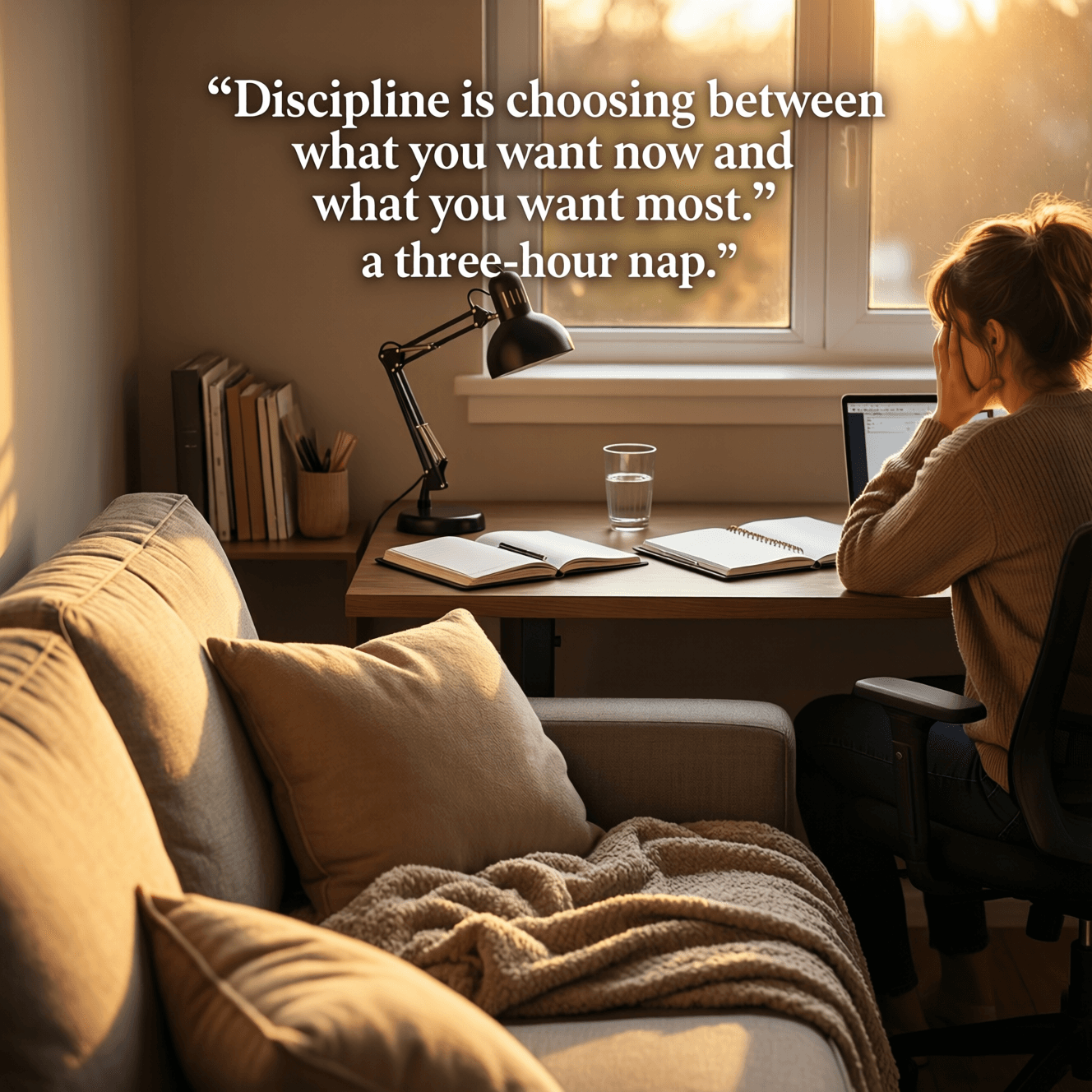
Discipline is choosing between what you want now and what you want most, even when what you want now is a three-hour nap. — Unknown
—What lingers after this line?
The Core Trade-Off
The quote frames discipline not as toughness for its own sake, but as a recurring decision between two desires: an immediate comfort and a deeper, longer-term aim. By putting “what you want now” beside “what you want most,” it implies that both wants are real and legitimate—yet they cannot always be satisfied at the same time. This sets up discipline as a form of prioritization rather than self-punishment. In other words, the point isn’t to eliminate short-term cravings, but to recognize when indulging them would quietly sabotage the outcomes you claim matter most.
Why the Nap Example Works
Then the quote disarms the reader with a very human image: a three-hour nap. It’s funny because it’s relatable, and it narrows the idea of discipline to an everyday moment rather than a heroic life overhaul. Most people don’t fail at discipline only during high-stakes crises; they drift off course through small, repeatable choices. By choosing a nap, the line also highlights that “now” often feels urgent in the body—fatigue, comfort, relief—while “most” is abstract and delayed. The humor makes the message gentler, but the contrast remains sharp.
Delayed Gratification in Modern Terms
From there, the quote connects naturally to the psychology of delayed gratification: the capacity to endure a smaller discomfort now to secure a larger benefit later. Walter Mischel’s Stanford marshmallow studies (late 1960s–1970s) became famous for exploring this exact tension, even though later work emphasized how context and trust shape self-control. In that light, discipline isn’t merely a personality trait; it can be a skill supported by environment. The “nap vs. goal” dilemma becomes less about moral virtue and more about managing incentives, energy, and expectations so that long-term choices become easier to repeat.
Discipline as Identity and Values
Next, the quote subtly suggests that your “most” is tied to values—health, mastery, financial security, creative work, or being dependable. Each time you choose the long-term aim, you’re not only gaining progress; you’re reinforcing a self-image: “I’m the kind of person who keeps promises to myself.” Philosophically, this resembles Aristotle’s idea in the Nicomachean Ethics (4th century BC) that virtues are built through repeated actions until they become character. In practical terms, discipline becomes less about one dramatic victory and more about steadily casting votes for the person you intend to become.
The Missing Piece: Rest Can Be the ‘Most’
Still, the nap detail also invites a necessary nuance: sometimes what you want most is actually rest. If you’re chronically sleep-deprived, refusing a nap may look like discipline while functioning as denial. In that case, the disciplined choice might be to sleep intentionally for 30–90 minutes, then return with clearer focus. This is where the quote becomes a prompt rather than a rule. It encourages asking, “Is this urge an escape, or a genuine need?” That question keeps discipline aligned with long-term wellbeing instead of turning it into rigid self-control that backfires.
Turning the Idea into a Repeatable Practice
Finally, the quote points toward a simple operating method: define what you want most, and make the next small choice consistent with it. That might mean shrinking the barrier—working for ten minutes before considering rest, or setting a timer so a nap doesn’t become avoidance. The goal is not constant intensity but consistent alignment. Over time, these tiny decisions compound. The three-hour nap becomes symbolic of any short-term comfort that can quietly consume the time and attention your larger goals require—unless you deliberately choose, again and again, where you want your life to be headed.
One-minute reflection
What does this quote ask you to notice today?
Related Quotes
6 selectedSaying 'I can't afford that' is a power move. Financial sobriety is choosing your future over a temporary vibe. — Unknown
Unknown
The quote flips a familiar phrase from embarrassment to authority. Instead of sounding powerless, “I can’t afford that” becomes a deliberate boundary: not a confession of lack, but a declaration of priorities.
Read full interpretation →Discipline is the highest form of self-love. It is the ability to choose what you want most over what you want right now. — Jim Rohn
Jim Rohn
At first glance, self-love is often associated with kindness, rest, or indulgence, yet Jim Rohn’s quote shifts the meaning in a more demanding direction. He argues that real care for oneself is not merely about feeling g...
Read full interpretation →You are not responsible for your first thought, but you are responsible for your second thought. — Viktor Frankl
Viktor Frankl
At its core, the quotation distinguishes between what arises automatically and what we deliberately endorse. A first thought may be reflexive, inherited, fearful, angry, or conditioned by habit; it appears before moral j...
Read full interpretation →The strongest person controls the self, not others. — Seneca
Seneca
Seneca’s statement turns the usual idea of power inside out. Instead of praising the person who dominates rivals, commands attention, or bends others to their will, he locates real strength in self-command.
Read full interpretation →We are not victims of our impulses or emotions; we have the power to control them. It is time to relinquish the excuses. — Allie Brosh
Allie Brosh
At its core, Allie Brosh’s quote rejects the comforting idea that emotions and impulses are irresistible forces. Instead, it insists that human beings possess agency: the ability to pause, choose, and act deliberately ev...
Read full interpretation →The senses have been conditioned by attraction to the pleasant and aversion to the unpleasant. Do not be ruled by them. — Bhagavad Gita
Bhagavad Gita
At its heart, this line from the Bhagavad Gita warns that human perception is rarely neutral. The senses constantly pull us toward what feels pleasant and push us away from what feels unpleasant, creating a cycle of crav...
Read full interpretation →More From Author
More from Unknown →The language is the substrate. The architecture is the contract.
The line sets up a deliberate pairing: language lies beneath everything, while architecture governs everything above it. In other words, what you can express determines what you can build, and what you commit to structur...
Read full interpretation →A scroll is not a break; it is a trap disguised as rest. — Unknown
The quote begins by challenging a familiar story we tell ourselves: that a brief scroll is a harmless pause between tasks. On the surface, it looks like recovery—no effort, no decision, no commitment.
Read full interpretation →Don't let your ice cream melt while you're counting someone else's sprinkles. — Unknown
The quote uses ice cream as a simple stand-in for life’s fleeting pleasures: what you have is delicious, but it won’t last forever if you ignore it. Meanwhile, “counting someone else’s sprinkles” captures the habit of mo...
Read full interpretation →If your absence doesn't affect them, your presence never mattered. — Unknown
The quote frames absence as a revealing experiment: remove yourself, and the reaction—concern, curiosity, indifference—becomes a kind of data. If nothing changes when you’re gone, it suggests your role was never integrat...
Read full interpretation →