
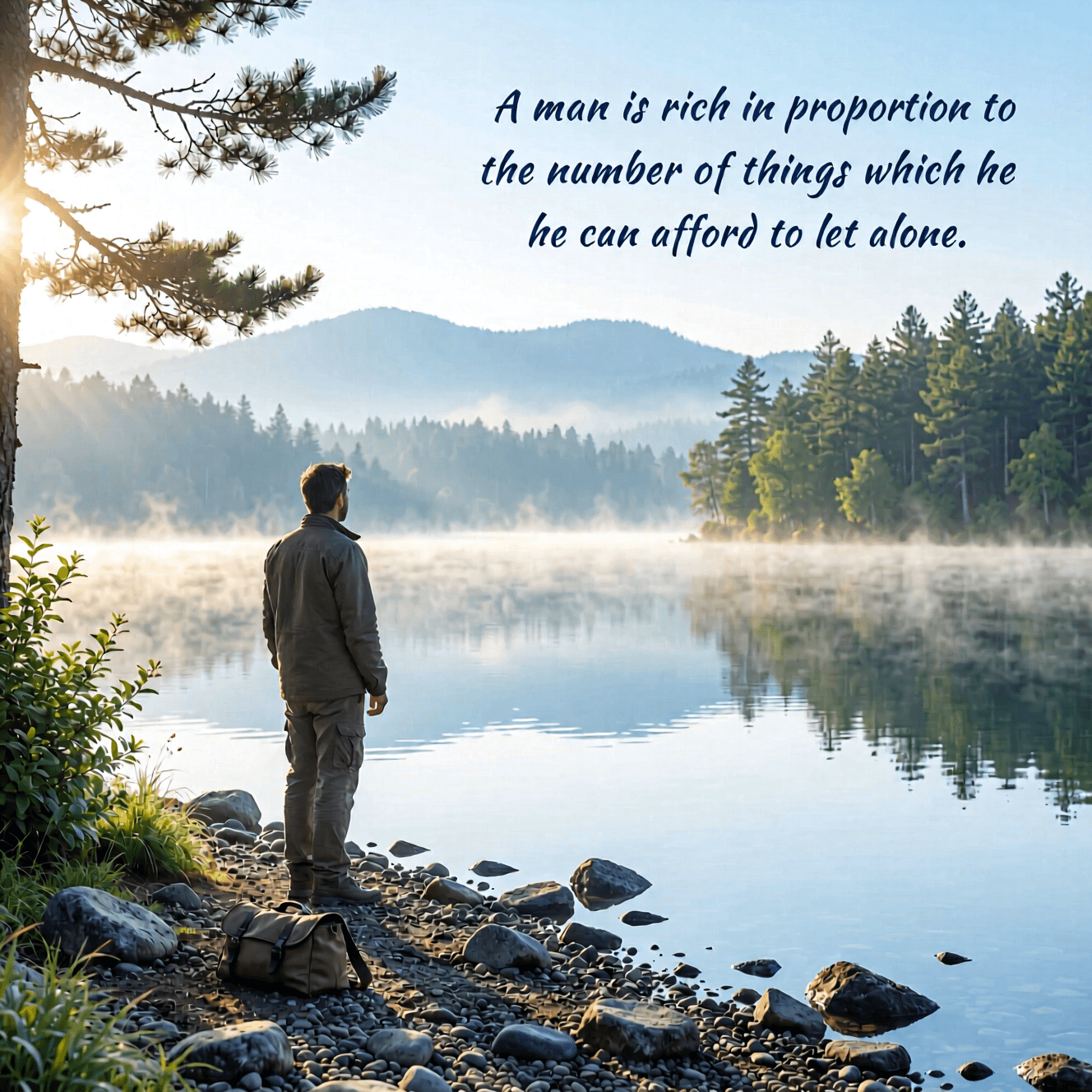
A man is rich in proportion to the number of things which he can afford to let alone. — Henry David Thoreau
—What lingers after this line?
Redefining Riches Beyond Possessions
Thoreau’s line turns the usual definition of wealth inside out. Instead of measuring richness by what someone owns, he measures it by what someone can ignore without feeling deprived. In that sense, abundance is not a pile of additions but a comfortable lack of dependence—an ability to watch opportunities, objects, and trends pass by without anxiety. This idea fits Thoreau’s broader challenge to material status, especially in *Walden* (1854), where he argues that people often become “tools of their tools.” If our comfort hinges on constant acquisition and upkeep, then our possessions quietly own our time. By contrast, the person who can “let alone” many things is wealthy in the currency of self-sufficiency.
Attention as the Scarce Resource
Once wealth is framed as the capacity to ignore, attention becomes the real limited asset. Every extra obligation—another subscription, another device, another social demand—extracts a small tax in maintenance, worry, and mental bandwidth. Thoreau’s measure highlights a practical truth: what we add to life often multiplies the number of decisions we must keep making. From there, the quote reads like an early warning about distraction economies. The richer person is not necessarily the one with more choices, but the one who can decline most of them without inner turmoil. In other words, prosperity appears as calm selectivity rather than frantic consumption.
Simplicity as Power, Not Deprivation
Thoreau’s “let alone” is not a romantic praise of poverty; it’s a claim about strength. If you can walk past a luxury without feeling smaller, you demonstrate independence from the social scripts that tell you what you must want. That independence functions like a kind of leverage—your needs don’t easily get manipulated. This is why simplicity can feel like a form of authority over one’s own life. As Thoreau suggests in *Walden* (1854), cutting wants is not merely subtracting pleasures; it is reducing the points where fear can enter—fear of losing, of keeping up, of being judged. The person with fewer compulsions is harder to control.
Time Wealth and the Cost of Maintenance
The things we cannot “let alone” usually demand maintenance: cleaning, upgrading, repairing, managing, and worrying. Even enjoyable possessions can quietly convert free hours into chores, and the price is often paid in evenings, weekends, and attention that could have gone elsewhere. Thoreau’s idea implies a different balance sheet, where the hidden cost of ownership is time. Consequently, someone may earn a high income yet be poor in Thoreau’s sense if their lifestyle requires constant tending. Meanwhile, another person with modest means might be rich because their days are less encumbered. The quote nudges readers to notice how freedom expands when the upkeep burden shrinks.
The Social Pressure to Want More
Moving from the personal to the cultural, Thoreau points at the quiet coercion of consumer norms. Many desires are taught: the sense that one must upgrade, display, and optimize to remain respectable. If you can afford to let those demands alone, you are insulated from comparison and the status treadmill. This also reframes “afford” as emotional and social capacity, not just financial ability. To let something alone, you must tolerate not having it and not being seen with it. In that light, Thoreau’s richness includes a kind of social courage—the willingness to be unimpressed by what impresses others.
Practicing Thoreau’s Wealth Today
The quote ultimately offers a test: list what you feel you must keep up with, and you’ll see where your life is being spent. From there, wealth can be cultivated by selectively dropping non-essentials—whether that means fewer commitments, fewer purchases that create upkeep, or fewer digital inputs that hijack attention. This is less about austerity than about recovering choice. In practical terms, Thoreau’s standard asks, “What can I leave untouched and still feel whole?” Each honest answer expands a person’s real prosperity: time that is not sold, attention that is not fragmented, and a sense of enough that does not need constant reinforcement.
One-minute reflection
What's one small action this suggests?
Related Quotes
6 selectedWealth consists not in having great possessions, but in having few wants. — Epictetus
Epictetus
Epictetus, a prominent Stoic philosopher, reframes the idea of wealth from material accumulation to internal contentment. In his *Discourses* (c.
Read full interpretation →Clutter is not just physical; it is the visual noise that prevents us from seeing what truly matters. — Fumio Sasaki
Fumio Sasaki
At first glance, Fumio Sasaki’s remark appears to be about untidy rooms, yet it quickly reaches further. He reframes clutter not merely as an excess of objects but as a form of visual interference that competes for our a...
Read full interpretation →You are only entitled to the action, never to its fruits. — Bhagavad Gita
Bhagavad Gita
At its heart, this line from the Bhagavad Gita teaches that a person controls effort, not results. In the dialogue between Krishna and Arjuna in the Bhagavad Gita (c.
Read full interpretation →Doing less doesn't make you less. — Tessa L. G. (Talk2Tessa)
Tessa L. G. (Talk2Tessa
At its core, Tessa L. G.’s line rejects a modern habit of confusing human value with constant activity.
Read full interpretation →Do your work, then step back. The only path to serenity. — Lao Tzu
Lao Tzu
At first glance, the saying seems contradictory: it asks us both to act and to withdraw. Yet that tension is precisely its wisdom.
Read full interpretation →Diligence in care is a virtue, yet carried too far it leaves no room for ease or joy; detachment is a noble bearing, yet taken to excess it cannot benefit others or serve the world. — Hong Yingming
Hong Yingming
Hong Yingming’s reflection begins with a subtle warning: even virtues can become distortions when they harden into extremes. Diligence in caring for things, people, or duties is admirable because it shows responsibility...
Read full interpretation →More From Author
More from Henry David Thoreau →In the long run, men hit only what they aim at. Therefore, they had better aim at something high. — Henry David Thoreau
Thoreau’s statement begins with a simple but demanding truth: over time, people tend to arrive where their intentions point them. In other words, even imperfect effort has a direction, and that direction matters.
Read full interpretation →Me thinks that the minute my legs begin to move my thoughts begin to flow. — Henry David Thoreau
At first glance, Thoreau’s remark seems simple: as soon as his body starts moving, his mind comes alive. Yet the line captures a deeper truth about the intimate bond between physical motion and mental clarity.
Read full interpretation →It is not enough to be industrious; so are the ants. What are you being industrious about? — Henry David Thoreau
Thoreau’s remark begins by puncturing a common illusion: activity is not the same as purpose. Ants are famously industrious, yet their labor is automatic, instinctive, and unquestioned.
Read full interpretation →The price of anything is the amount of life you exchange for it. — Henry David Thoreau
Thoreau’s line quietly overturns a common assumption: that the price of something is whatever appears on a tag. Instead, he asks us to translate every purchase into the time, energy, and attention required to obtain it.
Read full interpretation →