
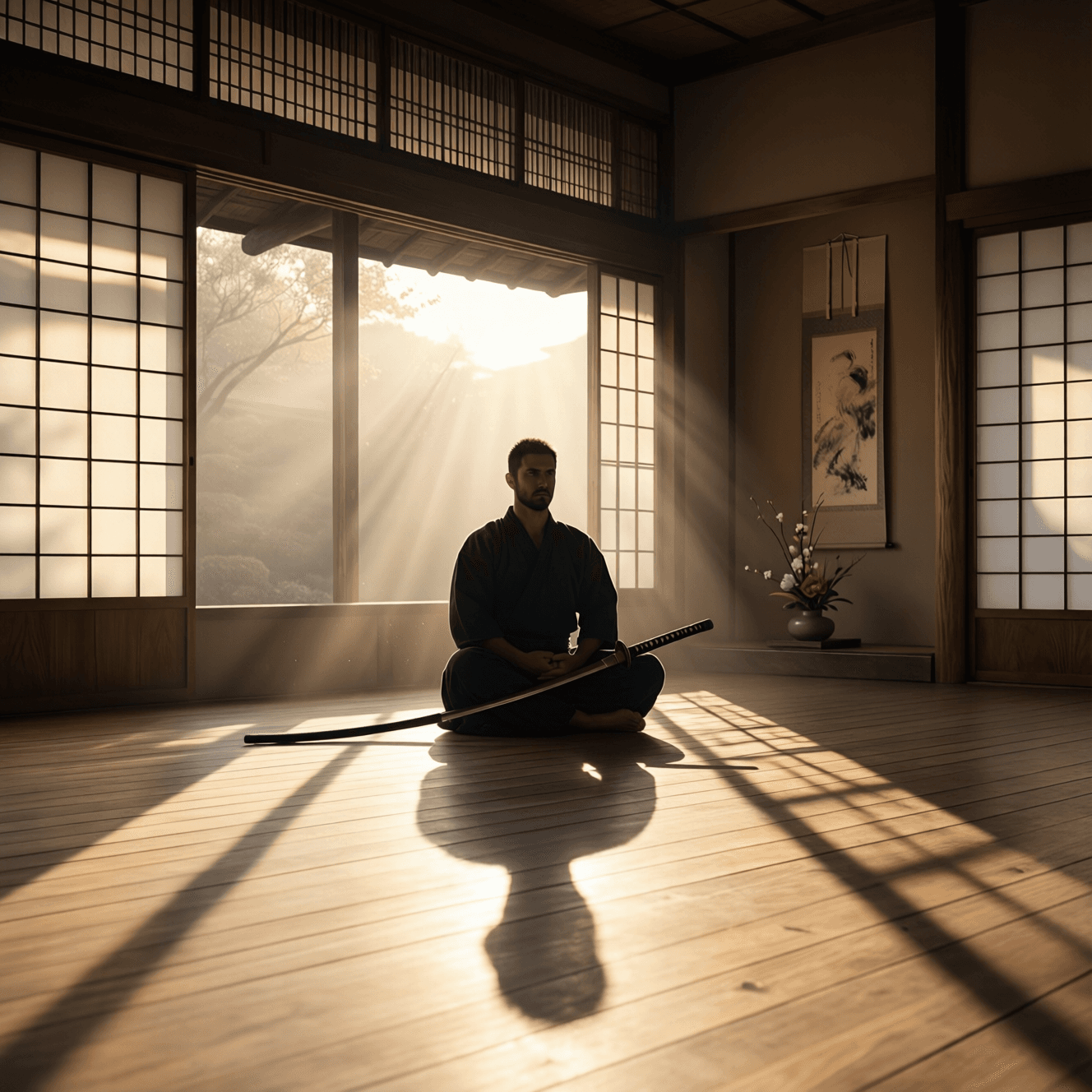
Do nothing which is of no use. — Miyamoto Musashi
—What lingers after this line?
A Maxim of Purposeful Living
Miyamoto Musashi’s line, “Do nothing which is of no use,” reads like a blunt filter for everyday life: if an action doesn’t serve a real aim, drop it. Rather than celebrating busyness, he points to a stricter standard—usefulness measured by outcomes, not effort. In that sense, the quote isn’t anti-rest or anti-joy; it challenges the habit of drifting into rituals, distractions, or performative work. From the outset, Musashi frames usefulness as a practical virtue. The question becomes not “Is this impressive?” but “Does this move me toward what matters?” That shift in criteria is where the quote begins to reshape decisions, large and small.
Roots in the Way of the Warrior
To understand the severity of the advice, it helps to place it within Musashi’s broader outlook in *The Book of Five Rings* (1645), where he emphasizes clear perception, economy of motion, and strategy over ornament. In combat, wasted movement isn’t merely inefficient—it’s dangerous. Musashi’s ethic therefore treats unnecessary action as a liability that exposes weakness. Carrying that forward, the quote becomes a transferable discipline: cut what does not contribute. The warrior context sharpens the point, but the underlying principle applies wherever stakes exist—reputation, craft, relationships, or limited time.
Usefulness as Mental Clarity
Moving from battlefield to mind, “no use” also targets internal noise—worry without planning, opinions without action, learning without application. Musashi’s statement implies that attention is a resource: spend it where it yields insight, skill, or progress. This is less about suppressing thought and more about insisting that thought earns its keep. Seen this way, the maxim becomes a method for clarity. Each time you remove a pointless step—scrolling, rehearsing arguments, polishing details nobody will notice—you reclaim space to think, decide, and execute with intention.
The Discipline of Subtraction
Practically, the quote advocates subtraction before addition. Instead of asking, “What should I do next?” it urges, “What can I stop doing?” That inversion is powerful because many problems are created by excess: too many commitments, too many tools, too many meetings, too many half-started plans. A simple anecdote captures the idea: a craftsperson who spends hours rearranging a workshop to feel productive, yet delays the actual build. Musashi would call the rearranging “of no use” if it doesn’t improve the work’s quality or speed. The discipline is to keep only what directly supports the craft.
Avoiding the Trap of False Efficiency
However, the maxim can be misread as a demand for constant utility, which risks turning life into a spreadsheet. Transitioning from rigor to balance, it helps to distinguish between “no use” and “indirect use.” Rest, play, and reflection may not show immediate output, yet they can be useful because they restore energy, deepen creativity, and prevent reckless decisions. Musashi’s point is best applied to actions that masquerade as necessary but aren’t—busywork, procrastination dressed as preparation, or status-driven tasks. The quote cuts through self-deception, not healthy recovery.
A Working Test for Daily Decisions
In the end, Musashi offers a portable decision rule: define your aim, then accept only actions that meaningfully serve it. A practical test is to ask, “If I skipped this, would the result suffer?” If the honest answer is no, it’s likely “of no use.” Over time, this approach creates a life that feels lighter—fewer obligations, clearer priorities, and more deliberate effort. By linking usefulness to purpose, the maxim becomes more than productivity advice; it becomes an ethic of alignment. What remains after removing the useless is not emptiness, but focus.
One-minute reflection
What's one small action this suggests?
Related Quotes
6 selectedSlowing down is sometimes the best way to speed up. — Mike Vance
Mike Vance
At first glance, Mike Vance’s remark sounds contradictory: how can slowing down possibly help us speed up? Yet the insight becomes clearer when we consider how haste often produces errors, confusion, and wasted effort.
Read full interpretation →We don't value craftsmanship anymore! All we value is ruthless efficiency, and I say we deny our own humanity that way! — William Morris
William Morris
William Morris’s complaint opens as more than nostalgia for handmade beauty; rather, it is a moral protest against a society that measures worth only by speed, output, and utility. When he says that ruthless efficiency d...
Read full interpretation →Do nothing which is of no use.
Unknown
“Do nothing which is of no use” compresses an entire philosophy into a single command: let utility be the filter through which actions pass. It does not merely warn against laziness; rather, it challenges the subtle habi...
Read full interpretation →Keep your eyes on the stars, and your feet on the ground. — Theodore Roosevelt
Theodore Roosevelt
This quote emphasizes the importance of balancing high aspirations with realistic approaches. It suggests one should aim for greatness and dream big ('eyes on the stars'), while also staying grounded in reality and pract...
Read full interpretation →The only way to deal with the future is to function efficiently in the now. — Gwendolyn Brooks
Gwendolyn Brooks
This quote highlights the value of staying focused on the present. To ensure a better future, it is essential to handle today's tasks and responsibilities effectively.
Read full interpretation →Take your time, but don’t waste time. — Michael Jordan
Michael Jordan
This quote encourages people to approach tasks and goals with patience and thoroughness. It advises against rushing, as quality and precision often come with taking the necessary time to do something well.
Read full interpretation →More From Author
More from Miyamoto Musashi →There is nothing outside of yourself that can ever enable you to get better, stronger, richer, or smarter. — Miyamoto Musashi
Miyamoto Musashi’s line begins by stripping away a common hope: that some external thing—money, teachers, circumstances, even luck—will finally “enable” a person to improve. Instead, he argues that the decisive source of...
Read full interpretation →Today is victory over yourself of yesterday; tomorrow is your victory over lesser men. — Miyamoto Musashi
Musashi’s line opens by redefining “victory” as an inward contest rather than a public spectacle. Instead of measuring success by applause, rank, or trophies, he points to a quieter benchmark: whether you are stronger, w...
Read full interpretation →You must train day and night in order to make decisions. — Miyamoto Musashi
Miyamoto Musashi’s line compresses a lifetime of martial experience into a single principle: sound decisions are not improvised—they are earned. When he says you must train “day and night,” he points to a kind of prepara...
Read full interpretation →Think lightly of yourself and deeply of the world. — Miyamoto Musashi
This quote advises individuals to avoid becoming overly focused on their own self-importance or ego. By 'thinking lightly of yourself,' it suggests practicing humility and not overinflating one's own significance.
Read full interpretation →