
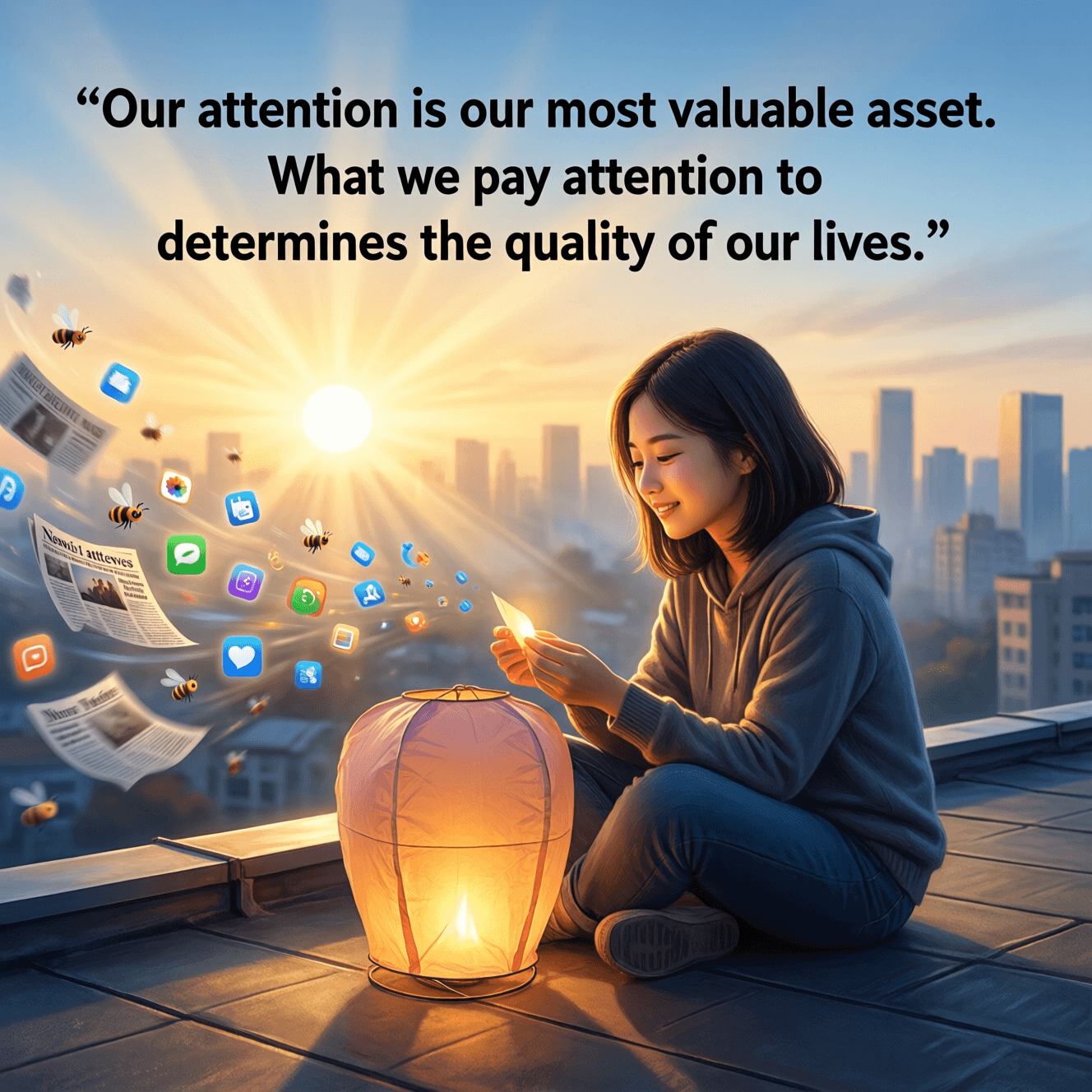
Our attention is our most valuable asset. What we pay attention to determines the quality of our lives. — Johann Hari
—What lingers after this line?
Attention as a Finite Currency
Johann Hari’s claim begins with a simple reframe: attention isn’t just something we use, it’s something we spend. Because it is limited, it functions like a currency that can be invested wisely or drained by constant demands. Once we see attention this way, everyday choices—opening another tab, checking a notification, saying yes to an unwanted obligation—stop feeling neutral and start looking like purchases with real costs. From there, the quote implies a quiet urgency: if attention is truly our most valuable asset, then losing control of it means losing control of the very resource that funds everything else we care about—learning, intimacy, creativity, and even rest.
Why Focus Determines Life Quality
Building on that premise, Hari connects attention to “the quality of our lives” because experience is filtered through what we notice. A day spent tracking irritations, status anxieties, or outrage will feel fundamentally different from a day spent noticing beauty, progress, or friendship—even if the external events are similar. In that sense, attention doesn’t merely reflect our life; it helps compose it. This idea echoes William James’s principle in *The Principles of Psychology* (1890) that “my experience is what I agree to attend to,” suggesting that attention selects reality from an overwhelming stream of possibilities. What we repeatedly select becomes our perceived world.
The Hidden Architects of Attention
However, attention is not shaped by willpower alone. Modern environments are engineered to pull it: endless feeds, autoplay, alerts, and attention-optimizing advertising models. Hari’s broader work in *Stolen Focus* (2022) argues that distraction is increasingly systemic rather than merely personal, which clarifies why so many people feel their minds are being “spent” without their consent. Consequently, the quote can be read as both a warning and a diagnosis: if attention is our best asset, then it is also the asset most likely to be targeted, fragmented, and monetized—unless we actively defend it.
Identity, Values, and What We Notice
Next, the statement hints that attention is a pathway to identity. What we habitually focus on trains our preferences and reinforces our values: attend to comparison, and life becomes a scoreboard; attend to craft, and life becomes a workshop; attend to relationships, and life becomes a network of care. Over time, attention doesn’t just shape moods—it shapes character. A small everyday example makes this tangible: a person who begins each morning by scanning alarming headlines may feel informed yet chronically tense, while someone who begins by reading a page of a book or taking a short walk may feel grounded. The “same” morning becomes a different life because the mind was pointed in a different direction.
Reclaiming Attention Through Design
If attention determines life quality, then the practical response is to design conditions that make good attention easier. This includes setting default boundaries—turning off nonessential notifications, creating phone-free meals, or batching email—so that focus is not constantly forced to reassert itself. In other words, instead of relying on repeated self-control, we reduce the number of battles. This approach aligns with behavioral insights popularized by Richard Thaler and Cass Sunstein’s *Nudge* (2008): environment shapes behavior. When you change the “choice architecture” around attention, you make it more likely that your days align with your intentions.
From Moment-to-Moment to Meaning
Finally, Hari’s line suggests a long view: attention is the bridge between fleeting moments and a meaningful life. What we attend to becomes what we remember, what we practice becomes what we become, and what we return to becomes what we worship—whether consciously or not. The quality of life is therefore not only about big events, but about the accumulation of tiny acts of noticing. Seen this way, reclaiming attention is not a productivity hack; it is an existential choice. By deciding, again and again, what deserves our mind, we quietly decide what kind of life we are living.
One-minute reflection
Where does this idea show up in your life right now?
Related Quotes
6 selectedThe most valuable asset in the age of distraction is an undistracted mind. — Johann Hari
Johann Hari
At first glance, Johann Hari’s line reframes value itself. In a culture saturated with notifications, advertisements, and algorithmic pulls, he suggests that attention has become more precious than many material possessi...
Read full interpretation →The quality of our attention determines the quality of our lives. — Mary Oliver
Mary Oliver
Mary Oliver’s line treats attention not as a minor habit but as the force that quietly builds a life from the inside out. What we notice, linger over, and return to becomes the raw material of our days; what we ignore fa...
Read full interpretation →The greatest luxury in a modern world is not things, but the ability to disconnect and reclaim your own attention. — Cal Newport
Cal Newport
At first glance, Newport’s statement overturns the traditional idea of luxury as something material. Instead of wealth being measured by rare objects, he suggests it is now measured by the freedom to step away from noise...
Read full interpretation →The more you can increase your focus of time and attention, the more capable you will be of managing your world. — Esther Dyson
Esther Dyson
Esther Dyson’s quote begins with a simple but powerful premise: the quality of our lives is shaped by where we place our attention. The more deliberately we focus our time and mental energy, the less we are pushed around...
Read full interpretation →We are not defined by the speed of our output, but by the depth of our attention. — Cal Newport
Cal Newport
At first glance, Cal Newport’s line challenges one of modern life’s favorite assumptions: that worth is proven through visible speed. In many workplaces and social spaces, quick replies, rapid delivery, and constant acti...
Read full interpretation →In the quiet of your own mind, you hold the power to reclaim your attention from the chaos of the world. — Thich Nhat Hanh
Thich Nhat Hanh
Thich Nhat Hanh’s words begin with a gentle but radical claim: the mind contains a quiet space that cannot be fully colonized by the world’s noise. Rather than portraying attention as something stolen forever by distract...
Read full interpretation →More From Author
More from Johann Hari →