
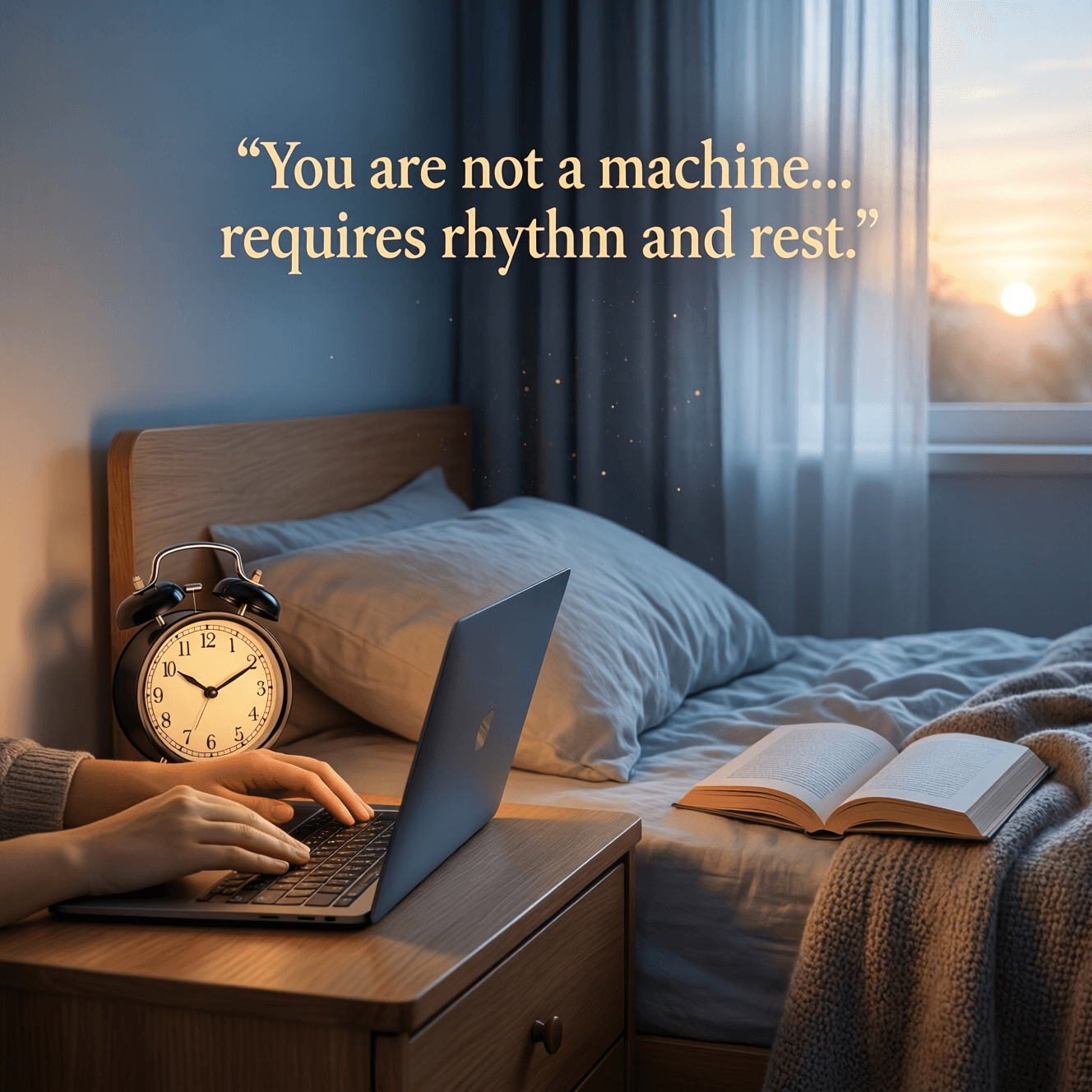
You are not a machine. You are a biological being that requires rhythm and rest to function at its highest level. — Dr. Nicole LePera
—What lingers after this line?
A Direct Refusal of Machine Thinking
Dr. Nicole LePera’s line begins by challenging a modern reflex: treating ourselves like endlessly upgradeable devices. In a culture that prizes constant output, “You are not a machine” pushes back against the belief that willpower alone can override fatigue, emotion, and physical limits. The quote reframes productivity as something that must cooperate with biology rather than conquer it. From there, the message invites a more humane self-assessment. Instead of asking how to squeeze more from the day, it prompts a different question: what conditions help a living system function well?
Biology as the Baseline, Not an Obstacle
The second sentence grounds the idea in physiology: you are “a biological being.” That phrasing emphasizes that energy, mood, and focus are inseparable from sleep, nutrition, movement, and stress regulation. Rather than framing the body as an inconvenient container for a busy mind, it positions biology as the operating system that sets the terms for everything else. This naturally leads to the recognition that limits aren’t personal failures. They are signals—hunger, fatigue, overstimulation—designed to keep the organism stable and safe.
Rhythm: The Hidden Architecture of Well-Being
Once biology is centered, “rhythm” becomes the key concept: the body works best in cycles, not marathons. Daily and seasonal patterns—sleep-wake timing, periods of focus and recovery—shape cognition and emotional resilience. The quote implies that peak functioning is less about intensity and more about alignment with natural oscillations. In that sense, rhythm is not a soft preference but a structural requirement. Ignoring it can feel like success in the short term, yet it often accumulates as irritability, brain fog, or burnout.
Rest as a Performance Requirement, Not a Reward
The line “requires rhythm and rest” reframes rest from something earned to something necessary. Many people delay recovery until tasks are finished, but living systems don’t work on a checklist; they work on replenishment. This echoes well-established sleep science, such as Matthew Walker’s *Why We Sleep* (2017), which describes sleep as foundational to memory consolidation, immune function, and emotional regulation. As a result, rest becomes strategic rather than indulgent. It is how the body resets the very capacities—attention, patience, creativity—that modern life demands.
Burnout as the Cost of Constant Override
If we accept the body’s need for rest, the next implication is clear: repeatedly overriding signals carries consequences. Chronic stress and insufficient recovery can narrow our tolerance window, making small problems feel overwhelming and reducing our ability to self-regulate. In everyday terms, this looks like working late for weeks and then suddenly feeling unable to concentrate, connect, or care. Seen this way, burnout isn’t simply too much work; it’s too little restoration relative to demands. The quote functions as an early warning system: ignoring biology eventually forces a stop.
Practicing a More Human Pace
The final turn of the quote is practical: to function at a “highest level,” we must plan for cycles. That might mean consistent sleep timing, deliberate breaks between cognitively heavy tasks, and a weekly rhythm that includes genuine downtime rather than “rest” filled with errands. Even brief pauses—stepping outside, breathing slowly, stretching—can serve as micro-recovery that keeps the nervous system from staying pinned in high alert. Ultimately, LePera’s statement is an argument for sustainability. High performance becomes less about pushing harder and more about living in a way a biological body can actually support.
One-minute reflection
Why might this line matter today, not tomorrow?
Related Quotes
6 selectedRest is not a luxury; it is a necessity for high performance. Protect your sleep, your boundaries, and your peace, for a well-rested nervous system is the foundation of all true resilience. — Doral Health & Wellness
Doral Health & Wellness
At its core, this quote overturns a common modern belief: that rest is a reward earned only after relentless effort. Instead, Doral Health & Wellness argues that rest is a basic requirement for doing meaningful work well...
Read full interpretation →Resting isn't quitting. It's repairing. — Unknown (Skipped - Replacing with: Recovery isn't a sign of weakness—it's an act of strength. — Curtis Tyrone Jones)
Curtis Tyrone Jones
At first glance, Curtis Tyrone Jones’s statement challenges a common cultural reflex: the idea that stopping means failing. Instead, it reframes recovery as purposeful action rather than passive retreat.
Read full interpretation →There is a time for many words, and there is also a time for sleep. — Homer
Homer
Homer’s line turns on a simple but profound contrast: there is a season for speaking at length, and there is another for surrendering to sleep. At once, he suggests that wisdom is not merely knowing what matters, but kno...
Read full interpretation →Exhaustion is not the only proof that you are trying. You are allowed to pause, even if everything feels urgent. — Annie Wright
Annie Wright
At first glance, Annie Wright’s quote challenges a deeply ingrained belief: that visible exhaustion is the clearest sign of seriousness. Many people have learned to equate being drained with being dedicated, as if fatigu...
Read full interpretation →Recovery begins to change when rest stops being something you must earn and starts becoming something your system is allowed to need. — Tessa
Tessa, Psychologist
At the heart of Tessa’s statement is a quiet but radical shift: recovery deepens when rest is no longer treated as a prize for productivity. In many cultures, people are taught to pause only after proving their worth, ye...
Read full interpretation →You are allowed to pause, even if everything feels urgent. — Emily Nagoski
Emily Nagoski
At its core, Emily Nagoski’s line offers something many people rarely grant themselves: permission. In a culture that equates constant motion with worth, the reminder that you may pause—even when everything feels urgent—...
Read full interpretation →More From Author
More from Dr. Nicole LePera →