
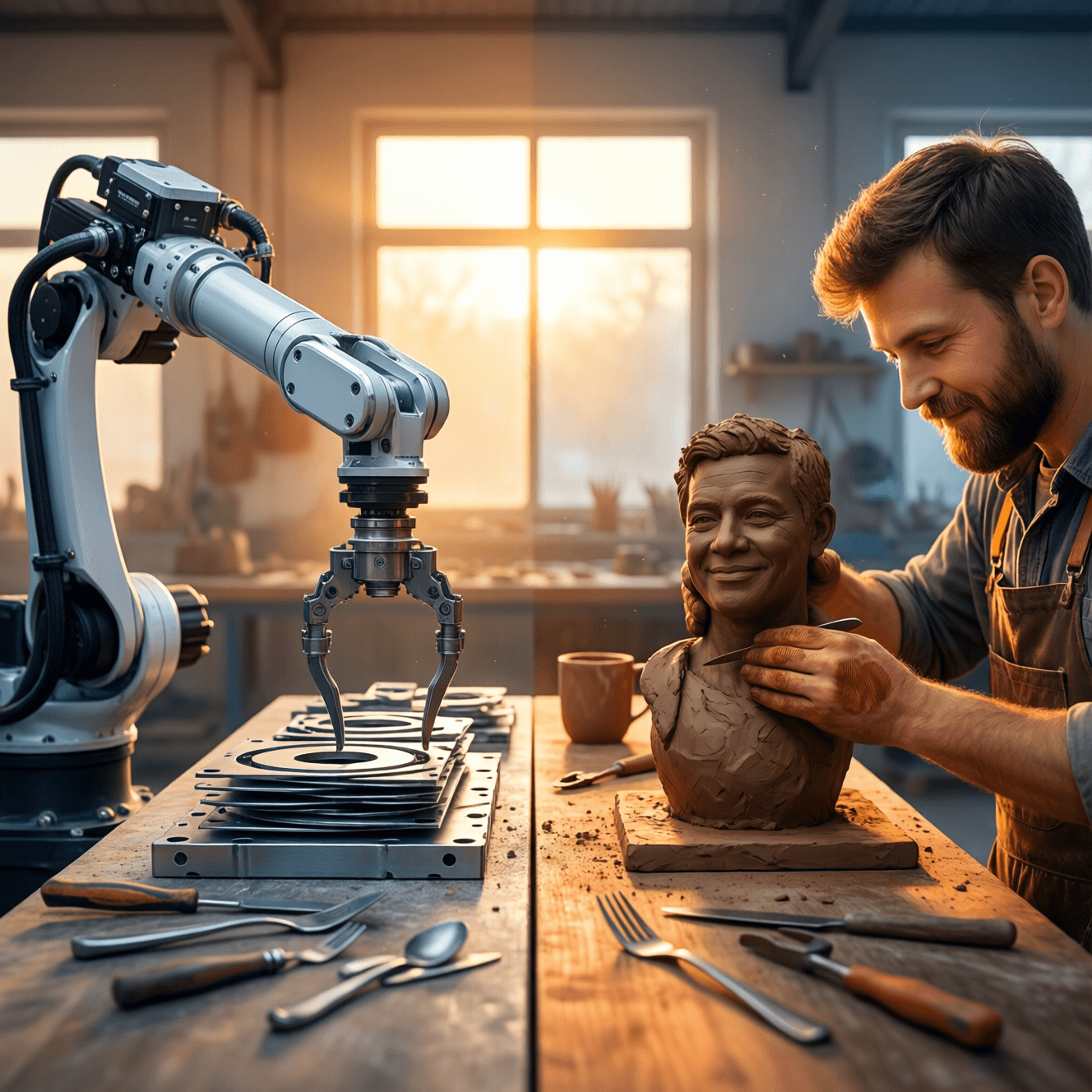
As machines become more efficient and perfect, it will become clear that imperfection is the greatness of man. — Ernst Fischer
—What lingers after this line?
The Provocation Behind Fischer’s Claim
Ernst Fischer’s remark turns the usual story of progress on its head. Instead of treating advancing technology as a straightforward triumph, he predicts that the more “perfect” machines become, the more distinctly human value will stand out. In that future, our flaws will not merely be problems to fix but signals of something machines cannot replicate. From the outset, Fischer frames imperfection not as a defect but as a dimension of meaning. This inversion matters because it challenges the instinct to measure everything—work, art, even relationships—by efficiency. As automation approaches frictionless performance, Fischer suggests we may finally notice that what makes a person significant is not optimized output, but the messy, unfinished qualities that make growth, conscience, and individuality possible.
Efficiency Versus Meaning
To understand why imperfection could become “greatness,” it helps to separate efficiency from purpose. Machines excel at tasks with clear rules and measurable outcomes; they can be tuned, benchmarked, and improved until errors are rare. Yet human life rarely fits that mold, because meaning often emerges from ambiguity—choosing a career that feels right rather than one that scores highest on a spreadsheet, or spending time with a friend even when it produces nothing quantifiable. As machines outperform us in precision, the temptation is to treat the human as an inefficient machine. Fischer’s warning implies the opposite: once efficiency is abundant, it may lose its prestige, and we may value the human capacity to hesitate, reinterpret, and act from reasons that cannot be reduced to speed or accuracy.
Imperfection as a Source of Creativity
Creativity frequently depends on errors, detours, and incomplete understanding—features that look like failures from a purely technical standpoint. Artistic breakthroughs often arise from constraints and mistakes: a musician bends a note, a painter embraces an uneven stroke, a writer follows an unexpected metaphor. Even in science, productive discovery can begin with anomaly; Thomas Kuhn’s The Structure of Scientific Revolutions (1962) describes how “normal science” is disrupted by findings that don’t fit existing paradigms. In this light, imperfection is not just tolerated but generative. As machines become better at reliably executing known patterns, the human ability to wander, misjudge, and then reframe the problem may appear less like noise—and more like the engine of originality.
Moral Responsibility and the Burden of Choice
Another kind of imperfection is ethical: humans can be conflicted, tempted, or uncertain, and yet still must choose. That vulnerability is inseparable from responsibility. A machine can be consistent, but it does not carry guilt, remorse, or the inner experience of deciding to do right when doing right is costly. Literature often portrays this tension as the core of humanity; Dostoevsky’s The Brothers Karamazov (1880) is saturated with the idea that freedom includes the possibility of error. As machines become more dependable, Fischer implies that the human will be defined less by competence and more by accountability. Our greatness may lie in being the kind of creature for whom decisions matter—because we can fail, regret it, and try again.
The Value of Vulnerability in Relationships
Human imperfection is also relational. Trust, intimacy, and community often deepen through visible flaws: admitting uncertainty, apologizing, or asking for help. These moments are not efficient, and they can be uncomfortable, but they are how bonds are formed and repaired. A perfectly calibrated assistant might anticipate needs flawlessly, yet it would not share the risk of being misunderstood, nor the mutual transformation that occurs when two imperfect people learn each other. Consequently, as machines simulate more polished social interactions, their smoothness may highlight what is missing: the authenticity that comes from real stakes and real fragility. Fischer’s “greatness” can be read here as the capacity to connect despite—indeed because of—our limitations.
Redefining Progress Without Erasing the Human
Fischer’s forecast ultimately urges a cultural redefinition of progress. If technological perfection becomes common, then the central question shifts from “Can we make this flawless?” to “What kind of life is worth living with flawless tools?” That invites a renewed appreciation for the unfinished human being: learning slowly, changing one’s mind, and developing character over time. Rather than romanticizing suffering or error, Fischer points toward a future where the human is no longer valued for competing with machines on their terms. Instead, our imperfection becomes the evidence of a different order of greatness—one rooted in imagination, moral depth, and the capacity to become more than we currently are.
One-minute reflection
Where does this idea show up in your life right now?
Related Quotes
2 selectedThe essence of being human is that one does not seek perfection. — George Orwell
George Orwell
This quote highlights the idea that to be human is to recognize and accept imperfections in ourselves and others. It implies that striving for perfection can lead to dissatisfaction and a disconnect from our true nature.
Read full interpretation →In an age optimized for speed and replication, your depth and authenticity are your most irreplaceable assets. Do not rush to be a machine when the world is starving for a human. — Faisal Hoque
Faisal Hoque
Faisal Hoque’s line reads like a caution label for modern life: when everything rewards rapid output and easy copying, the most valuable thing you can offer is what cannot be mass-produced—your lived perspective. By fram...
Read full interpretation →More From Author
More from Ernst Fischer →