
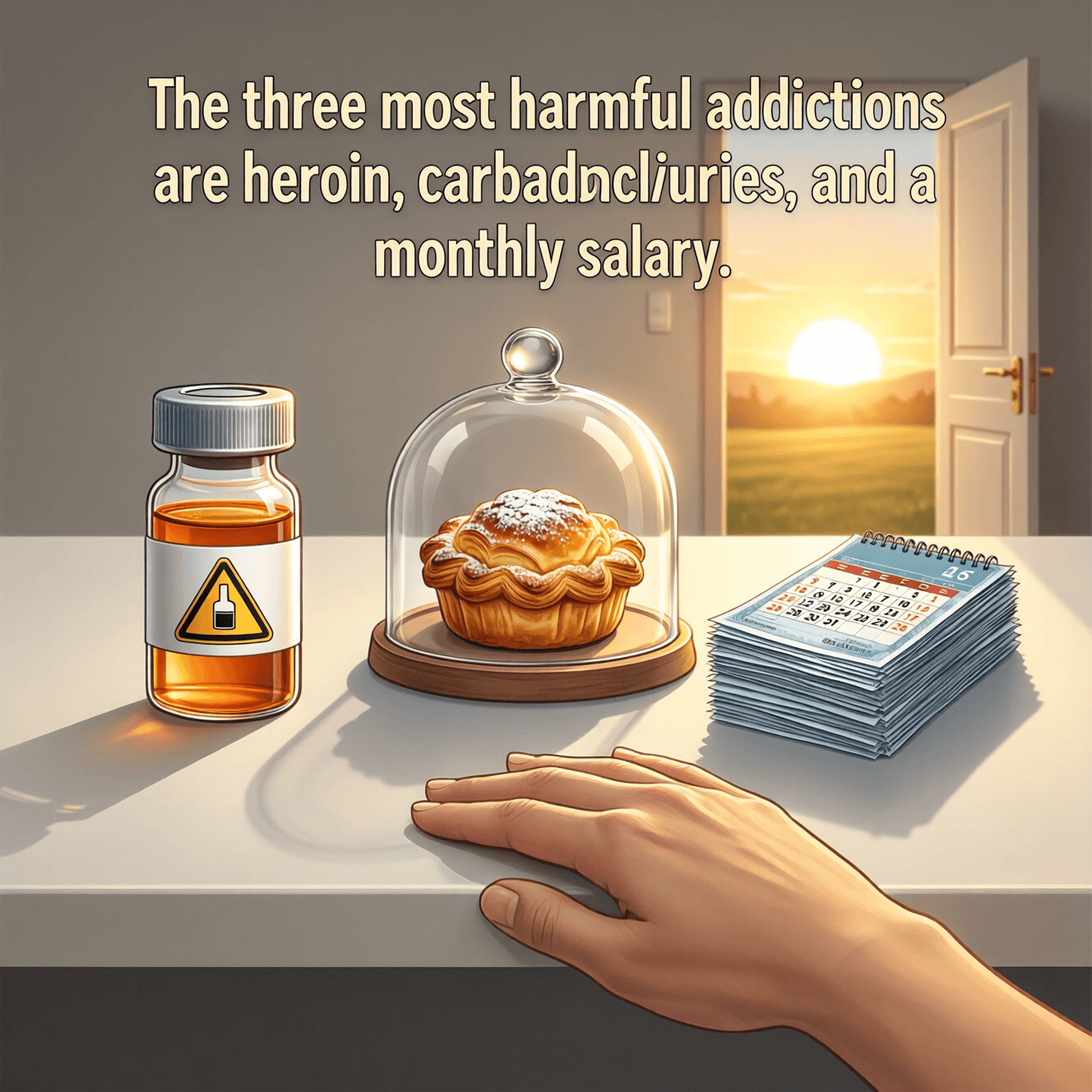
The three most harmful addictions are heroin, carbohydrates, and a monthly salary. — Nassim Nicholas Taleb
—What lingers after this line?
A Provocation in Three Words
Nassim Nicholas Taleb’s line is built like a punch: heroin, carbohydrates, and a monthly salary. By placing an illegal opioid beside everyday food and ordinary employment, he forces the reader to pause and ask what “addiction” really means. The quote isn’t a medical ranking so much as a rhetorical device meant to collapse the distance between obvious self-destruction and socially approved habits. From there, the argument becomes clearer: the most dangerous dependencies are often the ones that look normal. If a pattern reliably overrides long-term judgment—whether through chemistry, comfort, or routine—it can quietly narrow a person’s freedom of action.
Heroin as the Baseline of Obvious Ruin
Starting with heroin establishes the extreme case: a substance with well-documented physiological dependence, tolerance, and high overdose risk. It represents the addiction everyone agrees is harmful, the kind that can rapidly consume health, relationships, and agency. Precisely because heroin’s damage is so visible, it serves as Taleb’s benchmark for loss of autonomy. The transition to the next items is the real point: if heroin is the unmistakable trap, then the quote challenges us to notice other traps that don’t look like cages until choices begin to vanish.
Carbohydrates and the Modern Pleasure Loop
Moving from narcotics to carbohydrates shifts from illicit compulsion to culturally normalized reward. Taleb isn’t condemning all carbs as poison; he’s pointing at how refined, hyper-palatable foods can train appetite toward quick relief—sweetness, satiety, and the familiar dopamine-driven loop people describe as “cravings.” In that sense, “carbohydrates” functions as shorthand for industrialized convenience eating. This becomes harmful not only through health outcomes but through predictability: when stress, boredom, or fatigue automatically routes someone to the same comforting fix, the habit starts to resemble a dependency. The danger is subtle because it arrives wrapped in celebration, snacks, and everyday routine.
The Monthly Salary as a Soft Chain
The final item—“a monthly salary”—lands as the sharpest critique, because it targets a widely respected structure. Taleb’s implication is that predictable income can sedate risk-taking and make people overly tolerant of fragile systems. If rent, debt payments, and lifestyle inflation are calibrated to the paycheck schedule, the person can become locked into preserving the flow at almost any cost. Unlike heroin, this dependence is applauded as responsibility. Yet the mechanism rhymes with addiction: short-term security can override long-term resilience, encouraging people to trade optionality for stability until quitting, pivoting, or speaking up feels impossible.
What These Addictions Share: Reduced Optionality
Linking the three together reveals Taleb’s deeper theme: addiction is anything that systematically reduces optionality—your ability to adapt, say no, and choose differently under pressure. Heroin narrows options through biology, refined foods can narrow options through conditioned reward, and salary dependence can narrow options through financial commitments and institutional reliance. This frame fits Taleb’s broader concern with fragility: when you need a specific input at a specific interval—dose, sugar hit, paycheck—your life becomes more brittle. The severity differs, but the structural vulnerability is the common thread.
A Call Toward Antifragile Habits
Seen this way, the quote reads less like moralizing and more like a practical challenge: design a life that doesn’t collapse when one stream stops. That might mean building savings and multiple income sources, keeping expenses below means, and cultivating skills that travel across industries—while also developing healthier relationships with food and comfort. The transition from critique to action is implicit: heroin demands avoidance and treatment, but the other two invite deliberate constraint. By reducing reliance on easy pleasure and predictable paychecks as the sole support, a person increases resilience—and, in Taleb’s terms, regains the freedom that addiction quietly steals.
One-minute reflection
Where does this idea show up in your life right now?
Related Quotes
6 selectedI tried to drown my sorrows, but the bastards learned how to swim. — Frida Kahlo
Frida Kahlo
Frida Kahlo’s line opens with the familiar promise of escape—“I tried to drown my sorrows”—and then snaps into a punchline that refuses sentimentality. The sudden insult, “the bastards,” is more than comic shock; it’s a...
Read full interpretation →The question is not why the addiction, but why the pain. — Gabor Maté
Gabor Maté
Gabor Maté’s line pivots attention away from the surface behavior and toward the hidden wound that behavior may be attempting to soothe. Instead of treating addiction as a baffling moral failure or a purely chemical trap...
Read full interpretation →The difference between technology and slavery is that slaves are fully aware that they are not free. — Nassim Nicholas Taleb
Nassim Nicholas Taleb
Taleb’s line works as a moral jolt: if slavery is defined by the loss of freedom, then the crucial difference he highlights is awareness. Enslaved people know their constraint is imposed; the modern technology user may f...
Read full interpretation →Self-discipline is a form of freedom. Freedom from the slavery of your own moods. — Nassim Nicholas Taleb
Nassim Nicholas Taleb
Taleb’s line begins by flipping a common assumption: freedom is often imagined as fewer rules, fewer obligations, and maximum spontaneity. Yet he suggests that the more decisive liberty is internal—being able to act acco...
Read full interpretation →Difficulty is what wakes up the genius. — Nassim Nicholas Taleb
Nassim Nicholas Taleb
Taleb’s line suggests that genius is not a constant trait humming quietly in the background; instead, it is often dormant in comfort. When life is predictable, our minds can afford to run on routine, repeating what alrea...
Read full interpretation →To be free of a certain kind of ambition is a necessary condition for being a free man. — Nassim Nicholas Taleb
Nassim Nicholas Taleb
Taleb’s line begins with a provocation: some ambitions don’t elevate you—they tether you. The “certain kind” matters, because not all striving is corrosive; rather, it’s the ambition that makes your choices hostage to ex...
Read full interpretation →More From Author
More from Nassim Nicholas Taleb →The difference between technology and slavery is that slaves are fully aware that they are not free. — Nassim Nicholas Taleb
Taleb’s line works as a moral jolt: if slavery is defined by the loss of freedom, then the crucial difference he highlights is awareness. Enslaved people know their constraint is imposed; the modern technology user may f...
Read full interpretation →Self-discipline is a form of freedom. Freedom from the slavery of your own moods. — Nassim Nicholas Taleb
Taleb’s line begins by flipping a common assumption: freedom is often imagined as fewer rules, fewer obligations, and maximum spontaneity. Yet he suggests that the more decisive liberty is internal—being able to act acco...
Read full interpretation →Difficulty is what wakes up the genius. — Nassim Nicholas Taleb
Taleb’s line suggests that genius is not a constant trait humming quietly in the background; instead, it is often dormant in comfort. When life is predictable, our minds can afford to run on routine, repeating what alrea...
Read full interpretation →To be free of a certain kind of ambition is a necessary condition for being a free man. — Nassim Nicholas Taleb
Taleb’s line begins with a provocation: some ambitions don’t elevate you—they tether you. The “certain kind” matters, because not all striving is corrosive; rather, it’s the ambition that makes your choices hostage to ex...
Read full interpretation →