
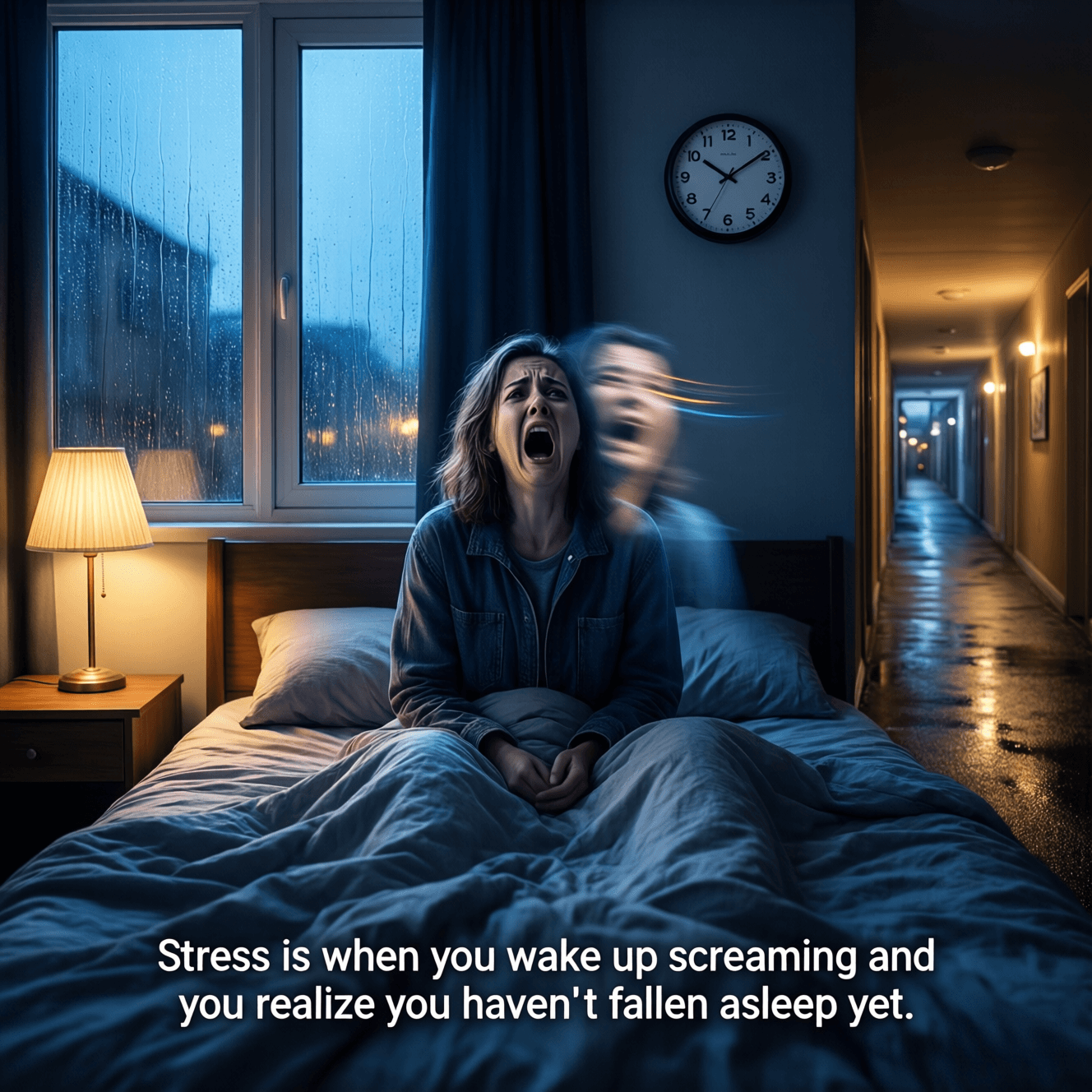
Stress is when you wake up screaming and you realize you haven't fallen asleep yet. — Ken Hakuta
—What lingers after this line?
A Joke That Lands Because It’s True
Ken Hakuta’s line works like a punchline, but it hits with the sting of recognition: the “scream” is hyperbole, yet the feeling is familiar to anyone who has lain awake in a tense, exhausted loop. By collapsing the difference between night terror and ordinary wakefulness, he suggests that stress can make consciousness itself feel unsafe. From there, the quote invites a reframe of stress not as a busy-day inconvenience, but as an experience that distorts time and perception—where even rest becomes another arena for pressure.
Hyperarousal: When the Body Won’t Power Down
Underneath the humor sits a physiological reality: stress triggers arousal systems designed for danger, not bedtime. When the nervous system stays on high alert, the body behaves as if it must keep watch, and sleep becomes difficult even when fatigue is intense. In that light, the “realize you haven’t fallen asleep yet” twist captures a common pattern—lying still for hours, noticing every thought and heartbeat—because the body’s stress response keeps signaling that now is the wrong time to let go.
The Mind’s Late-Night Catastrophe Machine
If the body provides the fuel, the mind often supplies the storyline. Stress tends to recruit rumination—replaying conversations, forecasting worst outcomes, and trying to solve tomorrow at 2 a.m. That’s why the quote’s imaginary scream feels plausible: internally, the mind can be as loud as an alarm. As the night goes on, the brain may start monitoring itself—“Why am I still awake?”—and that self-check becomes another problem to fix, tightening the loop Hakuta compresses into one sharp sentence.
Insomnia’s Feedback Loop: Fear of Not Sleeping
The line also points to how stress and insomnia reinforce each other. Once someone has a few bad nights, bedtime can become a cue for anxiety, so the mere attempt to sleep activates worry about consequences—productivity, health, irritability—making sleep even less likely. In other words, stress isn’t only what happens during the day; it can become a learned nighttime response. Hakuta’s “wake up” without having slept captures that cruel circularity: you feel as though you’ve already failed at resting before rest even begins.
Why Humor Helps: Naming the Unnameable
By exaggerating stress into a surreal moment, the quote gives language to something people often minimize. Humor can reduce shame—if the experience can be laughed at, it can also be shared—and that social permission matters because stress thrives in isolation. At the same time, the joke quietly validates the intensity of the problem. It suggests that what looks like “just worrying” can feel like a full-body emergency, which can be the first step toward taking sleep and mental recovery seriously.
Reclaiming Rest as a Skill, Not a Switch
The quote’s final implication is that sleep isn’t always a simple off-button; under stress, it becomes a practice of downshifting. That can mean reducing stimulation before bed, creating a wind-down routine, or setting boundaries that keep tomorrow’s tasks from invading tonight’s mind. Ultimately, Hakuta’s one-liner offers a compact truth: when stress is high enough, the night stops being a refuge. Recognizing that helps shift the goal from “force sleep” to “create safety,” so the body can finally accept that it’s allowed to rest.
One-minute reflection
Where does this idea show up in your life right now?
Related Quotes
3 selectedIt is not stress that kills us, it is our reaction to it. — Hans Selye
Hans Selye
Hans Selye’s statement immediately reframes a common assumption: stress itself is not always the true enemy. Instead, he points to the way we interpret, absorb, and respond to pressure as the factor that most shapes harm...
Read full interpretation →If you're overwhelmed right now, nothing is wrong with you. You're reacting normally to an abnormal amount of change. — Erin Loechner
Erin Loechner
At its core, Erin Loechner’s statement offers relief through reframing: feeling overwhelmed does not automatically signal weakness, failure, or personal deficiency. Instead, it names overwhelm as a reasonable response to...
Read full interpretation →Stress is an ignorant state. It believes that everything is an emergency. — Natalie Goldberg
Natalie Goldberg
Natalie Goldberg frames stress not just as a feeling but as a kind of ignorance—an impaired state of awareness that misreads reality. In her view, stress narrows perception until nuance disappears, and the mind loses the...
Read full interpretation →More From Author
More from Ken Hakuta →