
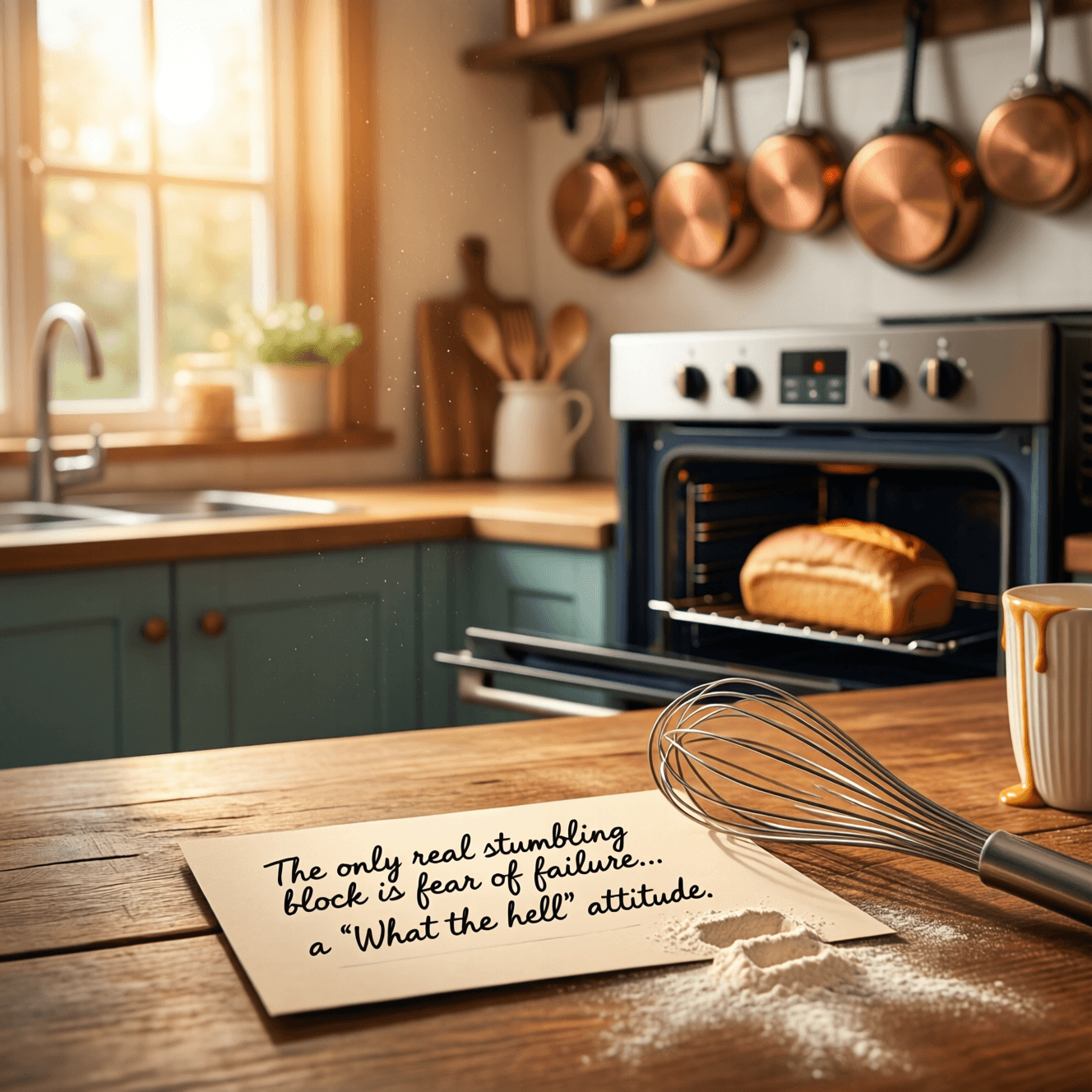
The only real stumbling block is fear of failure. In life, you've got to have a 'What the hell?' attitude. — Julia Child
—What lingers after this line?
Naming the True Obstacle
Julia Child’s remark begins with a blunt diagnosis: what trips most people up isn’t a lack of talent or opportunity, but the fear of failing. By calling fear the “only real stumbling block,” she reframes failure as an event—often survivable and even useful—while fear becomes the chronic condition that prevents movement. The insight is quietly empowering: if fear is the main barrier, then progress starts not with perfection but with action. From there, her statement invites a shift in attention away from flawless outcomes and toward the willingness to begin. In other words, the first victory is stepping into the attempt, even while uncertainty remains.
The 'What the Hell?' Mindset
Having identified fear, Child offers an antidote: a “What the hell?” attitude. This isn’t carelessness so much as permission—an intentional loosening of the grip that anxiety has on decision-making. It is the moment you stop negotiating endlessly with your doubts and decide that doing the thing imperfectly is better than not doing it at all. In that way, the phrase functions like a mental lever. Instead of asking, “What if I mess up?” the attitude answers, “Maybe I will—and I’ll learn.” The emotional tone matters: humor and audacity can break the spell of overthinking.
Failure as Feedback, Not a Verdict
Once you adopt that posture, failure changes meaning. Rather than serving as a final judgment on your ability, it becomes information about what to adjust next. This aligns with the growth-minded view popularized in Carol Dweck’s *Mindset* (2006), which contrasts seeing abilities as fixed with seeing them as developable through effort and iteration. So Child’s counsel effectively converts failure from a cliff into a staircase: you may slip on a step, but the direction is still upward. The transition is subtle yet decisive—less fear of being “exposed,” more curiosity about what works.
Why Small Risks Build Real Confidence
Confidence often gets treated as a prerequisite for action, but Child implies the reverse: action—especially action taken despite fear—creates confidence. When you repeatedly survive imperfect outcomes, your nervous system learns that the stakes were never as fatal as your imagination claimed. Over time, your tolerance for uncertainty grows. This is why the “What the hell?” approach works best when practiced in manageable doses. Each small risk becomes a rehearsal for bigger ones, and each imperfect attempt becomes evidence that you can handle the results.
A Kitchen-Table Model of Courage
Child’s perspective carries extra weight because it comes from a world where mistakes are visible and immediate. In cooking, a sauce can break, a souffle can fall, and guests still need dinner. That practical reality encourages improvisation: adjust the heat, add a little liquid, start again—keep moving. Her advice suggests that the point is not to avoid every culinary mishap, but to keep feeding the process. Seen this way, the kitchen becomes a metaphor for life’s experiments. You don’t need the guarantee of elegance; you need the willingness to continue after something goes slightly wrong.
Living with Boldness and Responsibility
Still, a “What the hell?” attitude is most powerful when paired with care for what matters. It doesn’t mean ignoring consequences; it means refusing to let imagined humiliation or perfectionism dictate your choices. The mature version is a blend of daring and attention: take the shot, then revise; try the new path, then learn quickly. Ultimately, Child’s line ends where it begins—with movement. When fear is no longer the gatekeeper, you live more experimentally, more resiliently, and with the kind of everyday courage that turns setbacks into stories rather than stop signs.
One-minute reflection
What's one small action this suggests?
Related Quotes
6 selectedDo not fear failure but rather fear not trying. — Roy T. Bennett
Roy T. Bennett
This quote highlights the importance of making an effort and taking risks. It suggests that the act of trying is valuable in itself, regardless of the outcome.
Read full interpretation →The greatest barrier to success is the fear of failure. — Sven Goran Eriksson
Sven Goran Eriksson
This quote highlights that fear, specifically the fear of failure, is often the biggest obstacle that prevents people from attaining success. Rather than external challenges, internal doubts and insecurities can be the m...
Read full interpretation →You can be cautious or you can be creative, but there's no such thing as a cautious creative. — George Lois
George Lois
George Lois draws a sharp line between two mindsets: caution protects what already exists, while creativity risks making something new. At first glance, the statement sounds absolute, yet that severity is exactly its poi...
Read full interpretation →If you are not willing to look stupid, nothing great is ever going to happen to you. — Julia Cameron
Julia Cameron
Julia Cameron’s remark begins with a hard truth: many people do not fail because they lack talent, but because they fear embarrassment. In that sense, ‘looking stupid’ becomes shorthand for being seen trying, stumbling,...
Read full interpretation →If you're not doing some things that are crazy, then you're doing the wrong things. — Francis Ford Coppola
Francis Ford Coppola
At first glance, Francis Ford Coppola’s remark sounds like a celebration of recklessness, yet its deeper point is more demanding than that. He suggests that meaningful work often requires choices that appear irrational t...
Read full interpretation →If you're not doing some things that are crazy, then you're doing the wrong things. — Larry Page
Larry Page
At first glance, Larry Page’s remark sounds like a celebration of recklessness, but its deeper meaning is more disciplined than impulsive. He is pointing to the nature of ambitious work: when goals are genuinely transfor...
Read full interpretation →More From Author
More from Julia Child →