
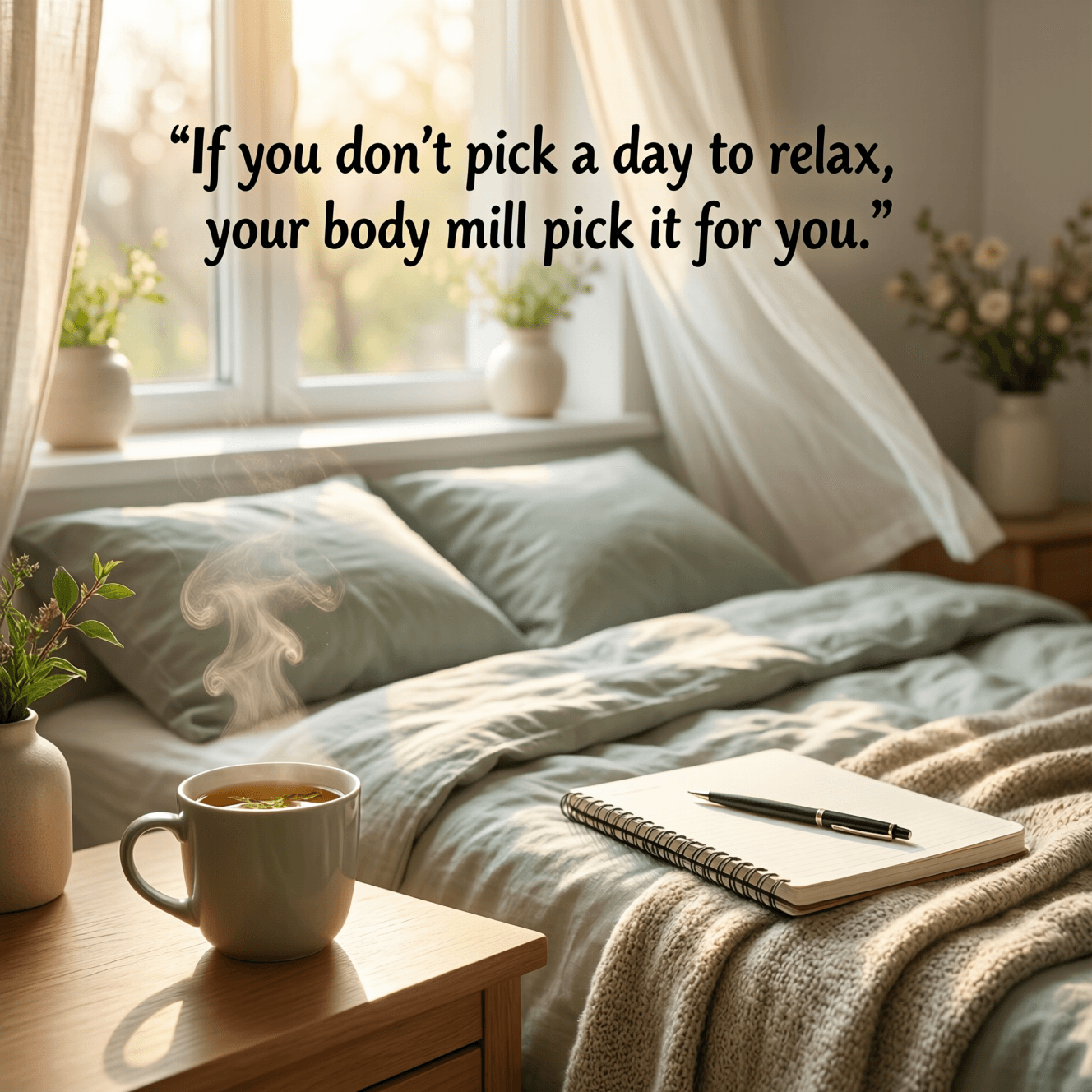
If you don't pick a day to relax, your body will pick it for you. — Courtney Carver
—What lingers after this line?
The Warning Hidden in a Simple Sentence
Courtney Carver’s line reads like friendly advice, but it carries the weight of a warning: rest is not optional in the long run. If we continually postpone recovery, the body will eventually enforce a pause through exhaustion, illness, or injury. In other words, what feels like control—powering through—can quietly become a loss of control when our limits finally assert themselves. From this starting point, the quote reframes relaxation as a decision with consequences rather than a luxury reserved for “when things calm down.” Once you see rest as something that either happens by choice or by breakdown, the urgency to schedule it becomes clearer.
Stress Accumulates Even When You Feel Fine
A key insight behind the quote is that stress doesn’t always announce itself immediately. People often adapt to chronic strain so well that fatigue feels normal, irritability becomes a personality trait, and sleep debt gets treated like ambition. Yet the body is still keeping score, layering tension onto the nervous, immune, and cardiovascular systems. This is why the delayed crash can seem to come “out of nowhere.” What Carver points to is the mismatch between our short-term perception (“I’m managing”) and the body’s long-term accounting (“you’re overdrawing”). Recognizing this gap is often the first step toward treating rest as preventative care.
When the Body ‘Picks the Day’
If relaxation is perpetually deferred, the body may choose a day in blunt ways: a migraine that forces a dark room, a back spasm that makes bending impossible, or a cold that lingers because you never slowed down. These moments can feel like bad luck, but they often function as compelled recovery—an involuntary boundary set by biology. In that light, burnout becomes not just an emotional state but a protective shutdown. Carver’s phrasing captures the irony: the same drive that convinces us we can’t rest today may create a future where we can’t work tomorrow.
Rest as a Form of Responsibility
From here, relaxation shifts from indulgence to stewardship. Choosing a day to rest is a way of maintaining the instrument you rely on for everything else—thinking, caring, producing, and relating. This is especially relevant for people with caregiving roles or high-responsibility jobs, where personal depletion quickly spills into mistakes, impatience, or diminished judgment. Rather than seeing rest as time taken away from duties, the quote suggests rest protects your capacity to meet them. In practical terms, it’s similar to budgeting: regular small deposits prevent catastrophic deficits.
Why Scheduling Rest Actually Works
Carver’s emphasis on “pick a day” highlights that rest often needs structure to survive modern life. If relaxation is left to chance, it competes with louder demands—emails, errands, and the endless sense that something else is more urgent. Scheduling creates a boundary that doesn’t rely on willpower in the moment. This doesn’t have to mean an entire day off; it can be a protected evening, a tech-free morning, or a weekly block that’s treated as non-negotiable. The deeper point is that rest becomes real when it is planned with the same seriousness as work.
A Sustainable Rhythm, Not an Emergency Stop
Ultimately, the quote argues for rhythm over rescue. When relaxation is built into life, it supports steady energy, clearer thinking, and more resilient moods, reducing the odds of forced downtime. Over time, chosen rest can feel less like “falling behind” and more like staying aligned with what the body can realistically sustain. The final takeaway is a quiet kind of agency: you can decide to pause while you still have choices, or you can wait until your body decides for you. Carver invites the former—not as weakness, but as wisdom.
One-minute reflection
Where does this idea show up in your life right now?
Related Quotes
6 selectedDo not let your mind bully your body into believing it must carry the weight of the world. — Astrid Alauda
Astrid Alauda
Astrid Alauda’s quote speaks with the calm urgency of a reminder many people need: the mind can become a harsh taskmaster. It creates stories of obligation, guilt, and endless responsibility, then persuades the body to l...
Read full interpretation →The most loving thing I ever did was say no to things that were killing me slowly. — Prentis Hemphill
Prentis Hemphill
At first glance, Hemphill’s line sounds simple, yet it redefines love as an act of protection rather than mere tenderness. Saying no becomes the deepest form of care when a person recognizes that certain habits, relation...
Read full interpretation →Setting boundaries is the way we care for ourselves. It is not a way to push others away, but a way to keep ourselves whole. — Melody Beattie
Melody Beattie
At its core, Melody Beattie’s statement reframes boundaries as an act of care rather than rejection. People often fear that saying no, asking for space, or naming limits will appear cold; however, Beattie suggests the op...
Read full interpretation →Your body remembers every moment you ignored yourself. Let today be different. — Morgan Harper Nichols
Morgan Harper Nichols
At first glance, Morgan Harper Nichols’s line suggests that the body is more than a physical shell; it is a living archive of our habits, hurts, and silences. Every time a person overrides exhaustion, suppresses grief, o...
Read full interpretation →You are allowed to pause, even if everything feels urgent. — Emily Nagoski
Emily Nagoski
At its core, Emily Nagoski’s line offers something many people rarely grant themselves: permission. In a culture that equates constant motion with worth, the reminder that you may pause—even when everything feels urgent—...
Read full interpretation →Setting boundaries is a way of caring for myself. It doesn't mean I'm mean, selfish, or uncaring because I don't do things your way. — Christine Morgan
Christine Morgan
At its core, Christine Morgan’s quote reframes boundary-setting as an act of care rather than a gesture of distance. To set a boundary is to recognize one’s limits, needs, and emotional capacity, then protect them with h...
Read full interpretation →More From Author
More from Courtney Carver →