
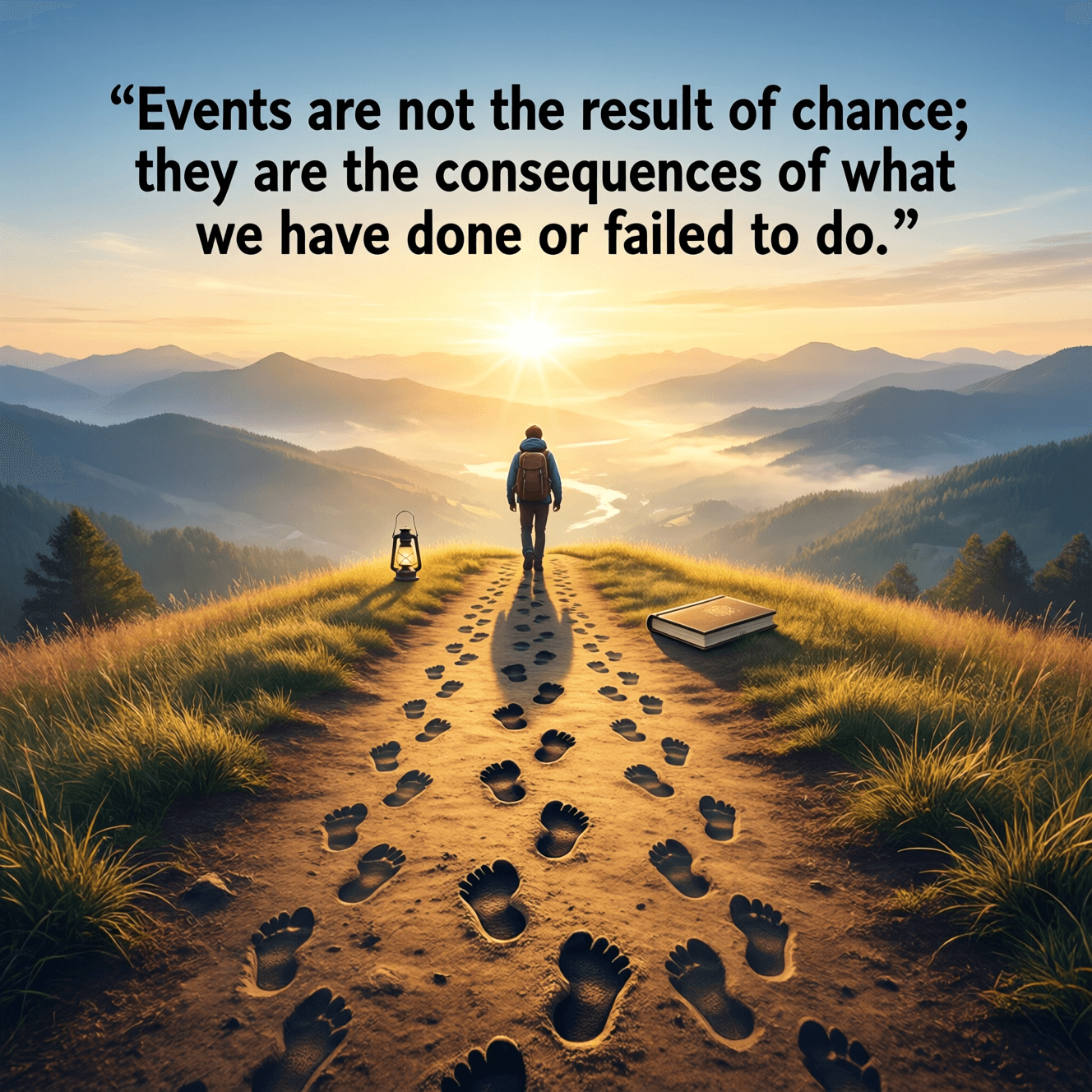
Events are not the result of chance; they are the consequences of what we have done or failed to do. — Naguib Mahfouz
—What lingers after this line?
From Chance to Consequence
Naguib Mahfouz’s line pushes back against the comforting idea that life simply “happens” to us. Instead, it frames events as outcomes—sometimes immediate, sometimes delayed—of choices we make and responsibilities we avoid. While accidents and uncertainty exist, his emphasis lands on the patterns that become visible in hindsight: repeated decisions, tolerated problems, and neglected duties often set the stage for what later feels like fate. This shift from chance to consequence is not meant to erase complexity; rather, it invites a more accountable reading of experience. If events carry the imprint of our actions, then our future is at least partly editable—because it can be influenced by what we do next.
The Power of What We Fail to Do
Mahfouz notably includes “failed to do,” highlighting omission as a force as real as commission. Not setting boundaries, not preparing, not speaking up, not repairing a relationship—these absences can accumulate quietly until they become a crisis that seems sudden. In everyday life, a health emergency can follow years of ignored checkups; a work collapse can follow months of unaddressed bottlenecks. This emphasis also explains why consequences often feel unfair: omissions are easier to forget, because nothing “happened” at the moment of neglect. Yet, as time passes, the cost of inaction emerges as an event with its own undeniable weight.
Moral Causality and Personal Responsibility
Moving from practical to ethical meaning, the quote implies a moral dimension: we are not merely spectators of our lives but participants whose choices leave traces. This resonates with classical ideas of character and habit, where repeated actions become dispositions that shape outcomes; Aristotle’s *Nicomachean Ethics* (4th century BC) argues that virtue is formed through practice, suggesting that what we repeatedly do becomes what we reliably experience. In this view, responsibility is not a burden added after the fact but a lens for understanding why certain “events” recur. Mahfouz’s statement is less about blame than about agency: if our conduct contributes to outcomes, we can also change our conduct to change outcomes.
Society’s Events as Collective Outcomes
Mahfouz, writing with a novelist’s sensitivity to social life, can also be read collectively: public events are often the compound interest of shared decisions and tolerated injustices. Policies enacted, corruption ignored, education neglected, or voices silenced do not remain abstract—they produce lived consequences that later look like sudden upheavals. This collective angle widens the quote beyond self-help into civic realism. When communities ask how a crisis emerged, the answer is frequently not a single villain or a random twist, but a long record of choices and non-choices distributed across institutions and citizens alike.
Why Consequences Feel Like Fate
A key reason events appear random is that causation can be indirect and delayed. Small decisions—avoiding a difficult conversation, postponing a repair, excusing a harmful habit—may not show effects until they intersect with stress, scarcity, or external shocks. By the time the event arrives, the chain that produced it is hard to reconstruct, so “chance” becomes the easiest label. Yet, once we see how feedback loops work, the quote becomes clearer: what feels like fate is often the moment when long-running causes finally surface. Recognizing this doesn’t eliminate uncertainty, but it reduces the mystery around recurring patterns.
Turning the Insight into a Practical Method
Finally, Mahfouz’s idea can be used as a tool: when an event occurs, ask what actions, incentives, and omissions preceded it—without rushing to self-condemnation. This is the logic behind after-action reviews and root-cause analysis: instead of treating outcomes as flukes, we map decisions and gaps, then adjust systems and habits accordingly. The hopeful implication is that accountability can be creative. If today’s events reflect yesterday’s choices, then tomorrow’s events can reflect today’s wiser ones—small, consistent acts of attention replacing the costly momentum of neglect.
One-minute reflection
Where does this idea show up in your life right now?
Related Quotes
6 selectedSuccess is not earned by chance but by the choices we make. — Anonymous
Unknown
This quote emphasizes that achieving success is a result of deliberate and thoughtful actions rather than random luck or fortune.
Read full interpretation →Actions are the seed of fate; deeds grow into destiny. — Harry S. Truman
Harry S. Truman
This quote emphasizes that our actions play a crucial role in shaping our future. Just as seeds grow into trees, the actions we take can lead to significant outcomes in our lives.
Read full interpretation →We are not victims of our impulses or emotions; we have the power to control them. It is time to relinquish the excuses. — Allie Brosh
Allie Brosh
At its core, Allie Brosh’s quote rejects the comforting idea that emotions and impulses are irresistible forces. Instead, it insists that human beings possess agency: the ability to pause, choose, and act deliberately ev...
Read full interpretation →My will shall shape my future. Whether I fail or succeed shall be no man's doing but my own. — Elaine Maxwell
Elaine Maxwell
At its core, Elaine Maxwell’s statement is a declaration of personal agency. By saying that her will shall shape her future, she rejects the idea that destiny is merely handed down by circumstance, luck, or the judgments...
Read full interpretation →You cannot build a life of meaning on a foundation of excuses. Your circumstances are the starting point, not the excuse for staying still. — David Goggins
David Goggins
At its core, David Goggins’s statement redraws the map between hardship and identity. He does not deny that circumstances can be painful, unfair, or limiting; instead, he insists they are only the opening conditions of a...
Read full interpretation →If it is to be, it is up to me. — William H. Johnsen
William H. Johnsen
At first glance, William H. Johnsen’s line compresses an entire philosophy into a few plain words: desired outcomes do not arrive by wish alone, but through personal action.
Read full interpretation →More From Author
More from Naguib Mahfouz →Build a life of honest labor and the city of your soul will shine. — Naguib Mahfouz
Mahfouz frames the inner life as a “city,” implying streets, foundations, and long-term maintenance rather than a single grand revelation. A city becomes livable through countless ordinary tasks—cleaning, repairing, buil...
Read full interpretation →Turn your questions into action; curiosity is the engine of change. — Naguib Mahfouz
Mahfouz’s line compresses a whole philosophy: inquiry should not idle in abstraction; it must set reality in motion. As a novelist of Cairo’s tight alleys and wide upheavals, he knew that small questions unsettle settled...
Read full interpretation →Find the lesson in hardship, then use it to design new doors, not new walls. — Naguib Mahfouz
Mahfouz’s line reframes adversity as a design brief: extract the insight, then build openings—not barricades. A “wall” is a reflex of fear, meant to shut out future pain; a “door” is a deliberate structure that channels...
Read full interpretation →Act as if you are unafraid of the storms, for they only make you stronger. — Naguib Mahfouz
The quote encourages facing challenges with courage and perseverance. Difficulties in life, like storms, test one's strength and character, ultimately leading to personal growth.
Read full interpretation →