
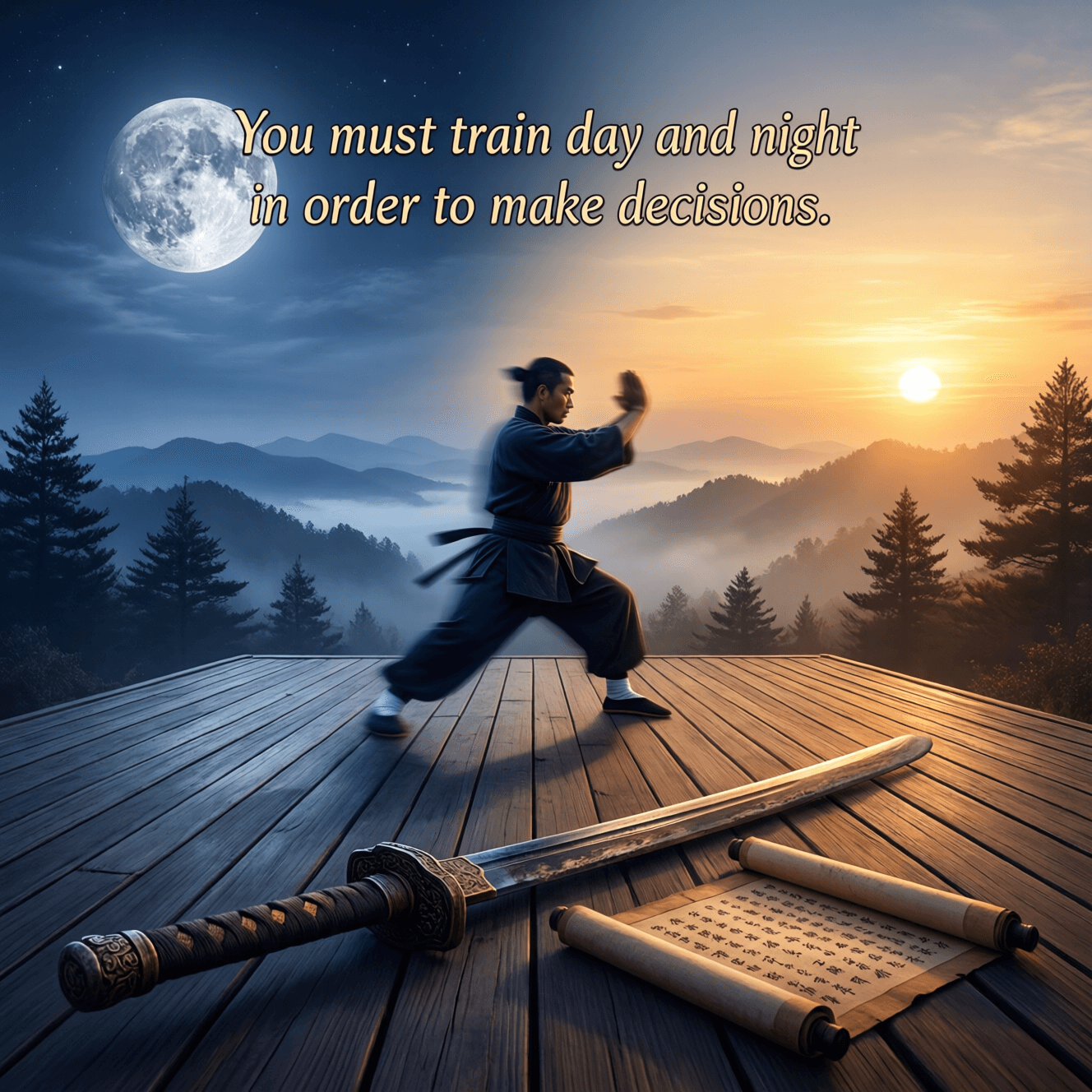
You must train day and night in order to make decisions. — Miyamoto Musashi
—What lingers after this line?
Musashi’s Core Claim: Preparedness Becomes Choice
Miyamoto Musashi’s line compresses a lifetime of martial experience into a single principle: sound decisions are not improvised—they are earned. When he says you must train “day and night,” he points to a kind of preparation so constant that it reshapes how you perceive options under pressure. Decision-making, in this view, is less a moment of cleverness than the visible tip of an invisible routine. From there, the quote reframes “choice” as a skill rather than a trait. If judgment is trainable, then hesitation, confusion, and panic are not simply personality flaws; they are signals that practice has not yet reached the depth required to make clarity automatic.
The Discipline of Continuity
The phrase “day and night” also matters because it implies continuity rather than sporadic effort. Musashi is not advocating occasional bursts of motivation; he is describing a life organized around repeated refinement, where learning does not end when conditions are comfortable. That constancy matters because decisions often arrive when conditions are worst—fatigue, uncertainty, time pressure. As a result, training is not only about improving technique but about normalizing difficulty. When discomfort becomes familiar through repetition, you can respond with steadier judgment because your mind has already practiced operating without ideal conditions.
Decisions Under Stress: From Thought to Reflex
Musashi’s demand for relentless practice suggests that the highest-quality decisions are those you can still make when thinking becomes expensive. In combat—and in many modern analogues like surgery, aviation, or crisis management—the time available for deliberation collapses. Training “day and night” builds patterns of recognition so that your response emerges quickly, without being careless. This is why tradition often treats drills as more than rote repetition: they build a library of situations. When a real moment arrives, you are not searching for an answer; you are selecting from rehearsed possibilities, and that selection is what looks like decisive intelligence.
Cultivating Perception: Seeing the Whole Field
Relentless training also changes what you notice. With enough repetition, details that once required conscious attention—timing, distance, posture, sequencing—become perceptual “givens.” Then your mind can widen outward to strategy rather than being trapped in mechanics. In Musashi’s terms, this is the difference between merely performing a move and understanding the situation that makes one move correct and another disastrous. Consequently, better decisions follow better perception. The trained person sees earlier, detects shifts sooner, and can act before a problem becomes obvious to everyone else.
Training as Moral and Psychological Conditioning
Musashi’s prescription is not only technical; it is psychological. Training hard at all hours teaches you to endure boredom, frustration, and fear without letting them steer the wheel. That matters because many poor decisions are not caused by ignorance, but by emotional leakage—ego, impatience, the need to prove oneself, or the urge to escape discomfort. By repeatedly meeting difficulty in practice, you reduce the novelty of pressure and the seduction of impulsive relief. Over time, composure becomes a trained habit, and decisions become less reactive because the inner storm has less authority.
Turning the Principle into a Daily Method
Applied beyond the sword, Musashi’s advice becomes a blueprint: if you want better decisions, make training continuous and specific to the choices you face. That might mean rehearsing scenarios, reviewing failures, practicing fundamentals until they are boringly reliable, and seeking feedback even when you would rather be praised. Like a fighter repeating footwork, a leader might repeat difficult conversations; like a strategist studying opponents, a professional might study past incidents and near-misses. In the end, the quote closes the loop: the “decision” is merely the public moment. The private life of repeated training—day and night—is what quietly determines whether that moment will be wise.
One-minute reflection
What's one small action this suggests?
Related Quotes
6 selectedWhatever you do in life, choose a theme that grounds your decisions when things feel noisy. — Erica Diamond
Erica Diamond
At its core, Erica Diamond’s quote argues that life becomes clearer when guided by a central theme rather than by scattered impulses. That theme might be integrity, service, creativity, or peace, but its real function is...
Read full interpretation →It is a good idea always to do something relaxing prior to making an important decision in your life. — Paulo Coelho
Paulo Coelho
Paulo Coelho’s remark begins with a simple but powerful premise: important decisions are rarely improved by agitation. When the mind is tense, it tends to confuse urgency with clarity, pushing us toward choices made out...
Read full interpretation →The hard part isn’t making the decision. It’s living with it. — Michael J. Fox
Michael J. Fox
Michael J. Fox’s line shifts attention away from the dramatic moment of choice and toward the quieter, longer struggle that follows.
Read full interpretation →Clarity about the destination makes everything else negotiable. — Doran Gao
Doran Gao
Doran Gao’s line begins with a simple but powerful claim: once the destination is clear, many other decisions lose their rigidity. In other words, certainty about where one wants to go creates freedom in how to get there...
Read full interpretation →Only those who have the patience to do simple things perfectly ever acquire the skill to do difficult things easily. — James J. Corbett
James J. Corbett
At first glance, Corbett’s remark seems to praise modest discipline, yet it points to something deeper: greatness begins with a willingness to repeat basic actions until they become exact. Simple things are rarely truly...
Read full interpretation →Skill is only developed by hours and hours of work. — Usain Bolt
Usain Bolt
Usain Bolt’s line strips skill down to its most unglamorous ingredient: accumulated hours. Rather than presenting excellence as a sudden gift, he frames it as a visible outcome of invisible labor—the uncounted repetition...
Read full interpretation →More From Author
More from Miyamoto Musashi →There is nothing outside of yourself that can ever enable you to get better, stronger, richer, or smarter. — Miyamoto Musashi
Miyamoto Musashi’s line begins by stripping away a common hope: that some external thing—money, teachers, circumstances, even luck—will finally “enable” a person to improve. Instead, he argues that the decisive source of...
Read full interpretation →Today is victory over yourself of yesterday; tomorrow is your victory over lesser men. — Miyamoto Musashi
Musashi’s line opens by redefining “victory” as an inward contest rather than a public spectacle. Instead of measuring success by applause, rank, or trophies, he points to a quieter benchmark: whether you are stronger, w...
Read full interpretation →Do nothing which is of no use. — Miyamoto Musashi
Miyamoto Musashi’s line, “Do nothing which is of no use,” reads like a blunt filter for everyday life: if an action doesn’t serve a real aim, drop it. Rather than celebrating busyness, he points to a stricter standard—us...
Read full interpretation →Think lightly of yourself and deeply of the world. — Miyamoto Musashi
This quote advises individuals to avoid becoming overly focused on their own self-importance or ego. By 'thinking lightly of yourself,' it suggests practicing humility and not overinflating one's own significance.
Read full interpretation →