
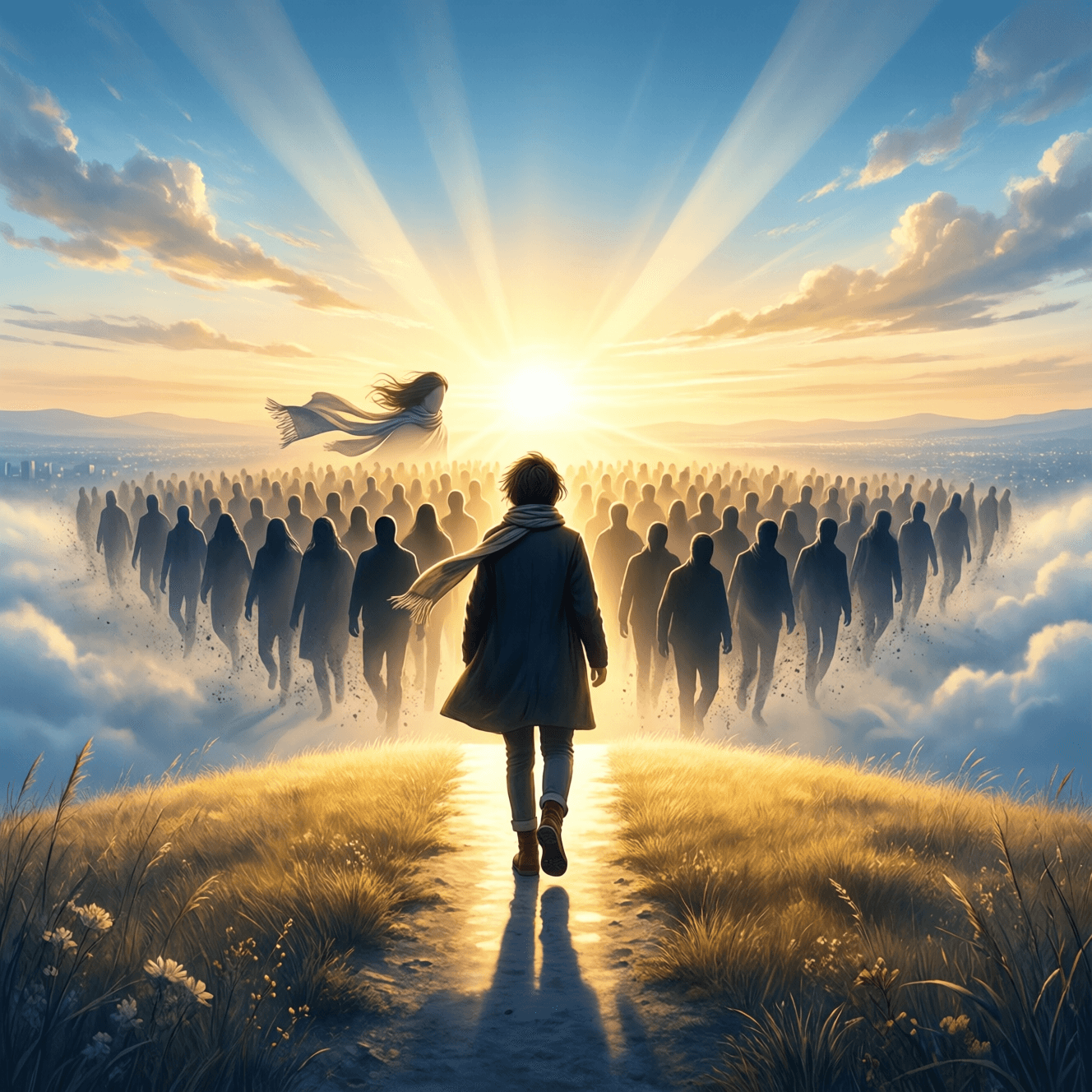
You cannot be free until you are no longer a slave to the opinions of people who don't even know who you are. — Nawal El Saadawi
—What lingers after this line?
Freedom as an Inner Condition
Nawal El Saadawi frames freedom less as a legal status and more as an internal state: you may move without chains and still live as if restrained. The quote points to a quieter captivity—measuring your worth by judgments that were never informed by your real life, struggles, or character. From there, her insight pushes the reader to ask what “freedom” actually means day to day. If your decisions are filtered through imagined reactions, then your autonomy is partially outsourced, and liberation becomes the work of reclaiming your own authority over your choices.
The Trap of Uninformed Judgment
The sharpest edge of the statement is that the people whose opinions imprison you “don’t even know who you are.” Their judgments are often based on fragments: a single mistake, a rumor, a social role, or a stereotype. In that sense, you are reacting not to knowledge but to projection. This leads naturally to the realization that many social verdicts are less about you and more about the observer’s fears and expectations. When you treat these verdicts as definitive, you accept a verdict rendered in a court that never heard your testimony.
Social Approval as a Form of Control
Once outside opinion becomes your compass, it begins to function like a control system: reward arrives as approval, punishment as rejection. El Saadawi, whose writing challenged patriarchal authority in works like *Woman at Point Zero* (1975), repeatedly illustrated how society disciplines people—especially women—into silence through shame and reputational threat. Consequently, the quote reads as a warning about governance by mood and gossip. When the crowd’s reaction becomes the measure of safety, conformity can feel like survival, even when it costs your integrity.
Identity Without an Audience
If the opinions are uninformed, then the task becomes separating your identity from the audience watching you. That separation is not indifference or arrogance; it is discernment—deciding whose feedback is grounded in care, knowledge, and accountability. A mentor who knows your work is different from a stranger who knows your label. In practice, this shift can be small but radical: choosing a career path your family doesn’t understand, speaking with your natural accent in a room that pressures you to perform, or admitting you’ve changed your mind. Step by step, self-definition replaces performance.
Reclaiming the Right to Be Misunderstood
El Saadawi’s line also implies a hard truth: freedom includes the possibility of being disliked, misread, or criticized. If you require universal understanding before acting, you will wait forever, because strangers do not owe you nuance. What you can claim, however, is the right not to let their misunderstanding rule your life. This is where courage becomes practical. You learn to tolerate discomfort—an awkward silence, a raised eyebrow, a dismissive comment—without treating it as an emergency. Over time, the fear of judgment loses its power because it is no longer treated as a verdict on your value.
A Measured Way to Live Free
Finally, the quote does not demand that you ignore all opinions; it invites you to stop being enslaved by the wrong ones. Freedom grows when you privilege feedback from people who know you, share your stakes, and can point to evidence—while letting anonymous or superficial judgments pass without becoming internal law. In that spirit, El Saadawi’s message becomes a guide for daily life: choose your reference points carefully, build self-respect that doesn’t depend on applause, and allow your decisions to reflect your convictions rather than the noise of spectators.
One-minute reflection
Where does this idea show up in your life right now?
Related Quotes
6 selectedGive up defining yourself—to yourself or to others. You won't die. You will come to life. — Eckhart Tolle
Eckhart Tolle
At its core, Eckhart Tolle’s statement urges us to loosen our grip on the identities we constantly construct. We define ourselves through profession, status, history, beliefs, and even wounds, imagining that these descri...
Read full interpretation →The best day of your life is the one on which you decide your life is your own. No apologies or excuses. — Elaine Maxwell
Elaine Maxwell
Elaine Maxwell’s quote frames transformation not as something that happens to us, but as a decision we make. The ‘best day’ is not defined by luck, wealth, or praise; instead, it begins when a person accepts full ownersh...
Read full interpretation →Discipline is not about being harsh with yourself; it is about aligning your actions with your purpose. It is a quiet form of freedom. — Ryan Holiday
Ryan Holiday
At first glance, discipline is often mistaken for punishment, deprivation, or relentless self-criticism. Ryan Holiday’s quote overturns that assumption by presenting discipline as a gentler, more intentional force: the p...
Read full interpretation →If you want to be free, be free. If you are chained, you are chained. But don't tell me you are free while wearing shackles. — Khalil Gibran
Khalil Gibran
Gibran’s words begin with a blunt distinction: freedom is real, and bondage is real, but confusion between them is a form of dishonesty. He is not merely speaking about physical captivity; rather, he is confronting the h...
Read full interpretation →I'll tell you what freedom is to me: no fear. I mean really, no fear! — Nina Simone
Nina Simone
Nina Simone’s line refuses abstractions and replaces them with something bodily and immediate: fearlessness. By saying “I’ll tell you what freedom is to me,” she frames freedom not as a slogan or a legal condition but as...
Read full interpretation →We are doing ourselves no favors when we look to the crowd to tell us where we are. — Erin Loechner
Erin Loechner
Erin Loechner’s line points to a quiet habit many of us treat as normal: using other people’s reactions to locate our worth, success, or direction. When we “look to the crowd,” we hand over the compass, letting likes, pr...
Read full interpretation →More From Author
More from Nawal El Saadawi →I am not afraid of anything. I am only afraid of being afraid. — Nawal El Saadawi
Nawal El Saadawi’s statement opens with an almost defiant certainty—“I am not afraid of anything”—only to pivot toward a more intimate vulnerability: she fears “being afraid.” That turn matters, because it distinguishes...
Read full interpretation →They said, 'You are a savage and dangerous woman.' I am speaking the truth. And the truth is savage and dangerous. — Nawal El Saadawi
In Nawal El Saadawi’s line, the insult—“savage and dangerous”—arrives as a social verdict meant to isolate and tame her. Rather than soften herself to regain approval, she reverses the charge: if she is dangerous, it is...
Read full interpretation →When the world says 'impossible', respond with steady practice and kind resolve — Nawal El Saadawi
Nawal El Saadawi’s line begins where many struggles start: not with an inner limit, but with an external judgment. “The world” here is less the planet than the chorus of institutions, customs, and casual voices that decl...
Read full interpretation →The canvas of life is shaped by our choices. — Nawal El Saadawi
This quote emphasizes that our lives are the result of the choices we make. Every decision contributes to shaping the path we follow, much like how an artist creates a painting with deliberate strokes.
Read full interpretation →