
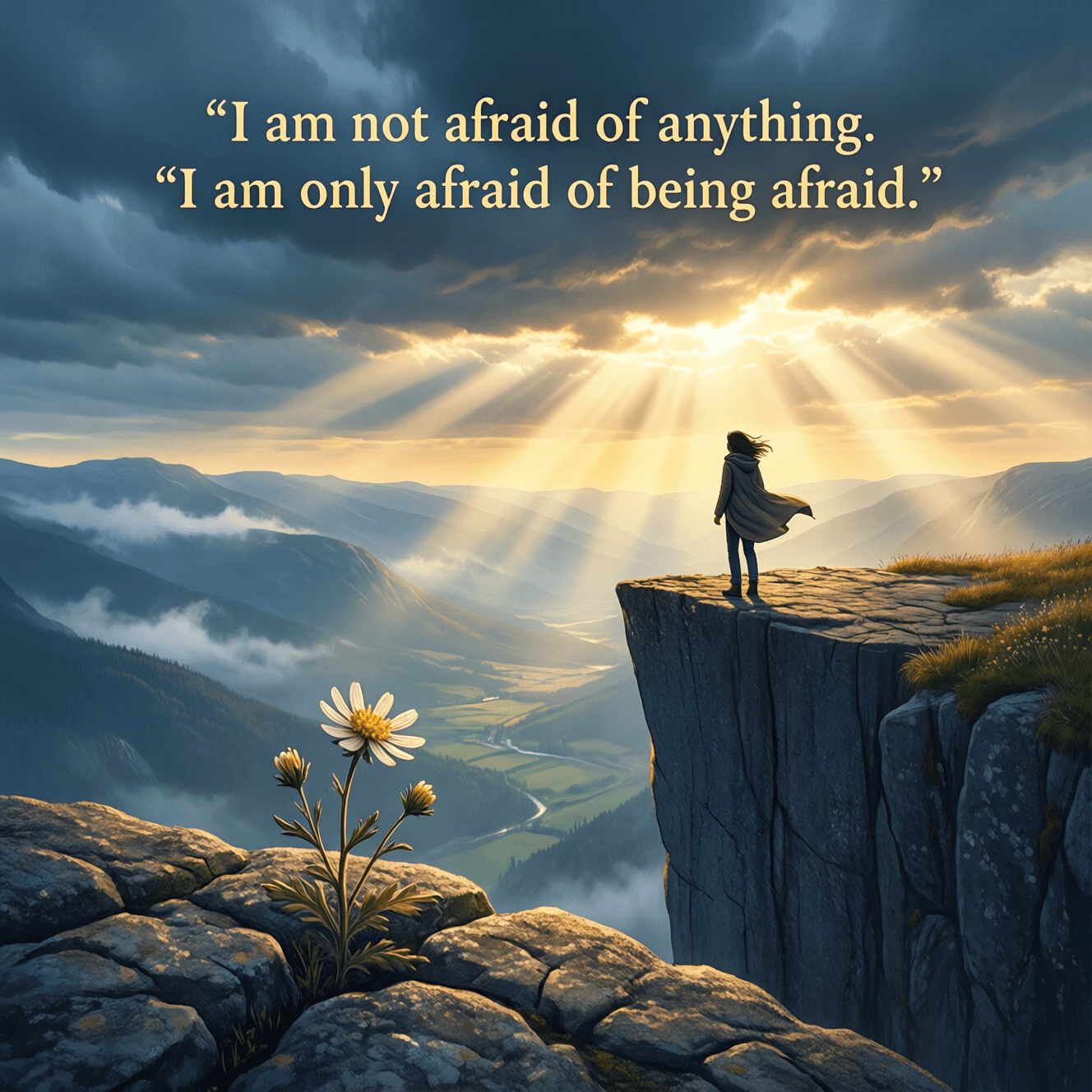
I am not afraid of anything. I am only afraid of being afraid. — Nawal El Saadawi
—What lingers after this line?
A Bold Claim with a Subtle Twist
Nawal El Saadawi’s statement opens with an almost defiant certainty—“I am not afraid of anything”—only to pivot toward a more intimate vulnerability: she fears “being afraid.” That turn matters, because it distinguishes external threats from the internal state that can shrink a person’s life before any danger even arrives. In other words, the quote isn’t a denial of reality; it’s a refusal to let fear govern perception and choice. By naming fear itself as the enemy, El Saadawi frames courage not as invincibility, but as a disciplined relationship to one’s own emotions.
Fear as a Second-Order Prison
Moving deeper, the line highlights a “second-order” fear: not the fear of a particular event, but the fear of experiencing fear. This is the kind of anticipatory dread that multiplies suffering—worrying about panic, worrying about weakness, worrying about how fear might expose you. As a result, people may start avoiding the very arenas where life happens—public speaking, intimacy, confrontation, activism—because the sensation of fear feels like failure. El Saadawi’s phrasing suggests a strategy: treat fear as a passing signal, not a verdict on your character.
Psychology’s Name for the Spiral
In psychological terms, fear of fear resembles what clinicians call anxiety sensitivity: the tendency to interpret anxiety symptoms as dangerous in themselves. Panic disorder models often describe a feedback loop where bodily cues (racing heart, short breath) are misread as catastrophe, intensifying fear and producing more symptoms in return. Consequently, El Saadawi’s insight reads like a compressed therapeutic principle: the sensation is not the same as the threat. When fear is no longer treated as proof of impending ruin, it loses much of its power to escalate.
Courage as Agency, Not Absence
From there, the quote nudges us toward a practical definition of courage: the capacity to act while afraid. This aligns with the long-standing view that bravery is not the lack of fear but the choice to proceed despite it, a theme echoed in Stoic thought where emotions arise but need not command assent (Epictetus’ Discourses, c. 108 AD, repeatedly distinguishes impressions from judgments). Thus, fearing “being afraid” becomes the real obstacle because it denies agency. If fear is permitted to exist without shame, action becomes possible again—imperfect, trembling, but real.
A Feminist and Political Undertone
El Saadawi’s life and work as an Egyptian physician, writer, and feminist make the quote resonate beyond the personal. In many oppressive systems, fear is not incidental; it is cultivated—through stigma, punishment, and the constant suggestion that dissent will cost too much. The deepest control happens when people internalize that warning and begin policing themselves. Seen in that light, the “fear of being afraid” is also the fear of becoming governable from the inside. Refusing it becomes a political act: reclaiming the inner territory where decisions are made.
Practicing Freedom from Fear of Fear
Finally, the quote hints at a trainable skill: learning to experience fear without surrendering to it. Methods like gradual exposure in CBT aim precisely at this—repeatedly entering feared situations until fear becomes tolerable rather than decisive. Even simple practices such as labeling the emotion (“this is fear”), slowing breath, and choosing one small next step can weaken the reflex to flee. Over time, the goal is not a fearless life, but a larger one. When being afraid is no longer treated as an emergency, fear can appear and pass—while you continue forward.
One-minute reflection
Why might this line matter today, not tomorrow?
Related Quotes
6 selectedEmbrace your fears, for they are the steps that lead you to your greatest growth. — Aria L. Haven
Aria L. Haven
This quote encourages individuals to confront their fears rather than avoiding them. By facing challenges head-on, one can develop resilience and learn valuable life lessons.
Read full interpretation →Your fear is 100% dependent on you for its survival. — Steve Maraboli
Steve Maraboli
This quote emphasizes that fear is a construct of the mind, reliant on one's perception. By changing the way we perceive situations, we have the power to diminish or eradicate our fears.
Read full interpretation →We cannot be more connected to others than we are to ourselves. — Brené Brown
Brené Brown
Brené Brown’s statement begins with a simple but demanding truth: our relationships with others are limited by the relationship we have with ourselves. If we are estranged from our own feelings, needs, and fears, then ou...
Read full interpretation →You don't have to bully yourself out of feeling fear. You just have to move while it's still there. — Annie Wright
Annie Wright
At its core, Annie Wright’s quote challenges the common belief that courage begins only after fear has disappeared. Instead, it reframes fear as something that can accompany action rather than prevent it.
Read full interpretation →The economy can take your money. A crisis can take your opportunities. But fear can take your judgment—and that is the loss most people never recover from. — Epictetus
Epictetus
At first glance, this saying draws a sharp line between what happens to us and what happens within us. Money can vanish in a recession, and opportunities can disappear when markets collapse, yet Epictetus argues that the...
Read full interpretation →We must look at the lens through which we see the world, as well as the world we see. — Sarah Ban Breathnach
Sarah Ban Breathnach
Sarah Ban Breathnach’s line reminds us that perception is never a simple act of receiving reality; it is also an act of interpretation. We do not merely look outward at events, people, and circumstances—we also look thro...
Read full interpretation →More From Author
More from Nawal El Saadawi →You cannot be free until you are no longer a slave to the opinions of people who don't even know who you are. — Nawal El Saadawi
Nawal El Saadawi frames freedom less as a legal status and more as an internal state: you may move without chains and still live as if restrained. The quote points to a quieter captivity—measuring your worth by judgments...
Read full interpretation →They said, 'You are a savage and dangerous woman.' I am speaking the truth. And the truth is savage and dangerous. — Nawal El Saadawi
In Nawal El Saadawi’s line, the insult—“savage and dangerous”—arrives as a social verdict meant to isolate and tame her. Rather than soften herself to regain approval, she reverses the charge: if she is dangerous, it is...
Read full interpretation →When the world says 'impossible', respond with steady practice and kind resolve — Nawal El Saadawi
Nawal El Saadawi’s line begins where many struggles start: not with an inner limit, but with an external judgment. “The world” here is less the planet than the chorus of institutions, customs, and casual voices that decl...
Read full interpretation →The canvas of life is shaped by our choices. — Nawal El Saadawi
This quote emphasizes that our lives are the result of the choices we make. Every decision contributes to shaping the path we follow, much like how an artist creates a painting with deliberate strokes.
Read full interpretation →