
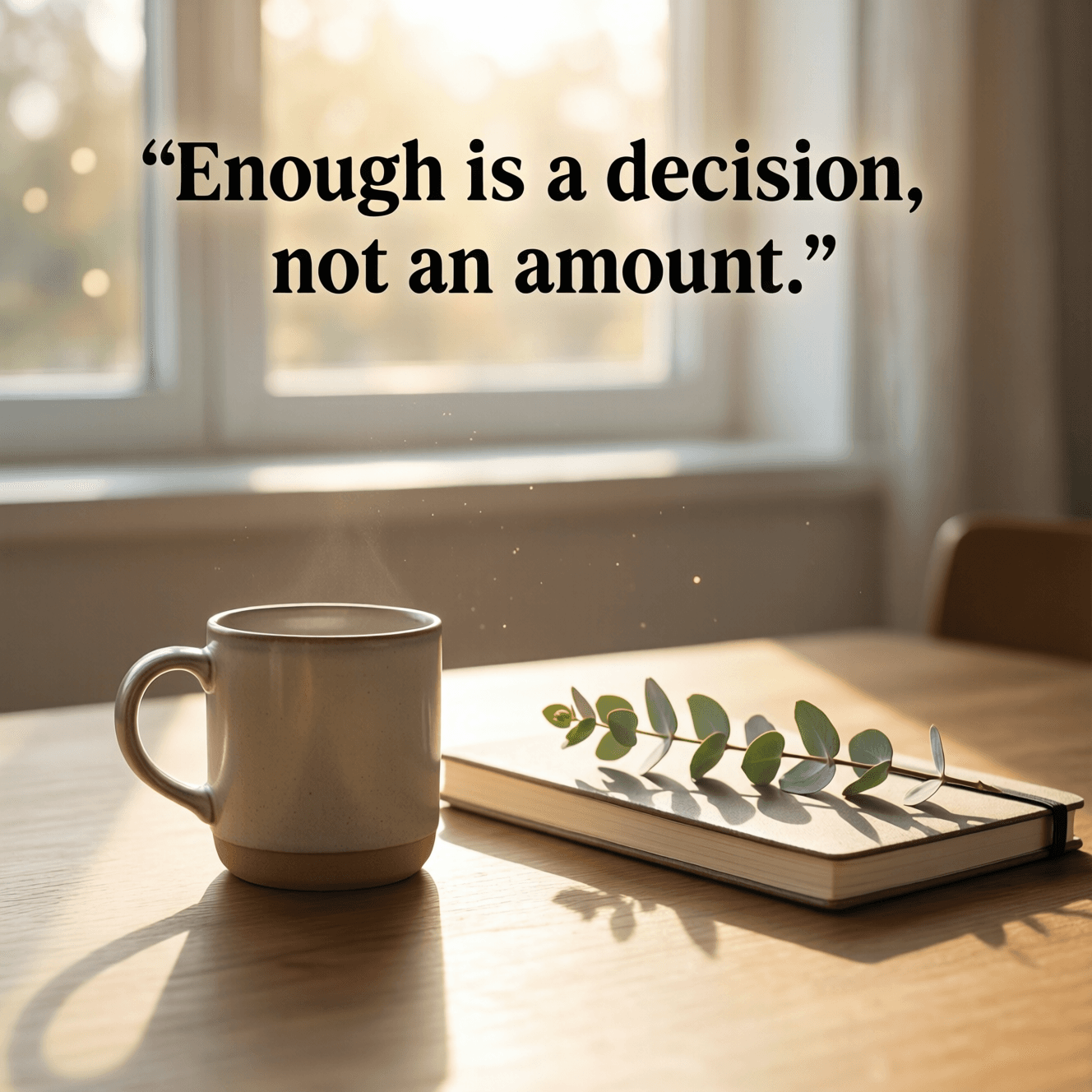
Enough is a decision, not an amount. — Alison Faulkner
—What lingers after this line?
Redefining “Enough” as a Choice
Alison Faulkner’s line reframes “enough” from a quantity you reach into a stance you take. Instead of treating satisfaction as something that arrives when the numbers finally add up—more money, more praise, more progress—she suggests it begins the moment you decide to stop negotiating with your own needs. From that starting point, the quote quietly shifts power back to the individual: if “enough” is a decision, then you can practice it even before circumstances change. This doesn’t deny real constraints; rather, it highlights that the inner boundary is often more decisive than the outer tally.
The Moving Goalpost Problem
Once “enough” is defined as an amount, it becomes vulnerable to constant revision. Achievements raise expectations, comparisons inflate desires, and yesterday’s milestone becomes today’s baseline. In this way, measuring enough by accumulation sets up a perpetual chase where satisfaction remains just beyond reach. Seen through Faulkner’s lens, the moving goalpost is not merely bad luck—it’s a predictable outcome of outsourcing contentment to metrics. By contrast, treating enough as a decision interrupts the cycle, because the finish line is no longer dependent on what the world rewards or what someone else has.
Identity, Comparison, and the “More” Reflex
Comparison makes “enough” feel illegitimate, as if it must be justified in public. Social signals—titles, lifestyles, curated success—encourage the reflex that more is safer than satisfied, and that wanting less is a form of losing. Yet the quote implies that enough is not a verdict on your worth; it’s a boundary that protects it. Building on that idea, deciding “enough” can also be an act of identity: choosing what matters most and letting other standards fade. When you stop using other people’s scorecards, you regain the ability to define a life that fits rather than one that merely impresses.
Enough as a Boundary With Time and Energy
The decision of enough shows up most clearly in non-numerical places: time, attention, and emotional bandwidth. A person may realize that another late-night email, another volunteer role, or another round of perfectionism isn’t a badge of dedication—it’s the quiet erosion of health and relationships. From there, “enough” becomes practical. It can sound like, “This is the level of effort that is sustainable,” or “This is the standard that serves the purpose.” The quote’s strength is that it treats boundaries not as scarcity, but as deliberate design.
Desire Without Dependence
Deciding enough doesn’t require rejecting ambition; it requires separating ambition from desperation. You can pursue growth while refusing to make future achievement the entry fee for present peace. In that sense, “enough” becomes a foundation: you build from wholeness instead of striving to earn it. This distinction matters because it changes the emotional tone of effort. When “enough” is already decided, progress becomes creative rather than compulsive, and setbacks become information rather than proof that you are lacking.
Practicing the Decision Daily
Because culture constantly sells “more,” the decision of enough often needs repetition. Small rituals can reinforce it: defining what “done” means before starting, setting a stopping time, choosing a spending limit that reflects values, or naming the trade-off you are unwilling to make. Over time, these choices accumulate into a lived philosophy: you are not waiting for enough to happen—you are choosing it on purpose. In that closing insight, Faulkner’s quote becomes less a slogan than a strategy for living with clarity and steadiness.
One-minute reflection
What does this quote ask you to notice today?
Related Quotes
6 selectedI have learned that to be with those I like is enough. — Walt Whitman
Walt Whitman
Whitman’s line reduces happiness to something disarmingly plain: the presence of beloved company. Rather than chasing wealth, status, or elaborate pleasures, he suggests that being with people one genuinely likes can alr...
Read full interpretation →I will get there, but now I'm here, and here is wonderful. — Jenny Offill
Jenny Offill
Jenny Offill’s line gently overturns the modern obsession with destinations. At first, “I will get there” acknowledges ambition and movement, yet the sentence immediately returns us to the present: “but now I’m here.” In...
Read full interpretation →Don't go expecting perfection; be satisfied with even the smallest progress. — Marcus Aurelius
Marcus Aurelius
Marcus Aurelius advises against the exhausting demand for flawlessness and redirects attention toward modest improvement. In the spirit of Stoic thought, especially in his Meditations (c.
Read full interpretation →A crust eaten in peace is better than a banquet partaken in anxiety. — Aesop
Aesop
At first glance, Aesop’s saying contrasts two meals, yet its real subject is the quality of life surrounding them. A dry crust seems poor beside a banquet, but once peace enters the comparison, the values reverse.
Read full interpretation →The secret of happiness is to admire without desiring. — Carl Sandburg
Carl Sandburg
Carl Sandburg’s line reframes happiness as an attitude rather than an acquisition. To admire without desiring means recognizing beauty, excellence, or joy in the world without immediately trying to possess it.
Read full interpretation →The slower the living, the greater the sense of fullness and satisfaction. — Ann Voskamp
Ann Voskamp
Ann Voskamp’s line proposes a quiet reversal of modern values: instead of equating a full life with a crowded schedule, she links fullness to slowness. At first glance, this seems countercultural, even impractical, becau...
Read full interpretation →More From Author
More from Alison Faulkner →