
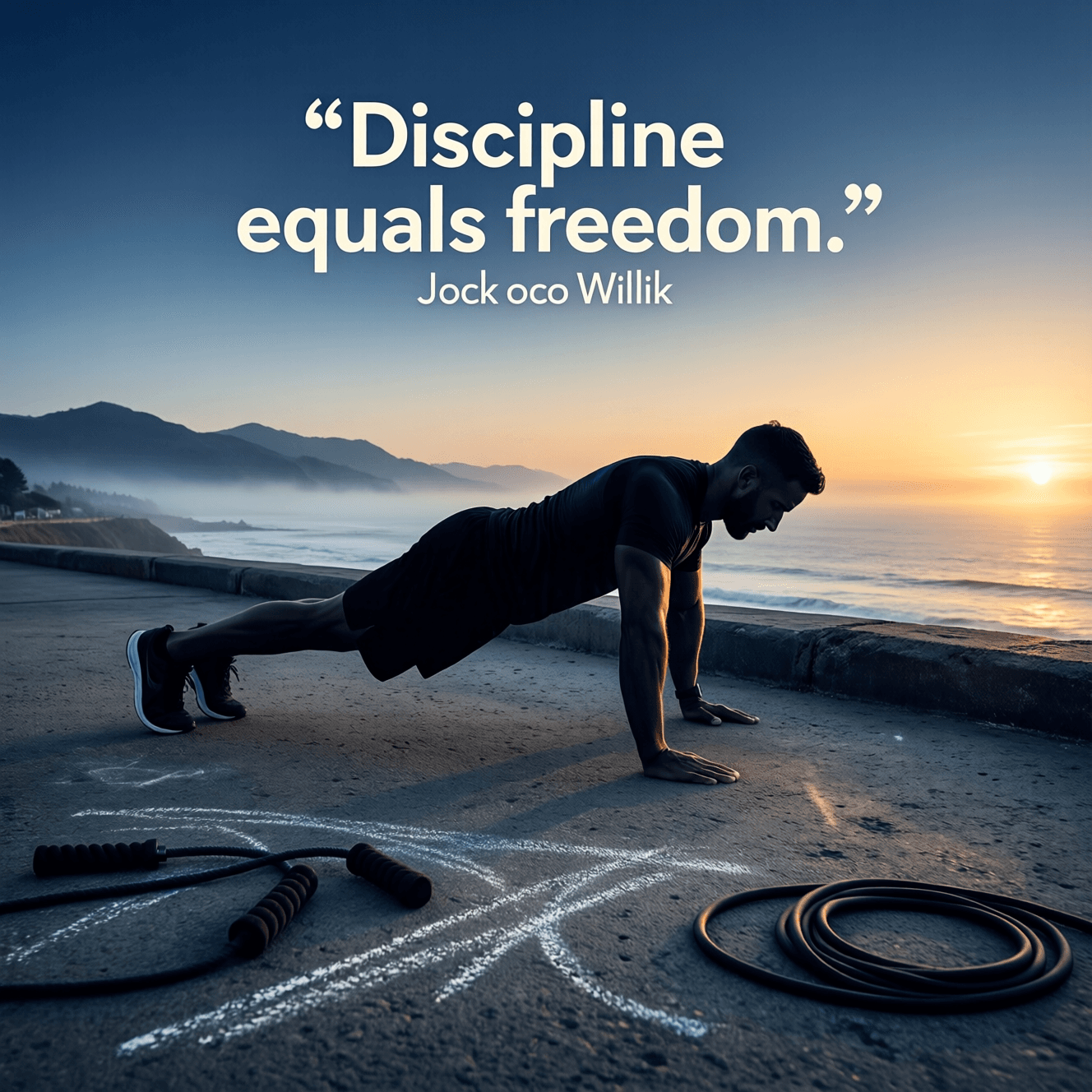
Discipline equals freedom. — Jocko Willink
—What lingers after this line?
The Apparent Contradiction
“Discipline equals freedom” initially sounds like a paradox because discipline is often associated with restriction, while freedom suggests the absence of constraint. Yet Jocko Willink’s line flips that assumption, implying that structure is not the enemy of autonomy but its prerequisite. In other words, what feels limiting in the moment can widen your options later. To see the logic, consider how small, repeated choices compound. When you choose a disciplined action—getting up on time, finishing a task, keeping a promise—you reduce future chaos. From that reduced chaos, more room appears: room for opportunity, for calm, and for choice.
Self-Mastery as Real Independence
Moving from paradox to principle, the quote argues that the most important form of freedom is self-rule. If impulses, procrastination, or fear dictate your behavior, your “freedom” becomes fragile—easily stolen by cravings, distractions, or mood. Discipline functions like an internal governance system that keeps your goals in charge rather than your momentary desires. This aligns with older philosophical threads. Aristotle’s *Nicomachean Ethics* (4th century BC) ties human flourishing to cultivated habits, suggesting that virtue is practiced into being. In that frame, discipline is not mere constraint; it is training yourself into the kind of person who can reliably choose well.
The Practical Economics of Choice
From self-mastery, the idea flows naturally into trade-offs: discipline is a way of “paying” in advance. A disciplined schedule, budget, or training plan costs effort upfront, but it buys future flexibility. For example, someone who consistently saves a portion of income may later have the freedom to leave a toxic job, handle an emergency, or take time to retrain. Conversely, avoiding discipline often creates invisible debt—missed deadlines, mounting bills, declining health. That debt eventually narrows choice. The quote, then, is less a slogan than a warning: short-term ease can become long-term captivity.
Training, Habits, and the Body’s Proof
The body provides one of the clearest demonstrations of the principle. Regular exercise and sleep hygiene can feel restrictive—saying no to late nights, showing up when motivation is low—but they frequently produce the freedom to move without pain, to have energy for family, or to avoid preventable illness. Over time, discipline turns into capability, and capability expands what you can do. A simple anecdote captures it: a person who commits to walking thirty minutes daily may, months later, hike with friends without fear of being the one who can’t keep up. The earlier “constraint” becomes access to experiences that were previously closed.
Psychology: Reducing Decision Fatigue
Another transition point is mental bandwidth. Discipline often means setting defaults—routines, checklists, pre-decided rules—which reduces decision fatigue. Research on self-control and cognitive load suggests that constant decision-making can degrade judgment over the day; by automating the basics, you preserve attention for complex choices. In practice, this is why disciplined people may appear more “free”: they aren’t negotiating with themselves about every small action. Their day has fewer internal battles, leaving more focus for creative work, relationships, or strategic thinking.
Freedom as Reliability and Trust
Finally, discipline creates a social form of freedom: trust. When others can rely on you—because you show up, deliver, and communicate clearly—you gain access to responsibility, autonomy, and opportunities that unreliable people rarely receive. Employers delegate more, teams grant more latitude, and relationships feel safer. This completes the loop: discipline begins as a personal commitment, but it often ends as expanded freedom in the world. Willink’s statement ultimately reframes discipline not as punishment, but as a tool that steadily converts effort into options.
One-minute reflection
What does this quote ask you to notice today?
Related Quotes
6 selectedIf you want to be more than you are, stop asking for permission to change and start demanding more from yourself. — Jocko Willink
Jocko Willink
Jocko Willink’s quote begins with a blunt challenge: growth does not start when others approve of it, but when we decide to act. In that sense, “stop asking for permission” rejects the quiet habit of waiting for ideal co...
Read full interpretation →Discipline is not about being harsh with yourself; it is about aligning your actions with your purpose. It is a quiet form of freedom. — Ryan Holiday
Ryan Holiday
At first glance, discipline is often mistaken for punishment, deprivation, or relentless self-criticism. Ryan Holiday’s quote overturns that assumption by presenting discipline as a gentler, more intentional force: the p...
Read full interpretation →Discipline is not about control; it is about teaching yourself how to govern your own life. — Booker T. Washington
Booker T. Washington
At first glance, discipline is often mistaken for external restraint: rules, punishments, and rigid self-denial. Yet Booker T.
Read full interpretation →Discipline is the highest form of self-love. It is the ability to choose what you want most over what you want right now. — Jim Rohn
Jim Rohn
At first glance, self-love is often associated with kindness, rest, or indulgence, yet Jim Rohn’s quote shifts the meaning in a more demanding direction. He argues that real care for oneself is not merely about feeling g...
Read full interpretation →Discipline is the bridge between your current reality and the person you are becoming. It is not about punishing yourself; it is about choosing your future self over your present impulses. — James Clear
James Clear
At its core, James Clear’s quote frames discipline as a connection between who you are now and who you hope to become. Rather than treating growth as a sudden transformation, it presents change as a gradual crossing buil...
Read full interpretation →Self-discipline is the magic power that makes you virtually unstoppable. — Dan Kennedy
Dan Kennedy
At first glance, Dan Kennedy’s quote sounds exaggerated, yet its force comes from a simple truth: disciplined people often achieve results that look extraordinary from the outside. What appears to be magic is usually rep...
Read full interpretation →More From Author
More from Jocko Willink →Don't expect to be motivated every day to get out there and make things happen. You won't be. Don't count on motivation. Count on Discipline. — Jocko Willink
Jocko Willink’s quote begins with a practical warning: motivation is powerful, but unreliable. Some mornings bring energy, clarity, and ambition; others bring fatigue, distraction, or doubt.
Read full interpretation →If you want to be more than you are, stop asking for permission to change and start demanding more from yourself. — Jocko Willink
Jocko Willink’s quote begins with a blunt challenge: growth does not start when others approve of it, but when we decide to act. In that sense, “stop asking for permission” rejects the quiet habit of waiting for ideal co...
Read full interpretation →