
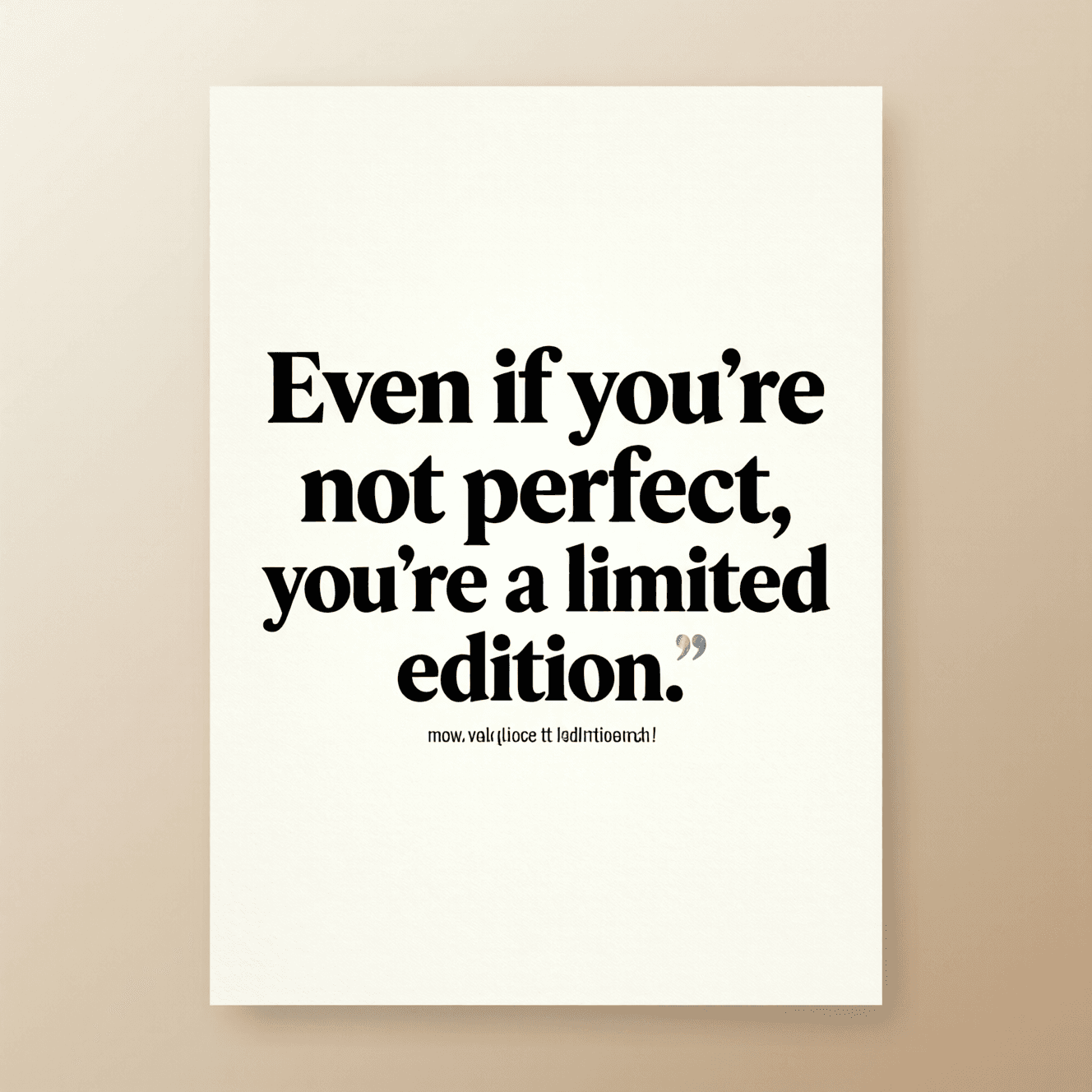
Even if you're not perfect, you're a limited edition. — Kim Nam-joon
—What lingers after this line?
A Reframe of “Not Perfect”
Kim Nam-joon’s line begins by disarming the pressure to be flawless, treating “not perfect” as a normal human baseline rather than a personal failure. Instead of arguing that imperfections don’t exist, it accepts them openly and then pivots toward what that reality can mean for self-worth. From there, the quote gently challenges the common habit of equating value with performance. If perfection is an impossible standard, measuring yourself by it guarantees disappointment; acknowledging limits becomes the first step toward a more livable, honest view of who you are.
“Limited Edition” as Identity, Not Marketing
The phrase “limited edition” borrows the language of collectibles, but its real force lies in identity: you are not mass-produced. Even if many people share similar traits, no one has your exact history, voice, timing, relationships, and private interior world—your particular combination cannot be replicated. Because of that, the quote doesn’t claim you’re valuable despite being imperfect; it implies your uniqueness includes the rough edges. In other words, what you might label as a flaw can also be evidence of a singular life lived under singular circumstances.
Scarcity Versus Comparison Culture
Once you accept yourself as “limited edition,” the logic of constant comparison starts to weaken. Comparison culture relies on the idea that people are interchangeable products ranked on one scale; scarcity thinking, by contrast, suggests that difference is the point, not the problem. This shift matters because it changes the question from “Am I as good as them?” to “What is distinct about me?” Rather than chasing someone else’s blueprint, you begin to notice what you alone can contribute—an approach that can reduce envy and increase clarity about your own path.
Wabi-Sabi and the Beauty of the Unfinished
The quote also echoes the Japanese aesthetic of wabi-sabi, which finds beauty in impermanence, asymmetry, and the incomplete. Instead of treating wear and irregularity as defects to hide, wabi-sabi treats them as marks of authenticity—evidence that something is real and has a story. Seen this way, imperfection isn’t merely tolerated; it becomes part of the object’s character. Similarly, your inconsistencies, failed attempts, and awkward seasons can be read not as disqualifications but as texture—proof of growth and honest contact with life.
Self-Compassion as a Practical Skill
However, calling yourself “limited edition” isn’t just a poetic compliment; it can function as a tool for self-compassion. Psychologist Kristin Neff’s research on self-compassion (e.g., *Self-Compassion*, 2011) emphasizes treating yourself with the same understanding you would offer a friend, especially when you fall short. By pairing “not perfect” with “limited edition,” the quote invites a balanced stance: you can admit mistakes without collapsing into self-contempt. That balance makes accountability easier, because you no longer have to defend an image of perfection to feel deserving of respect.
Turning Uniqueness into Direction
Finally, the line suggests a way forward: if you’re rare by nature, your job isn’t to become generic “perfect,” but to become more fully yourself. That might mean refining strengths you already have, setting boundaries that protect your temperament, or choosing goals that match your values instead of your insecurities. In practice, many people discover that their most meaningful work and relationships grow from the traits they once tried to erase—sensitivity, intensity, unconventional interests, or a nonlinear past. The quote closes the loop by implying that worth is not the prize at the end of improvement; it’s the ground you stand on while improving.
One-minute reflection
What's one small action this suggests?
Related Quotes
6 selectedTo be yourself in a world that is constantly trying to make you something else is the greatest accomplishment. - Ralph Waldo Emerson
Ralph Waldo Emerson
This quote highlights the importance of staying true to oneself. In a world where external pressures and societal expectations often force individuals to conform, maintaining one's unique identity is a significant achiev...
Read full interpretation →Embrace the glorious mess that you are; it is the beauty in our imperfections that transforms the ordinary into the extraordinary. — P!nk, USA.
P!nk, USA.
This quote highlights the importance of accepting oneself, flaws and all. Embracing one’s imperfections can lead to a greater sense of self-worth and identity.
Read full interpretation →Embrace the glorious mess that you are; it's in the chaos that you find your true beauty and strength. — Brene Brown, USA.
Brene Brown, USA.
This quote highlights the importance of accepting one's flaws and imperfections. By embracing our 'messiness,' we can appreciate our uniqueness and authenticity.
Read full interpretation →Quiet confidence is not about being loud; it is about knowing who you are and being comfortable in your own skin. — Julie Andrews
Julie Andrews
Julie Andrews’ observation begins by separating confidence from volume. In a culture that often rewards assertive display, she reminds us that genuine self-assurance does not need constant announcement.
Read full interpretation →To be part of society is to lose a part of yourself; do what you would do if you were the only person on Earth. — Derek Sivers
Derek Sivers
Derek Sivers’ line begins with a sober observation: joining society often means trimming away parts of the self to fit shared expectations. Manners, careers, tastes, and even ambitions can become performances shaped by a...
Read full interpretation →The world accommodates you for fitting in, but only rewards you for standing out. — Matshona Dhliwayo
Matshona Dhliwayo
Matshona Dhliwayo’s quote begins with a social truth: the world often makes room for people who adapt to its expectations. Fitting in can bring acceptance, safety, and access, because groups tend to welcome those who und...
Read full interpretation →More From Author
More from joon →