
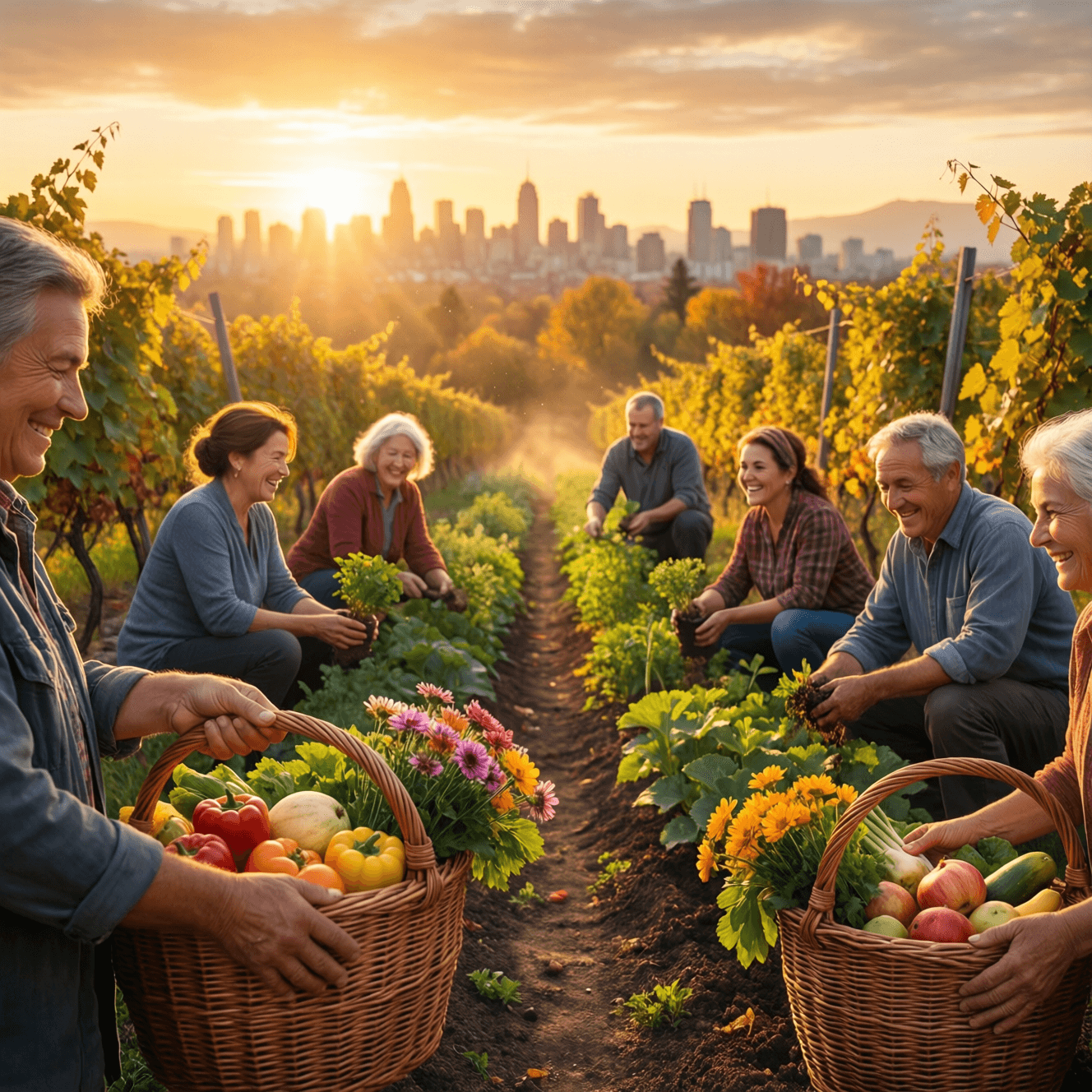
We are each other's harvest; we are each other's business; we are each other's magnitude and bond. — Gwendolyn Brooks
—What lingers after this line?
A Communal Claim in Plain Speech
Gwendolyn Brooks compresses an entire social philosophy into a few declarative lines: “We are each other’s…” repeated like a steady drumbeat. That structure matters, because it insists this is not a sentimental preference but a condition of living among others. Rather than placing the self at the center, the quote begins by relocating meaning to the space between people—where effort, responsibility, and recognition circulate. As a result, the statement reads less like a private reassurance and more like a public reminder about what binds a community together.
“Harvest”: What We Reap From One Another
The word “harvest” frames relationships as seasons of labor and consequence: what we become is shaped by what others plant, tend, and model for us. Brooks suggests that our outcomes—skills learned, values absorbed, wounds carried, hopes sustained—are rarely self-made in the strict sense. In that light, praise and blame also become shared: a thriving neighbor often reflects unseen caretaking, while a struggling one can reveal neglected soil. This idea echoes the social texture in Brooks’s own work, where everyday lives accumulate meaning through interdependence, as in “The Bean Eaters” (1960), which portrays endurance not as heroic isolation but as quiet, mutual continuity.
“Business”: The Practical Duties We Owe
After the organic image of harvest, Brooks pivots to “business,” a term that brings moral life down to concrete transactions—time, attention, fairness, and accountability. Community, she implies, isn’t only empathy; it is also administration: showing up, keeping promises, sharing burdens, and negotiating conflicts. Even love has logistics. In this sense, her line resembles a civic ethic more than a romantic one. It aligns with the view that social bonds are maintained through ongoing work, much like Aristotle’s emphasis on friendship and polis in the Nicomachean Ethics (c. 350 BC), where flourishing depends on practiced reciprocity rather than isolated virtue.
“Magnitude”: Measuring Ourselves Through Others
Calling one another our “magnitude” suggests that human scale is not merely individual achievement but relational impact. We become “larger” through the people who challenge us, teach us, and extend our imagination of what is possible. Conversely, we can be diminished when others are denied opportunity or dignity, because the collective measure of a society shrinks with every preventable loss. This reframes status and success as distributed phenomena: your growth is partly evidence of someone else’s investment, and your neglect of others is a subtraction from the world you inhabit. The metric Brooks proposes is ethical, not merely economic—how much humanity we enable in one another.
“Bond”: The Tie That Is Chosen and Inherited
Finally, “bond” gathers the earlier terms into a durable connection: harvest implies shared outcomes, business implies shared responsibility, and magnitude implies shared meaning. Bond is what remains when moods fluctuate—a link that can be strengthened by care or weakened by indifference, but rarely erased without cost. Brooks’s insistence on “we” acknowledges that bonds are both inherited (family, neighborhood, history) and chosen (solidarity, friendship, commitment). Her line also hints at the fragility of social fabric: to deny the bond is to pretend we can cut the thread without unraveling ourselves.
A Modern Reading: Solidarity as Daily Practice
Taken together, Brooks offers a practical definition of solidarity: we shape each other’s outcomes, manage each other’s well-being, define each other’s significance, and remain tied to each other’s fate. The quote resists both cynicism (“everyone is on their own”) and naïve idealism (“care is effortless”), replacing them with a grounded view of mutual reliance. In everyday terms, it can look small: a teacher staying after class, a neighbor checking in during a storm, a coworker advocating for fair credit. Yet Brooks implies these small acts are not extras; they are the very economy of human life. We are, inevitably, each other’s work.
One-minute reflection
What does this quote ask you to notice today?
Related Quotes
6 selectedI can never be what I ought to be until you are what you ought to be. This is the interrelated structure of reality. — Martin Luther King, Jr.
Martin Luther King Jr.
At the heart of Martin Luther King, Jr.’s statement is a simple but demanding truth: no person develops in isolation. Our moral growth, dignity, and freedom are bound up with the condition of others.
Read full interpretation →You are not Atlas carrying the world on your shoulder. It is good to remember that the planet is carrying you. — Vandana Shiva
Vandana Shiva
Vandana Shiva’s words begin by overturning a familiar heroic image: the individual as Atlas, straining beneath the weight of the world. Instead, she gently corrects that illusion, reminding us that we are not supporting...
Read full interpretation →To love is to recognize that we are not alone in the universe; we are threads woven into a shared tapestry of existence. — Iris Murdoch
Iris Murdoch
At its heart, Iris Murdoch’s reflection presents love not merely as emotion but as recognition. To love someone is to awaken to the fact that life is never fully solitary; instead, our identities are shaped through conta...
Read full interpretation →The only way we're going to make it is in the company of others. We need each other. In all ways. — Mia Birdsong
Mia Birdsong
Mia Birdsong’s statement begins with a simple but far-reaching truth: human life is not built for isolation. By saying “the only way we’re going to make it” is with others, she reframes survival as a collective act rathe...
Read full interpretation →No man is an island, entire of itself; every man is a piece of the continent, a part of the main. — John Donne
John Donne
John Donne begins by dismantling the fantasy of complete self-sufficiency. To say that no man is an island is to argue that human beings cannot exist in any meaningful sense apart from others; our identities, duties, and...
Read full interpretation →We don't accomplish anything in this world alone… and whatever happens is the result of the whole tapestry of one's life and all the weavings of individual threads from one to another that creates something. — Sandra Day O'Connor
Sandra Day O'Connor
Sandra Day O’Connor’s reflection begins by rejecting the myth of the self-made individual. At its heart, the quote suggests that no achievement emerges in isolation; instead, every success, failure, and turning point is...
Read full interpretation →More From Author
More from Gwendolyn Brooks →Take life one cup at a time. — Gwendolyn Brooks
This quote encourages individuals to focus on the present moment, savoring each experience as it comes, much like one would enjoy a warm cup of coffee or tea.
Read full interpretation →The journey may be hard, but it is the destination that matters. — Gwendolyn Brooks
This quote emphasizes the importance of the destination or end goal, suggesting that the hardships faced during the journey are secondary to the value of reaching the desired outcome.
Read full interpretation →To know what you prefer instead of drinking to forget is to be really alive. — Gwendolyn Brooks
This quote emphasizes the importance of self-awareness, suggesting that understanding one's true preferences and desires is a fundamental part of living authentically.
Read full interpretation →The only way to deal with the future is to function efficiently in the now. — Gwendolyn Brooks
This quote highlights the value of staying focused on the present. To ensure a better future, it is essential to handle today's tasks and responsibilities effectively.
Read full interpretation →