
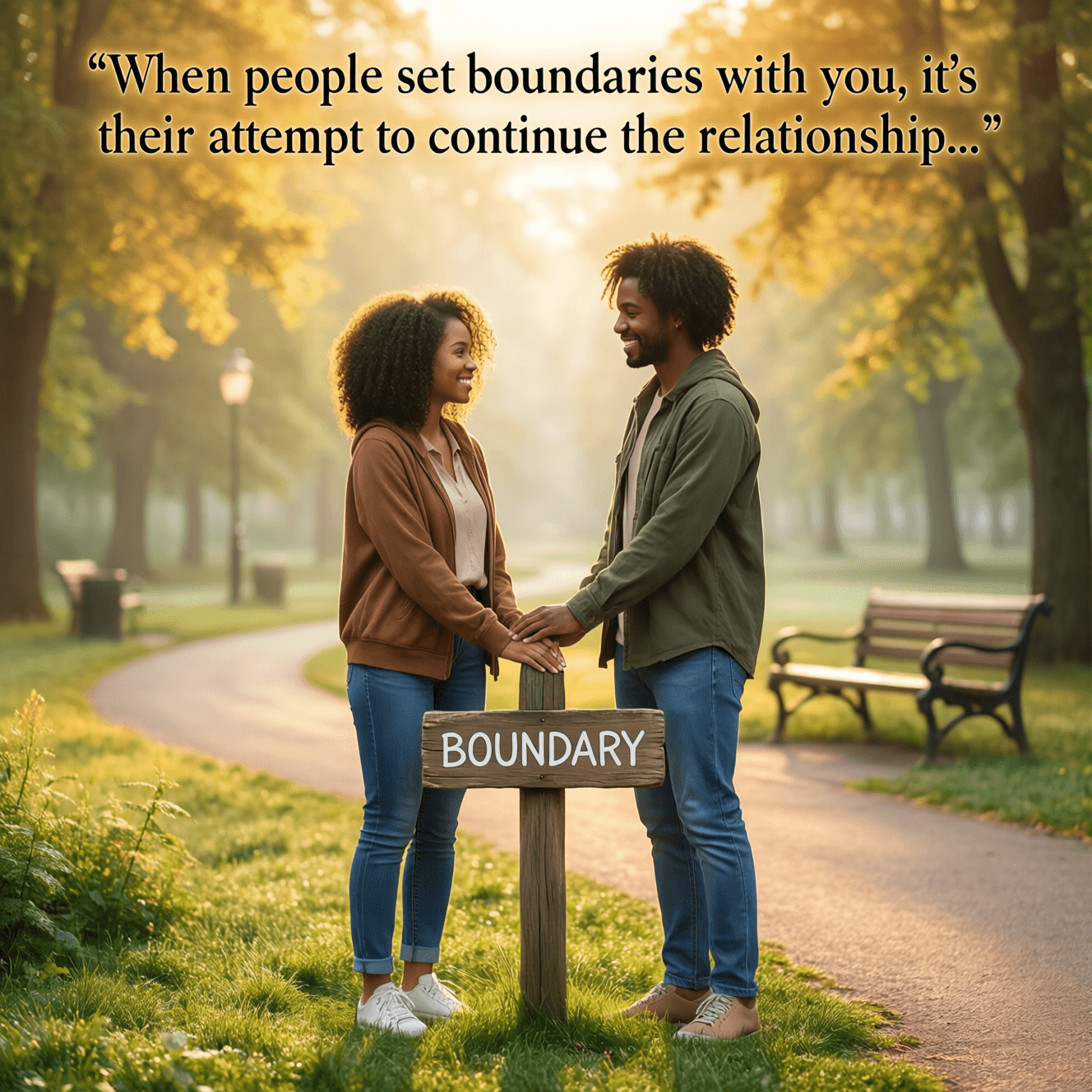
When people set boundaries with you, it's their attempt to continue the relationship. It's not an attempt to hurt you. — Elizabeth Earnshaw
—What lingers after this line?
Reframing What a Boundary Means
Elizabeth Earnshaw’s quote asks us to reconsider the gut reaction many people have when they hear “I can’t” or “I’m not okay with that.” Instead of treating boundaries as rejection, she frames them as a relational tool—an effort to keep contact possible without resentment or burnout. In that sense, a boundary is less like a wall and more like a bridge with guardrails. This reframe matters because conflict often escalates at the moment a limit is named. If the boundary-setter is understood as trying to preserve the relationship rather than punish the other person, the conversation can shift from defensiveness to collaboration.
Why Boundaries Often Feel Like Criticism
Even when a boundary is stated calmly, it can land as an indictment: “You’re too much,” “You did something wrong,” or “I don’t value you.” That sting is amplified when someone has a history of being excluded, shamed, or controlled; a simple request can echo older experiences and trigger a threat response. However, Earnshaw’s point nudges us to separate intent from impact. A boundary may feel painful in the moment, yet it can still be motivated by care—especially when the alternative is quiet withdrawal, passive aggression, or eventual rupture.
Boundaries as Maintenance, Not Punishment
Seen through a relational lens, boundaries function like routine maintenance: they keep the connection sustainable. “I can talk about this, but not late at night” or “I need you to ask before dropping by” are ways of preventing small frictions from becoming chronic damage. In family systems thinking, Murray Bowen’s *Family Therapy in Clinical Practice* (1978) emphasizes differentiation—maintaining one’s self while staying emotionally connected—which aligns with the idea that limits can support closeness rather than threaten it. In other words, a boundary is often the most pro-relationship move available, precisely because it names what would otherwise erode trust.
The Hidden Hope Inside a Limit
When someone sets a boundary, they are usually revealing two things at once: what hurts and what they still want. A friend who says, “Please don’t joke about that topic with me,” is implicitly saying, “I want to keep spending time with you, but I need safety to do it.” The boundary contains hope—hope that the relationship can adapt. This is why boundaries are often offered before a person gives up. They are a last attempt at clarity when subtle cues and unspoken discomfort haven’t worked.
How to Respond Without Breaking Connection
If boundaries are bids for continued relationship, the most effective response is not argument but curiosity and accountability. Simple phrases like “Thanks for telling me,” “What would feel better instead?” or “I can do that” communicate respect and reduce the chance that the boundary-setter will feel forced to escalate. By contrast, debating the legitimacy of the boundary (“You’re too sensitive”) often confirms the very reason it was needed. Importantly, you can still express your feelings—disappointment, confusion, sadness—without treating the boundary as an attack. This keeps both truth and connection on the table.
Boundaries as a Two-Way Practice
Earnshaw’s message also implies reciprocity: if one person is allowed to set limits, the other is too. Healthy relationships evolve through mutual negotiation—each person learning what the other can genuinely offer and what costs too much. That realism can deepen intimacy, because it replaces guessing and resentment with clear agreements. Ultimately, boundaries are not the end of closeness but a method of protecting it. They say, in effect, “I want us—just not at the price of my well-being,” which is often the most honest form of commitment.
One-minute reflection
What feeling does this quote bring up for you?
Related Quotes
6 selectedYou are in control of your life. Set new boundaries by removing all of the toxic people from your inner circle. — Jeanette Coron
Jeanette Coron
Jeanette Coron’s statement begins with a direct reminder: you are not merely reacting to life, but participating in its design. By saying you are in control, the quote shifts attention away from blame and toward agency,...
Read full interpretation →If it costs my peace, it's outside my boundary. — Adam J. Jackson
Adam J. Jackson
At its core, Adam J. Jackson’s line reframes boundaries as more than rules we impose on others; they become protections for our inner life.
Read full interpretation →The only way to exist in a world that feels increasingly cold is to be the warmth you wish to receive from others. — Maya Angelou
Maya Angelou
At its core, Maya Angelou’s line reframes loneliness as a call to action rather than a verdict on the world. If life feels impersonal, distant, or harsh, she suggests that waiting passively for kindness may only deepen t...
Read full interpretation →Art and love are the same thing: it's the process of seeing yourself in things that are not you. — Chuck Klosterman
Chuck Klosterman
At first glance, Chuck Klosterman’s line collapses two vast experiences into one elegant idea: both art and love involve recognizing ourselves in something outside us. In this sense, a painting, a song, or another person...
Read full interpretation →With each person you meet, remind yourself that you share a common humanity. — Epictetus
Epictetus
At its core, Epictetus’s advice asks for a disciplined shift in perception. Rather than meeting others as rivals, strangers, or obstacles, we are urged to begin with a deeper truth: each person participates in the same f...
Read full interpretation →I've learned that it's harder to hate up close. — Michelle Obama
Michelle Obama
Michelle Obama’s observation begins with a simple but powerful truth: distance makes it easier to turn people into abstractions, while closeness restores their full humanity. When we know others only as labels, stereotyp...
Read full interpretation →More From Author
More from Elizabeth Earnshaw →