
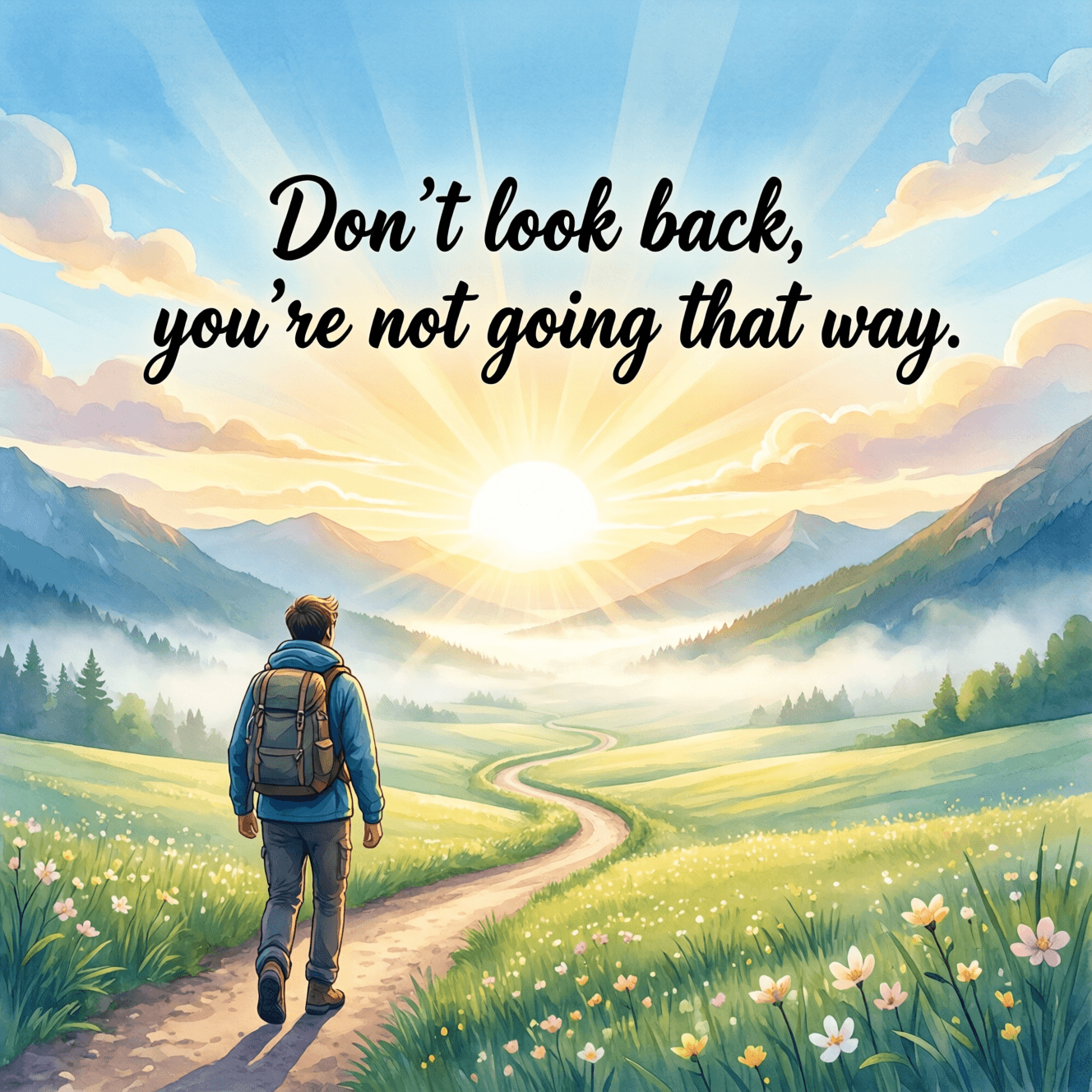
Don't look back, you're not going that way. — Mary Engelbreit
—What lingers after this line?
A Simple Command with Sharp Edges
Mary Engelbreit’s line sounds like friendly advice, yet it arrives with the force of a boundary: stop turning your attention toward what cannot be revisited. In that sense, it’s less about denying memory and more about refusing to let memory steer the wheel. From the outset, the quote frames life as directional. If your destination lies ahead, then repeatedly checking what’s behind you becomes not only pointless but also potentially dangerous—an emotional version of drifting lanes while driving.
Regret as a Form of Misnavigation
Once the idea of direction is established, the next implication is that regret can become a habit of travel in the wrong mental lane. Looking back often masquerades as reflection, but it can quietly turn into replaying alternate outcomes—routes you no longer have access to. This doesn’t mean past mistakes are irrelevant; rather, it suggests the proper use of the past is instructional, not residential. You take the lesson, mark the hazard, and continue forward instead of setting up camp at the site of what went wrong.
Reframing Memory into Learning
Because the past still contains valuable information, the quote invites a shift from nostalgia or self-reproach to purposeful learning. That transition matters: reflection is a tool when it helps you adjust your next step, but it becomes a trap when it only deepens self-judgment. In practice, this can look like conducting a brief “after-action review”—What happened? What did I control? What will I do differently?—and then returning to present choices. The backward glance is quick, deliberate, and completed.
Why “Forward” Protects Your Identity
Moving forward also protects you from being defined by earlier versions of yourself. If you keep looking back, you may keep auditioning old roles—failure, heartbreak, embarrassment—as if they’re still the casting director for your life. By contrast, refusing to look back too long is a declaration that identity is not frozen in a single chapter. The quote’s underlying confidence is that you are allowed to outgrow what happened, even if it once felt like the whole story.
Courage in Unfinished Futures
Still, the hardest part of not looking back is that the future is uncertain while the past is familiar. Engelbreit’s phrasing acknowledges that temptation and answers it with decisiveness: uncertainty is not a reason to retreat. Consider someone leaving an unsatisfying job or ending a draining relationship; the mind often bargains with what it already knows. The quote gently but firmly reorients them: familiarity is not the same as suitability, and forward is the only path where change can actually occur.
A Practical Way to Live the Quote
To make the idea actionable, it helps to pair it with a small ritual of closure. You might write down what you’re releasing, name the lesson you’re keeping, and choose one next step that aligns with where you want to go. In that way, the quote becomes more than inspiration—it becomes a method. You honor the past without granting it veto power, and you give your attention to the direction where your decisions still matter: the road ahead.
One-minute reflection
Where does this idea show up in your life right now?
Related Quotes
6 selectedEmbrace each moment as a step in your journey, for even the smallest strides forward are the seeds of tomorrow's triumphs.
Unknown
This quote emphasizes the importance of living in the moment. Each present moment is valuable and contributes to the overall journey of life.
Read full interpretation →Understand that the power is in the principle of moving forward. — Robert Downey Jr.
Robert Downey Jr.
Robert Downey Jr.’s statement begins with a simple but forceful idea: power is not always found in control, certainty, or dramatic victory. Instead, it often emerges from the decision to keep moving, even when progress f...
Read full interpretation →Your most important work is always ahead of you, never behind you. Keep your eyes on the horizon, not the past. — Stephen Covey
Stephen Covey
Stephen Covey’s statement frames life as an unfolding responsibility rather than a completed record. At its core, the quote insists that our finest contribution is not something we have already done, but something we are...
Read full interpretation →We are so busy running toward our future that we rarely stop to notice that we are already standing in the middle of a life. — Pico Iyer
Pico Iyer
Pico Iyer begins with a familiar modern habit: the constant sprint toward what comes next. We organize our days around goals, promotions, milestones, and imagined better versions of ourselves, often assuming that real li...
Read full interpretation →Your attention is your most precious currency; spend it on what nourishes your future rather than what exhausts your present. — Cal Newport
Cal Newport
At its core, Cal Newport’s statement reframes attention as a form of currency: limited, valuable, and constantly at risk of being wasted. By calling it ‘your most precious currency,’ he implies that what we notice, dwell...
Read full interpretation →I learned when hit by loss, to ask the right question: 'What's next?' instead of 'Why me?' — Julia Cameron
Julia Cameron
Julia Cameron’s line hinges on a simple but powerful pivot: loss may be unavoidable, yet the question we ask determines whether we become trapped in it or moved by it. “Why me?” searches for a culprit, a cosmic explanati...
Read full interpretation →More From Author
More from Mary Engelbreit →Bloom where you are planted. — Mary Engelbreit
This quote encourages individuals to make the best of their current circumstances. It suggests that people can thrive and succeed regardless of their environment if they are adaptable.
Read full interpretation →Life’s too mysterious to take too serious. — Mary Engelbreit
To begin, Mary Engelbreit’s quote reminds us that life’s essence is deeply mysterious, filled with unexpected twists and unanswered questions. From the earliest philosophies—consider the musings in Marcus Aurelius’ *Medi...
Read full interpretation →