
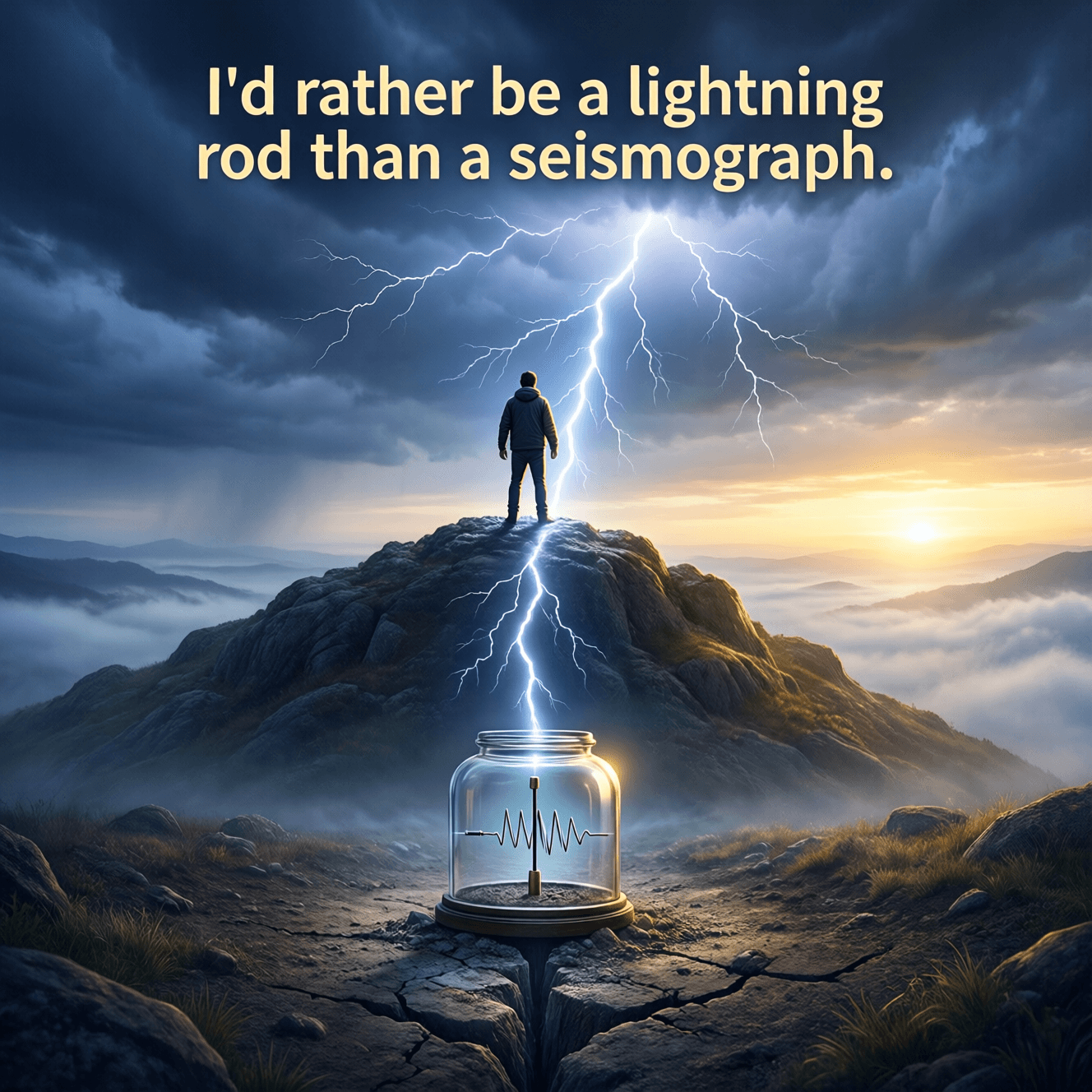
I'd rather be a lightning rod than a seismograph. — Ken Kesey
—What lingers after this line?
A Vivid Metaphor of Temperament
Ken Kesey’s line hinges on two instruments that represent opposing ways of moving through life. A seismograph registers tremors; it is designed to detect, record, and translate distant shocks into readable marks. A lightning rod, by contrast, does not merely observe a storm—it becomes a chosen point of contact, drawing a dangerous force and channeling it. From the start, the comparison suggests a preference for direct engagement over careful measurement. Kesey isn’t praising recklessness so much as declaring allegiance to intensity: he would rather be the person who takes the strike, transforms it, and keeps the structure standing than the person who notes that the ground is shaking.
Action Versus Observation
Following the metaphor, the quote frames a familiar human dilemma: do you primarily witness events, or do you shape them? The seismograph’s virtue is accuracy and restraint; it provides information without interference. Yet its neutrality can also resemble passivity, a life spent chronicling disturbances rather than confronting their causes. In contrast, choosing to be a lightning rod implies a willingness to absorb risk on behalf of others. The lightning rod does not stop the storm, but it changes how the storm lands. In that sense, Kesey points toward a kind of moral or creative agency—being the person who steps into volatility and redirects it into something survivable.
Kesey’s Countercultural Context
This preference for charged participation aligns with Kesey’s public persona and era. As the author of One Flew Over the Cuckoo’s Nest (1962) and a prominent figure in the 1960s counterculture, Kesey often gravitated toward confrontation with systems rather than detached critique. His “Merry Pranksters” and the famous bus trips documented in Tom Wolfe’s The Electric Kool-Aid Acid Test (1968) embodied a style of activism-through-presence—immersive, provocative, and unapologetically destabilizing. Seen in that light, the quote reads less like a personal quirk and more like a credo: don’t just record the cultural tremor; become the conductor that forces a reckoning with it.
The Cost of Being the Conductor
However, the lightning-rod choice is not romantic without consequence. A seismograph can operate for decades precisely because it is built to sense without taking the full blow. A lightning rod survives by being grounded, but it still endures repeated strikes; it must be installed correctly, maintained, and attached to a structure that can bear the pathway of discharge. Translating that into human terms, Kesey’s stance implies accepting burnout, criticism, and emotional wear as part of the job. The person who volunteers to take the hit—whether in leadership, art, or dissent—often becomes a target. The quote quietly acknowledges that impact is expensive, and it dares the reader to pay anyway.
When Sensitivity Becomes a Trap
Next comes the implicit critique of pure sensitivity. Being a “seismograph” can describe the highly attuned person who detects every shift in mood, politics, or danger. That awareness can be a gift, yet it can also collapse into hypervigilance—an existence dominated by reaction rather than intention. In many workplaces and relationships, there is a familiar figure who can “feel the quake” before anyone else, but never converts that perception into a decisive move. Kesey’s line pushes against that pattern. It suggests that there is a point where noticing becomes a way of avoiding: if you only register disturbances, you may never discover your capacity to intervene.
Grounding: The Hidden Wisdom in the Image
Finally, the metaphor offers a practical lesson: a lightning rod is only useful because it is grounded. The daring stance Kesey admires is not mere volatility; it is disciplined channeling. In human terms, grounding might look like community, craft, routine, ethics, or a clear purpose—anything that prevents intensity from becoming self-destruction. So the quote can be read as an invitation to become an instrument of transformation rather than a recorder of anxiety. Kesey’s preference is for the person who stands where the charge is highest, but who also builds the pathway that turns danger into direction—proof that boldness and structure can coexist.
One-minute reflection
What's one small action this suggests?
Related Quotes
6 selectedIf you're not doing some things that are crazy, then you're doing the wrong things. — Francis Ford Coppola
Francis Ford Coppola
At first glance, Francis Ford Coppola’s remark sounds like a celebration of recklessness, yet its deeper point is more demanding than that. He suggests that meaningful work often requires choices that appear irrational t...
Read full interpretation →Life is too short to be subtle — Mary Quant
Mary Quant
Mary Quant’s line begins with a blunt accounting: life is finite, and that fact should change how we show up in the world. If time is scarce, then excessive restraint can become a kind of self-sabotage—postponing honest...
Read full interpretation →Your silence serves no one. Be the domino. — Luvvie Ajayi Jones
Luvvie Ajayi Jones
Luvvie Ajayi Jones’s line begins by stripping silence of its usual neutrality: it “serves no one,” meaning it rarely protects the vulnerable for long, and it almost never reforms the powerful. In practice, silence tends...
Read full interpretation →One can never consent to creep when one feels an impulse to soar. — Simone de Beauvoir
Simone de Beauvoir
Simone de Beauvoir’s line begins with a quiet rebellion: once you feel the tug of possibility, “consenting to creep” becomes intolerable. The word consent matters, because it frames smallness as a choice we are pressured...
Read full interpretation →A bold refusal to give up reshapes the world more than a thousand cautious plans. — Seneca
Seneca
Seneca’s line pivots on a surprising claim: reality bends less to elaborate planning than to a person’s unyielding decision not to surrender. A “bold refusal” is not mere stubbornness; it is a moment when someone stops n...
Read full interpretation →Begin with a single honest gesture and watch the horizon change its shape. — Octavio Paz
Octavio Paz
Octavio Paz’s line invites us to linger on the word “begin.” Rather than demanding a grand transformation, he calls for a single, honest gesture—a small, concrete act that nonetheless carries immense weight. This framing...
Read full interpretation →More From Author
More from Ken Kesey →