
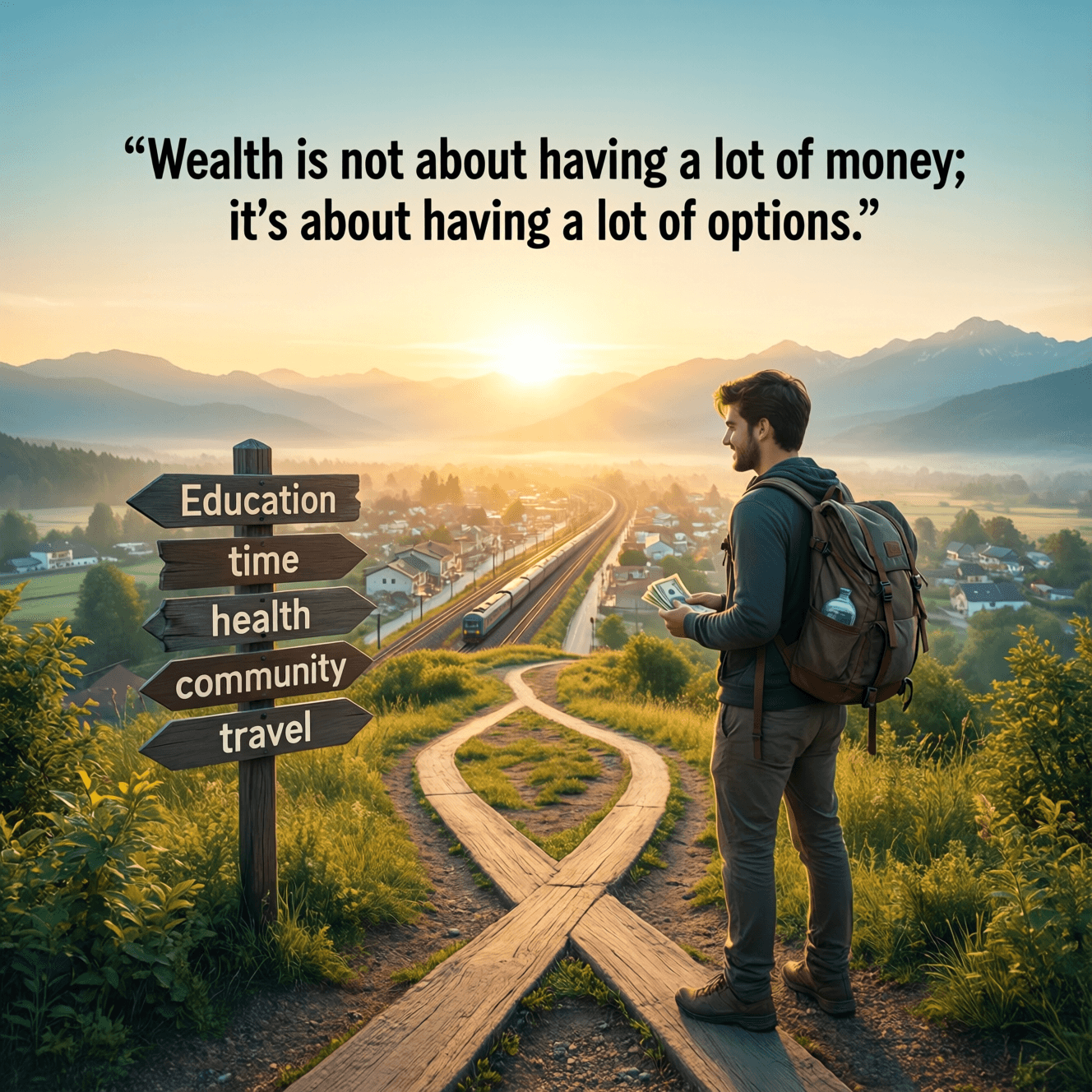
Wealth is not about having a lot of money; it's about having a lot of options. — Chris Rock
—What lingers after this line?
Reframing Wealth as Freedom
Chris Rock’s line pivots the idea of wealth away from a scoreboard of dollars and toward the lived experience of freedom. Money matters, of course, but only insofar as it expands what you can choose—where you live, how you spend your time, and what risks you can afford to take. In that sense, wealth is less a pile of cash and more a widening menu of possibilities. From this starting point, the quote challenges a common assumption: that rich always means lavish. Instead, it suggests that true prosperity is the ability to steer your own life, even in small ways, without being forced into the only available path.
Options as the Real Currency
Once wealth is defined as options, everyday examples become more revealing than luxury imagery. The person who can quit a toxic job without panic, pay an unexpected medical bill, or relocate for a better opportunity holds a kind of power that isn’t always visible. Those options reduce stress and increase agency—two outcomes people often associate with “being well-off,” even when they don’t say it outright. As a result, the quote implies a practical metric: not “How much do you have?” but “How many doors can you open if life changes tomorrow?”
Time, Leverage, and the Ability to Say No
Building on the idea of doors and choices, one of the clearest signs of option-wealth is control over time. When basic needs are covered and obligations are manageable, you gain the ability to say no—to extra shifts, exploitative deals, or relationships that drain you. Economists and sociologists often describe this as bargaining power: the less desperate you are, the more you can negotiate on your own terms. In that light, wealth can look like breathing room. It’s the margin that allows planning instead of constant reacting, which is why “options” captures something deeper than a bank balance.
Why Big Income Doesn’t Always Mean Wealth
If options are the goal, then a high salary alone can be a trap when it comes with fragile finances or lifestyle inflation. Someone earning a lot but carrying heavy debt, high fixed expenses, or no emergency savings may feel locked in—unable to take a sabbatical, switch careers, or handle surprises. The outward signs read “successful,” yet the inner reality can be narrow and anxious. This contrast clarifies Rock’s point: wealth is not the size of the inflow but the resilience and flexibility of the whole system. Options come from stability, not just earnings.
How People Actually Build More Options
With the definition established, the next question is how options accumulate. Often it’s through unglamorous choices: saving an emergency fund, keeping recurring costs low, diversifying income, and investing for the long term. Even skills and networks function like financial assets because they increase the number of viable paths—new jobs, side work, collaborations, or geographic mobility. Over time, these pieces compound into what many call “runway”: the capacity to withstand setbacks and pursue opportunities. In that sense, wealth is as much about preparation as it is about possession.
The Social and Moral Edge of Choice
Finally, seeing wealth as options highlights why inequality feels so consequential: it isn’t only about comfort, but about constrained lives. When people lack savings, healthcare access, or stable housing, they also lack choices—sometimes facing dilemmas no one should have to make. Conversely, those with options can avoid harm, access better environments, and recover faster from mistakes. Rock’s punchline lands because it exposes the core: money is a tool, but autonomy is the outcome. By measuring wealth in options, the quote invites a more human, less flashy understanding of what it means to be truly well-off.
One-minute reflection
What feeling does this quote bring up for you?
Related Quotes
6 selectedContentment is the only real wealth. — Alfred Hitchcock
Alfred Hitchcock
At first glance, Hitchcock’s remark seems to dismiss money, status, and possessions, yet its deeper point is subtler: wealth matters only insofar as it produces a sense of enough. Contentment, in this view, is the inner...
Read full interpretation →Wealth is the slave of a wise man. The master of a fool. — Seneca
Seneca
Seneca’s line turns a common assumption upside down: money doesn’t automatically grant freedom; it can just as easily impose a new kind of dependence. By calling wealth a “slave” to the wise, he implies that the wise per...
Read full interpretation →Two roads diverged in a wood, and I— I took the one less traveled by, and that has made all the difference. — Robert Frost, United States.
Robert Frost, United States.
This quote highlights the importance of making choices in life. By choosing the 'road less traveled,' it emphasizes the value of individuality and the courage to follow one's unique path rather than conforming to the nor...
Read full interpretation →You are always free to change your mind and choose a different future, or a different past. — Richard Bach
Richard Bach
This quote highlights the human capacity to make choices at any moment. It emphasizes that we are not stuck with our current beliefs, decisions, or future, but are always free to make new choices.
Read full interpretation →When you come to a fork in the road, take it. — Yogi Berra
Yogi Berra
This quote humorously emphasizes the importance of making a decision rather than remaining stagnant. Even when the choices are unclear, action is better than inaction.
Read full interpretation →Life is change. Growth is optional. Choose wisely. — Karen Kaiser Clark
Karen Kaiser Clark
This quote highlights that change is a natural and unavoidable part of life. It emphasizes that we cannot prevent change, as it is a constant force in our existence.
Read full interpretation →More From Author
More from Chris Rock →