
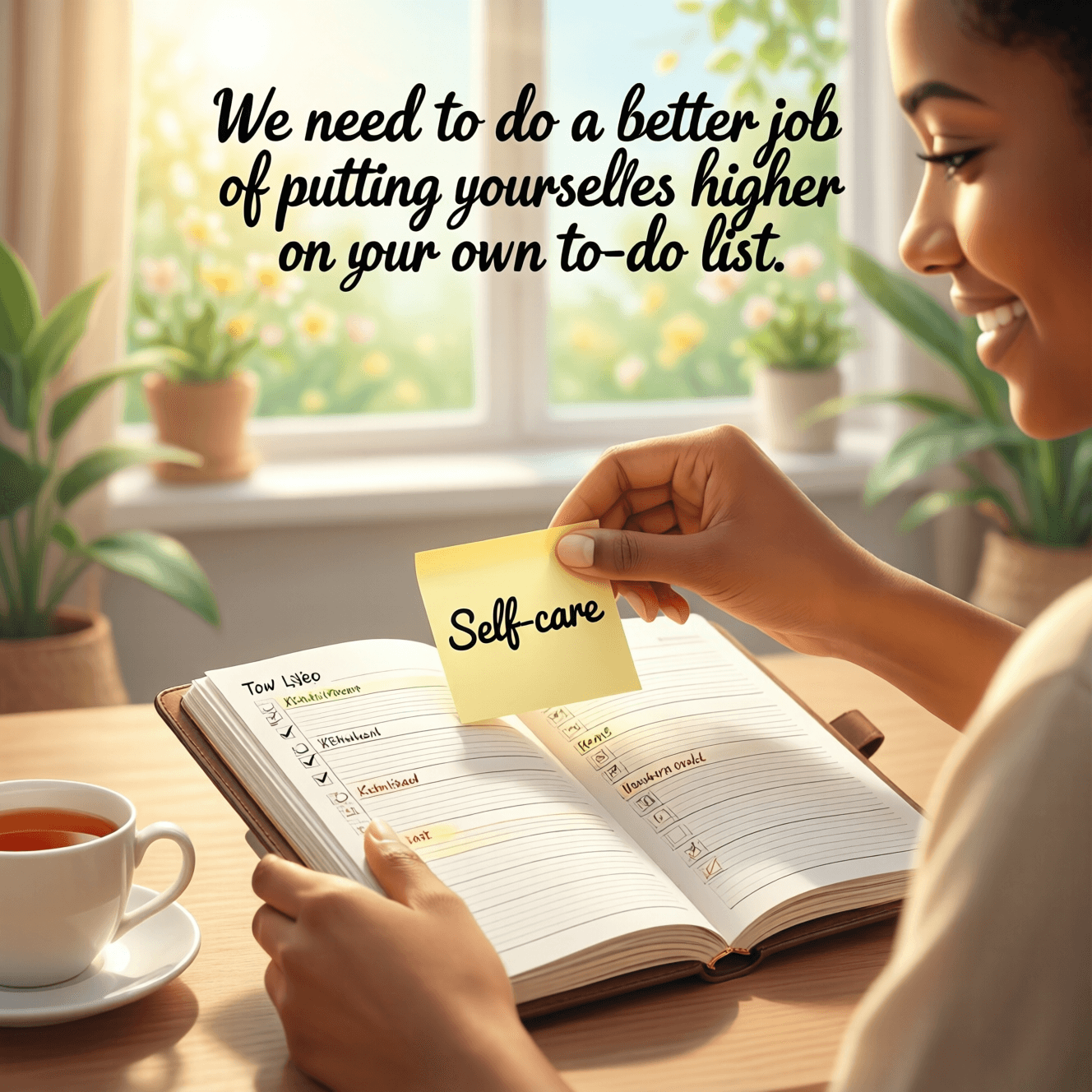
We need to do a better job of putting ourselves higher on our own to-do list. — Michelle Obama
—What lingers after this line?
Self-Care as a Practical Priority
Michelle Obama’s line reframes self-care as something sturdier than an occasional treat; it is a task worthy of the same seriousness we give work, family, and obligations. By saying we must put ourselves “higher” on the list, she implies we are already on it—just too far down to be acted on consistently. This matters because to-do lists reveal values in action, not merely in intention. When personal needs always fall to “later,” later often never arrives, and the result is a quiet erosion of energy, patience, and health that eventually affects everything else we are trying to manage.
Why We Drift Toward Over-Responsibility
To understand the problem, it helps to notice how easily responsibility expands to fill every available hour. Many people learn—through workplace culture, family roles, or social expectations—that being good means being endlessly available. The most conscientious among us then treat our own rest as negotiable while treating everyone else’s needs as fixed deadlines. As a result, self-neglect can feel strangely virtuous. Yet this “virtue” is often just a habit of postponement: we keep proving reliability to others while quietly accepting unreliability toward ourselves.
The Hidden Costs of Always Being Last
Once self-care becomes optional, the costs appear first as small leaks: irritability, brain fog, skipped meals, or a sense that weekends are merely recovery zones. Over time, those leaks can become systemic—burnout, chronic stress, and strained relationships—because depleted people have less emotional bandwidth to respond with generosity or clarity. In that way, putting yourself last does not only harm you; it also destabilizes the very commitments you are trying to honor. The paradox is that relentless self-sacrifice can eventually reduce the quality of your presence in work, parenting, partnership, and friendship.
Boundaries That Turn Values Into Action
If the to-do list is where priorities become real, boundaries are what protect those priorities from being erased. A boundary can be as simple as blocking a 20-minute walk before email, declining a meeting that could be an update, or ending the day at a consistent time. These moves aren’t dramatic—they’re structural. Moreover, boundaries reduce decision fatigue. Instead of debating daily whether you “deserve” rest, you create a default that treats your well-being as part of the plan, not as a reward for finishing everything (which rarely happens).
Small Commitments With Compounding Returns
Raising yourself on the list does not require a total life redesign; it often starts with modest, repeatable actions. For example, someone who adds “eat lunch away from the desk” or “call a friend once a week” may feel a surprisingly fast improvement in mood and resilience. The effect is not magical—it’s cumulative. As these habits stabilize, they tend to spread benefits outward: better sleep supports better focus, which shortens tasks, which frees time, which reduces stress. In this sense, self-care is not time taken from life but time invested back into it.
A Sustainable Ethic of Caring for Others
Ultimately, Obama’s message supports a sustainable way of showing up for the world. Caring for yourself is not a retreat from responsibility; it is how responsibility remains bearable. Like the airline oxygen-mask instruction—secure your mask before assisting others—self-preservation is the mechanism that keeps assistance possible. When you consistently rank yourself higher, you model a healthier norm: that dignity includes your own needs. And from that steadier foundation, service to others becomes less frantic, more intentional, and far more likely to last.
One-minute reflection
What's one small action this suggests?
Related Quotes
6 selectedNervous system regulation is the new mental fitness. You cannot pour from an empty cup, nor can you build a sanctuary while the world is still burning. — April Koh
April Koh
April Koh’s quote reframes wellness by suggesting that mental fitness is no longer just about discipline, productivity, or positive thinking. Instead, it begins with the body’s capacity to return to steadiness after stre...
Read full interpretation →Stop shrinking yourself to make others comfortable. Your peace is worth more than their approval. — Nedra Glover Tawwab
Nedra Glover Tawwab
Nedra Glover Tawwab’s words begin with a quiet but powerful warning: when we constantly make ourselves smaller to keep others comfortable, we often pay with our confidence, honesty, and emotional well-being. This kind of...
Read full interpretation →Your peace is worth more than their approval. — Karen Salmansohn
Karen Salmansohn
Karen Salmansohn’s quote draws a clear boundary between inner well-being and the exhausting pursuit of validation. At its heart, it reminds us that approval from others can feel rewarding, but it is often unstable, condi...
Read full interpretation →You can't pour from an empty cup. Take care of yourself first. — Arianna Huffington
Arianna Huffington
At its heart, Arianna Huffington’s line turns self-care into an image anyone can understand: a cup cannot nourish others if it has nothing left to give. The metaphor is gentle, but its message is firm.
Read full interpretation →Taking time out each day to relax and renew is essential to living well. — Judith Hanson Lasater
Judith Hanson Lasater
Judith Hanson Lasater’s words begin with a simple but often neglected truth: well-being is not sustained by effort alone. To live well, a person must also step back, soften, and allow the body and mind to recover.
Read full interpretation →Do not let your mind bully your body into believing it must carry the weight of the world. — Astrid Alauda
Astrid Alauda
Astrid Alauda’s quote speaks with the calm urgency of a reminder many people need: the mind can become a harsh taskmaster. It creates stories of obligation, guilt, and endless responsibility, then persuades the body to l...
Read full interpretation →More From Author
More from Michelle Obama →Confidence is not absence of fear; it is the quiet recognition that you have survived every hard day so far. — Michelle Obama
At first glance, confidence is often mistaken for boldness without hesitation, yet Michelle Obama’s words gently overturn that myth. She frames confidence not as the absence of fear, but as a steadier inner knowledge: yo...
Read full interpretation →We were planting seeds of change, the fruit of which we might never see. We had to be patient. — Michelle Obama
Michelle Obama’s quote frames social progress through the language of cultivation: people plant seeds now, even when the harvest may come much later. In that image, change is not sudden or theatrical but gradual, organic...
Read full interpretation →I've learned that it's harder to hate up close. — Michelle Obama
Michelle Obama’s observation begins with a simple but powerful truth: distance makes it easier to turn people into abstractions, while closeness restores their full humanity. When we know others only as labels, stereotyp...
Read full interpretation →Inspiration on its own was shallow; you had to back it up with hard work. — Michelle Obama
Michelle Obama’s remark begins with a necessary correction to a popular myth: feeling inspired is not the same as accomplishing something meaningful. Inspiration can ignite ambition, but on its own it is fleeting, emotio...
Read full interpretation →