
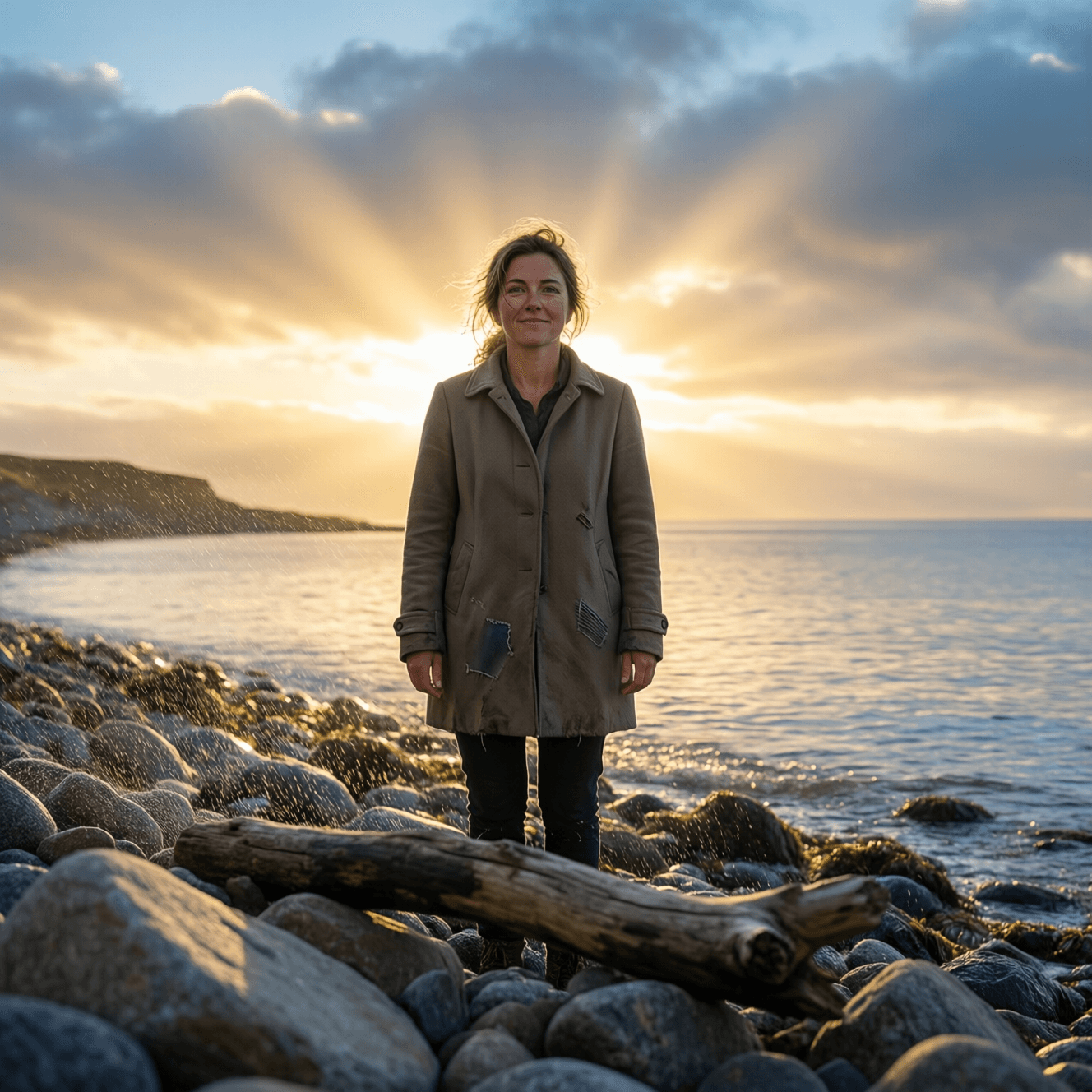
I am stronger than I am broken. — Roxane Gay
—What lingers after this line?
A Defiant Reframing of Identity
Roxane Gay’s line begins by refusing a common trap: letting injury become the whole story. “Broken” can describe an experience—trauma, loss, shame, illness—but she separates that from the core self who survives it. In doing so, she reframes identity as something larger than the worst thing that happened. From there, the sentence works like a quiet act of reclamation. It doesn’t deny damage; instead, it places damage in a smaller grammatical space than strength, implying that what hurts you is real, but not sovereign.
Strength That Includes the Cracks
Rather than presenting strength as flawless toughness, the quote suggests a sturdier kind: strength that can coexist with fractures. This matters because many people feel they must “get over” pain before they’re allowed to claim competence, dignity, or joy. Gay’s phrasing counters that expectation. Consequently, brokenness becomes evidence of having endured, not proof of being ruined. The self can be scarred and still be capable; in fact, the scar may mark the exact place where resilience was practiced repeatedly, in private and uncelebrated ways.
Owning the Narrative After Harm
The line also hints at the power of narration—who gets to name what you are. In memoir and cultural criticism, Gay often explores how bodies and histories are read by others, and how those readings can become cages. Here, she asserts authorship: you may witness my damage, but you do not define my limits. Building on that, the statement functions like a boundary. It tells the world that compassion is welcome, but pity is not required—and that the speaker’s future is not automatically constrained by the past.
The Psychology of Resilience
Modern psychology offers language that echoes this claim. Resilience research emphasizes adaptation—maintaining or regaining functioning after adversity—rather than erasing what happened. In that sense, “stronger than I am broken” aligns with the idea that distress and competence can appear together in the same life, even in the same week. Moreover, the quote gestures toward post-traumatic growth, where some people report increased clarity, purpose, or relational depth after hardship. It’s not a romanticization of suffering; instead, it acknowledges that humans can metabolize pain into insight without pretending the pain was necessary or good.
A Message for Marginalized Lives
Because brokenness is often projected onto people who are already devalued—women, queer people, disabled people, survivors, the poor—Gay’s sentence can read as a social argument as much as a personal one. It rejects the gaze that treats certain lives as inherently damaged or “less than.” Therefore, the statement becomes a compact form of resistance: I am not your cautionary tale, your tragedy, or your proof of inevitability. Whatever has happened, I remain more complex than the harm, and my agency is still intact.
Practicing the Quote in Daily Life
In practical terms, living this sentence might look small and ordinary: asking for help without surrendering self-respect, setting a boundary without a long apology, returning to a craft or friendship after a setback. These actions don’t contradict brokenness; they demonstrate the part of you that continues. Finally, the quote invites repetition as a grounding mantra—not to silence grief, but to keep grief from becoming the only voice. It says: you can acknowledge what is fractured and still choose a stance of capability, endurance, and forward motion.
One-minute reflection
Why might this line matter today, not tomorrow?
Related Quotes
6 selectedSelf-mastery rarely looks impressive. It simply holds. — James Clear
James Clear
James Clear’s observation begins by stripping self-mastery of glamour. It is not usually a heroic moment, a public triumph, or a dramatic display of willpower.
Read full interpretation →When I hear somebody sigh, 'Life is hard,' I am always tempted to ask, 'Compared to what?' — Sydney J. Harris
Sydney J. Harris
Sydney J. Harris’s remark begins with an ordinary expression of fatigue: “Life is hard.” Yet his response, “Compared to what?” quietly turns complaint into inquiry.
Read full interpretation →Instead of trying to build the perfect life in which to dwell, we can fortify and master the vehicle through which we traverse it. — Designing the Mind
Designing the Mind
The quote from Designing the Mind begins by challenging a common assumption: that peace depends on arranging life into ideal conditions. Rather than waiting for the perfect home, career, relationship, or routine, it redi...
Read full interpretation →Don't fight the challenges. Just find a new way to stand. — Germany Kent
Germany Kent
Germany Kent’s words begin with a quiet reversal of instinct: instead of treating every challenge as an enemy to defeat, she invites us to reconsider our posture toward difficulty. The emphasis is not on surrender, but o...
Read full interpretation →Optimist: someone who figures that taking a step backward after taking a step forward is not a disaster, it's more like a cha-cha. — Robert Brault
Robert Brault
Robert Brault’s line begins with a witty redefinition: an optimist is not someone who denies backward motion, but someone who interprets it differently. Instead of treating a setback as proof of failure, the optimist see...
Read full interpretation →A mind grows by staying with difficulty long enough for the experience to change it. — Mary Catherine Bateson
Mary Catherine Bateson
Mary Catherine Bateson’s observation begins with a quiet but demanding truth: the mind does not grow merely by encountering difficulty, but by remaining with it. Challenge becomes transformative only when we resist the u...
Read full interpretation →More From Author
More from Roxane Gay →