
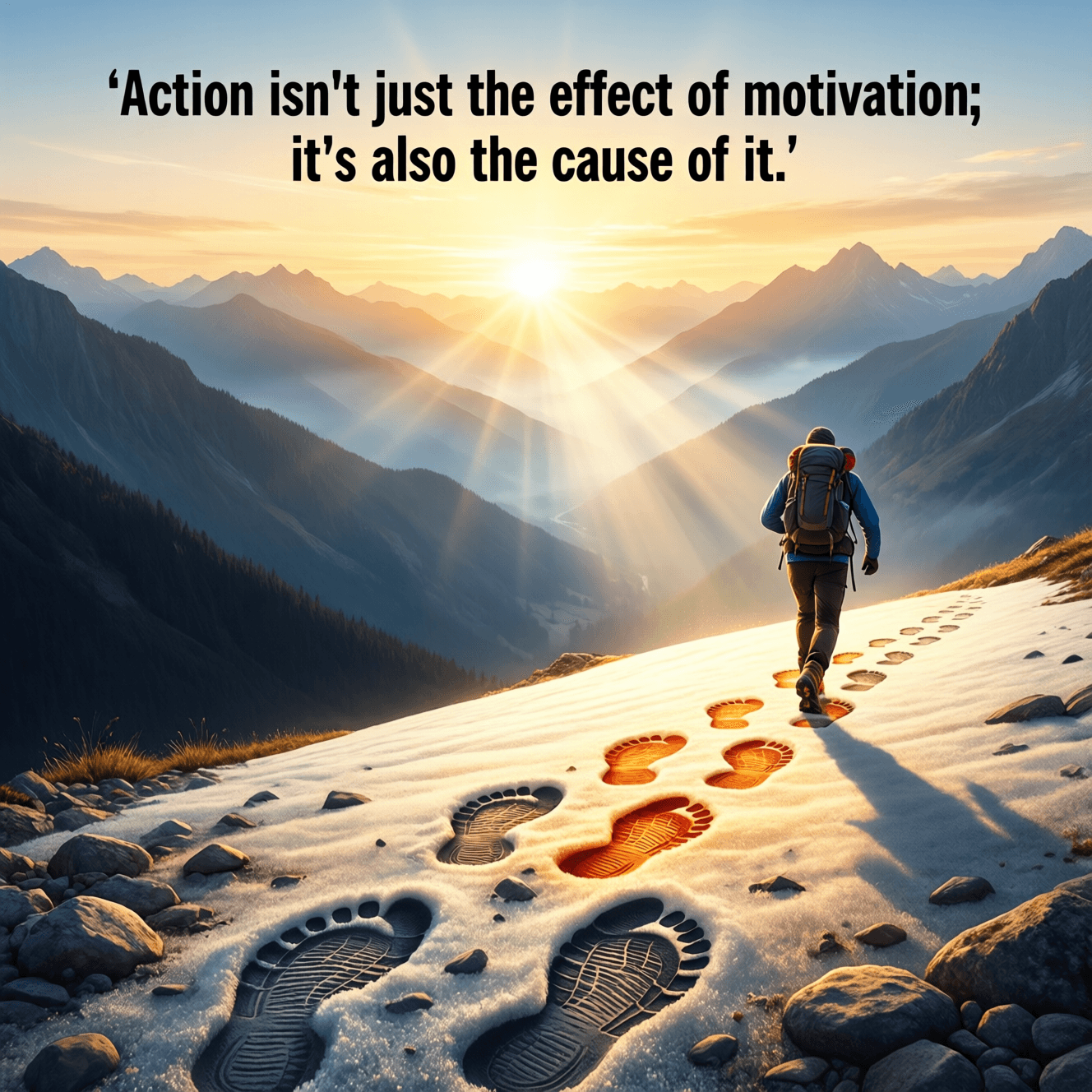
Action isn't just the effect of motivation; it's also the cause of it. — Mark Manson
—What lingers after this line?
Reversing the Usual Story of Motivation
Mark Manson’s line challenges a familiar assumption: that we must first feel inspired, confident, or ready before we can act. Instead, he argues that action can be the spark rather than the reward. In other words, waiting for motivation is often a subtle way of postponing the very behavior that would generate it. This reversal matters because it reframes stagnation. If motivation isn’t a prerequisite but a byproduct, then the path forward begins with doing something small and concrete—an email draft, a five-minute walk, a first paragraph—rather than searching for the perfect emotional state.
The Feedback Loop Between Doing and Feeling
Once you take a step, even a minor one, your mind receives new information: progress is possible, effort has a shape, and the task is no longer purely hypothetical. That shift can produce a reinforcing loop—action creates a sense of capability, which makes further action easier, which then builds momentum. This is why starting is disproportionately powerful. After the first move, uncertainty shrinks and the work becomes more navigable. As momentum builds, motivation often shows up as a lagging indicator, arriving after you’ve already begun to change your circumstances.
Behavioral Science and “Activation”
Manson’s point aligns with a core strategy in behavioral activation, a method used in cognitive-behavioral therapy for depression. Researchers such as Peter Lewinsohn (1974) emphasized that increasing constructive activity can improve mood, rather than waiting for mood to improve first. The principle is simple: behavior alters emotional state by increasing contact with rewards like mastery, social connection, or relief. In this light, motivation becomes less of a mysterious inner resource and more of a predictable outcome of engagement. By choosing actions that reliably produce positive feedback—however modest—you help your brain relearn that effort leads somewhere.
Identity Builds Through Evidence, Not Intention
Another layer is identity: people often expect to “feel like” a writer, athlete, or entrepreneur before they behave like one. Yet identity usually follows evidence. Each time you act, you cast a vote for the kind of person you are becoming, and that accumulating proof can create motivation grounded in self-trust. Consider someone who wants to run but feels unmotivated. If they lace up and jog for eight minutes three times a week, the emerging story becomes, “I’m someone who runs.” That identity-based confidence can then fuel larger goals, making motivation less fragile because it rests on repeated behavior.
Why Waiting for Motivation Often Backfires
When you rely on motivation as the starting gun, you make progress dependent on fluctuating emotions, sleep, stress, and self-doubt. Moreover, the longer you wait, the bigger the task feels, and the more your mind associates it with discomfort. This can create avoidance loops where inaction breeds guilt, and guilt drains energy that could have supported action. By acting first, you interrupt that loop. Even imperfect action—showing up late, doing a smaller version, producing a rough draft—reduces the psychological weight of the task and replaces rumination with tangible movement.
Practical Ways to Let Action Lead
A workable approach is to make action easier than deliberation. Set “minimum viable” commitments, such as writing 100 words, doing one push-up, or opening the budgeting app and categorizing just one transaction. These tiny starts lower resistance while still providing the key ingredient: evidence of follow-through. From there, transition into consistency by attaching actions to cues: after coffee, read two pages; after work, change into gym clothes; at 9:00 a.m., open the project file. Over time, the repeated actions produce competence and momentum—and, as Manson suggests, motivation emerges not as a prerequisite but as a consequence.
One-minute reflection
What feeling does this quote bring up for you?
Related Quotes
6 selectedI don't believe that external rewards should motivate a skilled craftsperson, but they can serve as an indicator of mastery. — Ryan Holiday
Ryan Holiday
At its core, Ryan Holiday’s statement separates motive from measurement. A skilled craftsperson, in this view, does not work primarily for money, praise, or status, but for the integrity of the work itself.
Read full interpretation →You cannot command things, but you can command yourself. — Michael D. Pollock
Michael D. Pollock
At first glance, Michael D. Pollock’s line draws a sharp boundary between the outer world and the inner one.
Read full interpretation →You must always be willing to work without applause. — Ernest Hemingway
Ernest Hemingway
Hemingway’s line points first to a stern but liberating truth: meaningful work often happens in silence, long before anyone notices it. In this view, applause is not the engine of effort but only an occasional byproduct.
Read full interpretation →A boundary is not a wall; it is a door with a lock that you control. — Annie Wright
Annie Wright
At first glance, Annie Wright’s quote corrects a common misunderstanding: people often treat boundaries as acts of distance or punishment, when in fact they are tools of intentional relationship. A wall shuts everyone ou...
Read full interpretation →Creativity itself doesn't care at all about results—the only thing it craves is the process. Learn to love the process and let whatever happens next happen. — Elizabeth Gilbert
Elizabeth Gilbert
Elizabeth Gilbert’s quote shifts attention away from outcomes and back to the act of making itself. In her view, creativity is not a transaction in which effort must always yield praise, profit, or permanence; rather, it...
Read full interpretation →When you feel like you are at a dead end, remember that you are at a place where you can choose a different path. — Haemin Sunim
Haemin Sunim
At first glance, a dead end feels like failure, as though movement itself has been denied. Yet Haemin Sunim’s insight gently reverses that impression: what seems like a wall may actually be a point of decision.
Read full interpretation →More From Author
More from Mark Manson →The key to a good life is not giving a fuck about more; it's giving a fuck about only what is true. — Mark Manson
Mark Manson’s quote grabs attention by using blunt language to make a careful distinction: the problem isn’t caring, but caring indiscriminately. In everyday life, people often equate a “good life” with maximizing concer...
Read full interpretation →Happiness is not found in a life without problems; it is found in the pursuit of solving good ones. Choose the struggles that are worth your sweat. — Mark Manson
Mark Manson’s line begins by dismantling a common fantasy: that happiness arrives when life finally becomes smooth. Instead, he argues that a “life without problems” is not a realistic destination, and even if it were, i...
Read full interpretation →