
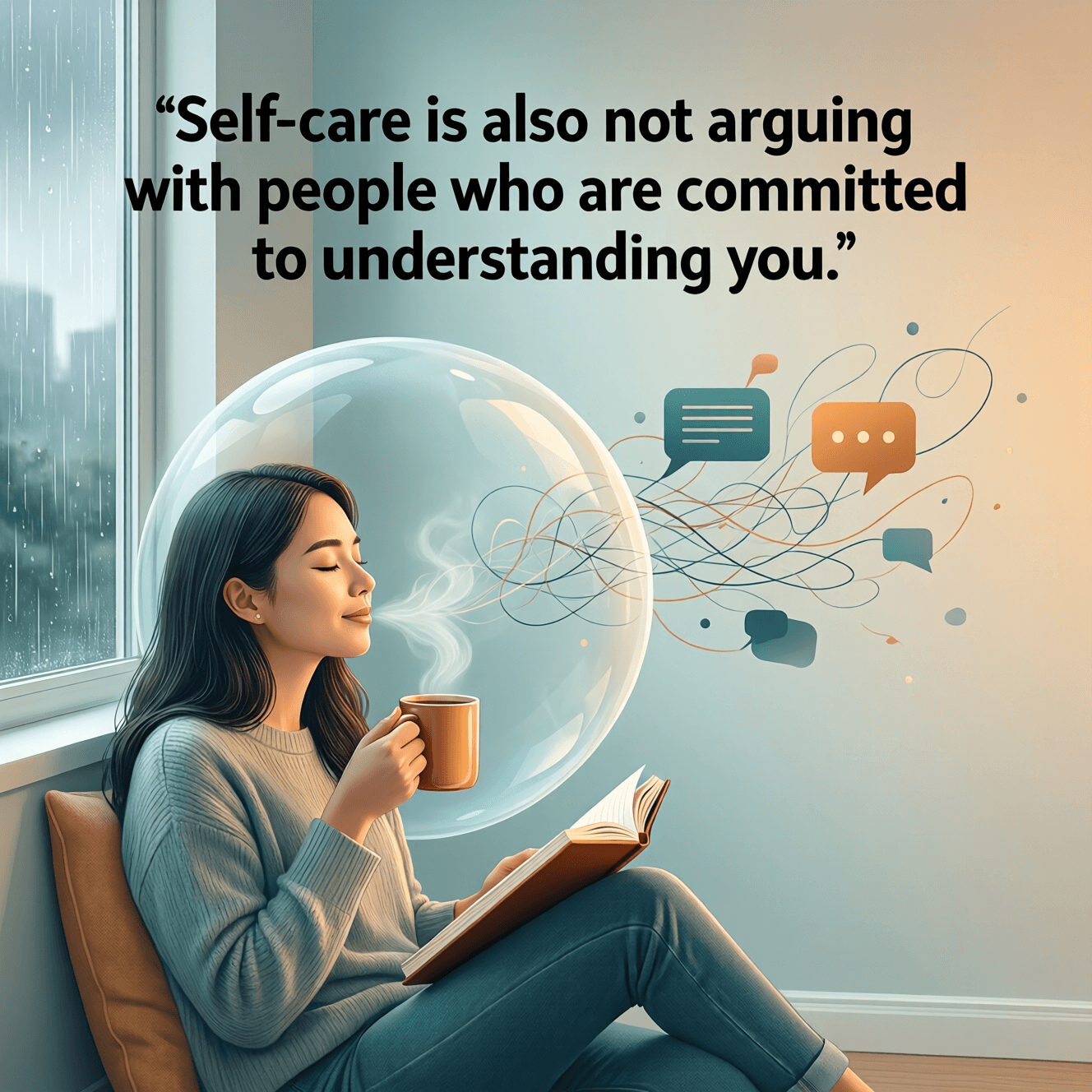
Self-care is also not arguing with people who are committed to misunderstanding you. — Ayishat Akanbi
—What lingers after this line?
Redefining Self-Care Beyond Pampering
Akanbi’s line widens the meaning of self-care from soothing rituals to strategic emotional boundaries. Instead of focusing on what feels pleasant, she points to what preserves your energy: not feeding conversations designed to drain you. In that sense, self-care becomes less about fixing your mood after conflict and more about preventing unnecessary conflict in the first place. From here, the quote invites a practical question: how do you tell the difference between a hard conversation worth having and a performative argument meant to keep you stuck?
When Misunderstanding Is a Choice
The key word is “committed.” People can misunderstand you innocently, especially across differences in culture, experience, or knowledge. But commitment implies intent: they aren’t seeking clarity; they’re seeking leverage. In these moments, every explanation becomes raw material for a new accusation, and the goalposts move as soon as you approach them. Once you recognize that pattern, the interaction changes shape—it stops being a dialogue and starts resembling a trap, where your participation is the resource being extracted.
The Futility of Arguing in Bad Faith
Arguing assumes shared rules: evidence matters, meanings can be agreed upon, and both sides might revise their view. Bad-faith engagement rejects those rules while pretending to follow them. Philosophers have long warned about this kind of exchange; Plato’s Socratic dialogues often contrast sincere inquiry with sophistry, where rhetoric is used to win rather than to understand, as in *Gorgias* (c. 380 BC). Consequently, the healthiest response may not be a better argument but a clearer refusal to play a game built for your defeat.
Emotional Labor and the Hidden Cost
Trying to be understood by someone committed to misunderstanding you demands constant emotional labor: translating yourself, softening your tone, providing context, and still being told you’re unclear or “too sensitive.” Over time, this chips away at self-trust, because you start editing your own reality to fit their narrative. The exhaustion isn’t just from the disagreement; it’s from the endless proving of your basic legitimacy. That’s why stepping back can feel like relief—your nervous system gets a break from a loop that was never designed to resolve.
Boundaries as a Form of Dignity
Refusing the argument doesn’t mean you’re unable to defend your point; it means you’re choosing dignity over depletion. A boundary can be as simple as, “I’m not discussing this with you if you keep misrepresenting what I said,” or “We can revisit this when you’re ready to listen.” These statements aren’t escapes—they’re conditions for respectful communication. And importantly, they shift the focus from winning the debate to protecting your time, your mind, and your sense of self.
Discernment: When to Clarify, When to Exit
Akanbi’s advice isn’t a ban on disagreement; it’s a call for discernment. If someone asks questions, summarizes your point fairly, or changes their stance when presented with new information, clarification is worthwhile. But if they repeatedly distort your words, demand endless explanations, or treat your perspective as inherently suspect, exiting is often the most self-respecting option. In the end, the quote frames self-care as a quiet skill: recognizing who is reaching for understanding—and who is reaching for control—and responding accordingly.
One-minute reflection
What's one small action this suggests?
Related Quotes
6 selectedSetting boundaries is the way we care for ourselves. It is not a way to push others away, but a way to keep ourselves whole. — Melody Beattie
Melody Beattie
At its core, Melody Beattie’s statement reframes boundaries as an act of care rather than rejection. People often fear that saying no, asking for space, or naming limits will appear cold; however, Beattie suggests the op...
Read full interpretation →Self-care is not about fixing everything; it's about tending to yourself with the same consistency and care you give to others. — Erica Diamond
Erica Diamond
At first glance, Erica Diamond’s quote challenges a common misunderstanding: self-care is not a dramatic solution to every personal struggle. Instead, it is a sustained practice of noticing what you need and responding w...
Read full interpretation →Learning to listen to yourself is an act of self-care. — Accor
Accor
At its core, Accor’s quote frames self-care not as indulgence but as attention. To listen to yourself is to notice your thoughts, emotions, fatigue, and desires before they become impossible to ignore.
Read full interpretation →To me, self-care does not mean going to the spa. It's learning to say no. — Tracee Ellis Ross
Tracee Ellis Ross
Tracee Ellis Ross challenges a popular, consumer-friendly version of self-care that equates wellness with treats and aesthetics. By contrasting the spa with the simple act of saying no, she shifts the definition from som...
Read full interpretation →Self-care is more than a spa day. It is the ability to say no to people and situations that drain your energy. — Nedra Glover Tawwab
Nedra Glover Tawwab
Nedra Glover Tawwab’s quote begins by dismantling a common misconception: that self-care is primarily about treats, products, or occasional relaxation rituals. While comfort can be restorative, she argues that it’s not t...
Read full interpretation →You are in control of your life. Set new boundaries by removing all of the toxic people from your inner circle. — Jeanette Coron
Jeanette Coron
Jeanette Coron’s statement begins with a direct reminder: you are not merely reacting to life, but participating in its design. By saying you are in control, the quote shifts attention away from blame and toward agency,...
Read full interpretation →More From Author
More from Ayishat Akanbi →