
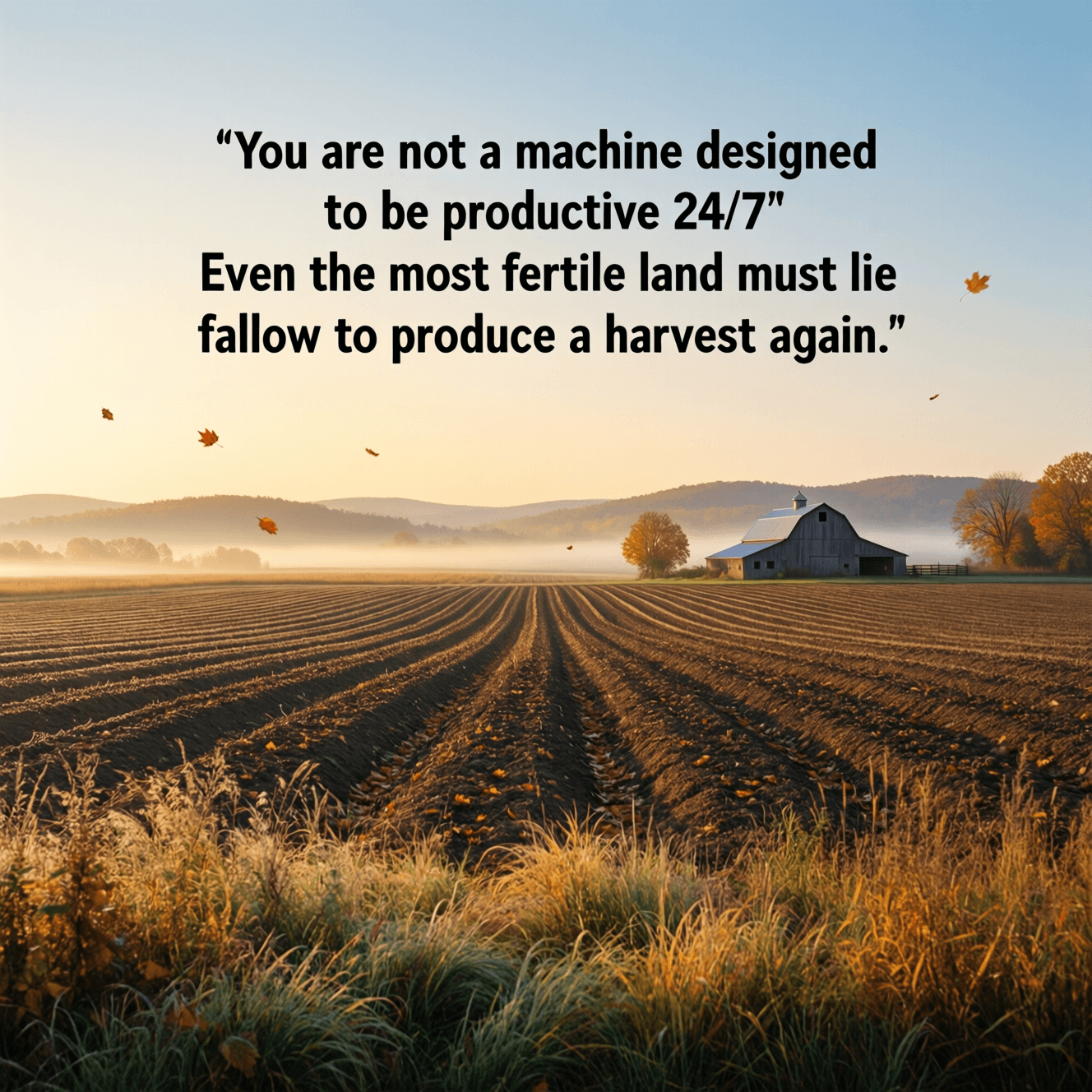
You are not a machine designed to be productive 24/7. Even the most fertile land must lie fallow to produce a harvest again. — Wendell Berry
—What lingers after this line?
A Human Rebuttal to Endless Output
Wendell Berry’s line begins by challenging a modern assumption: that our worth is measured by constant productivity. By stating plainly that you are “not a machine,” he re-centers the conversation on human limits—physical, emotional, and spiritual. In doing so, he frames rest not as a luxury or a reward, but as an essential condition of being human. From there, the quote subtly shifts responsibility away from individual “willpower” and toward a broader understanding of how life actually works. If we accept that humans aren’t built for continuous extraction, then exhaustion isn’t a personal failure—it’s a predictable result of treating people like engines.
The Fallow Field as Moral Metaphor
Berry’s second sentence deepens the point through agriculture, a world where consequences can’t be negotiated away with slogans. The image of fertile land lying fallow evokes a practice older than industrial timekeeping: pausing cultivation to restore the soil’s strength. This is not idleness; it’s stewardship. That transition—from “you” to “land”—matters because it widens the claim into an ethic. If even soil, the very symbol of generative capacity, requires intervals of non-production, then rest becomes a principle of renewal rather than a lapse in discipline. The metaphor insists that sustainability is not passive; it is chosen.
Cycles, Seasons, and the Reality of Renewal
Once the agricultural metaphor is in place, the quote invites a seasonal view of work. Fields do not produce year-round; they follow rhythms of planting, growing, harvesting, and recovery. Berry’s phrasing implies that human creativity and labor follow similar arcs—periods of high output naturally demand periods of restoration. Seen this way, rest is not the opposite of productivity but one of its phases. The “harvest again” at the end of the quote ties renewal directly to future fruitfulness, suggesting that what looks like pause in the short term is actually continuity in the long term.
Burnout as Overcultivation of the Self
The fallow-field image also offers a clear diagnosis of burnout: it resembles overcultivation. When land is pressed to yield without replenishment, it erodes; when a person is pressed to perform without recovery, attention frays, judgment narrows, and even simple tasks become heavy. Berry’s point lands because it is both practical and compassionate—fatigue is not merely inconvenient, it is informative. In that light, rest becomes an act of listening. It acknowledges that diminished returns are a signal, much like depleted soil, and that pushing harder may worsen the underlying problem rather than solve it.
Rest as a Practice of Stewardship
Moving from diagnosis to remedy, Berry implicitly frames rest as stewardship—of one’s body, time, and inner life. Just as a careful farmer plans for soil health, a careful person plans for recovery: sleep, unstructured time, play, quiet, or simply doing less. These are not indulgences but maintenance of the conditions that make good work possible. This framing also changes the emotional texture of resting. Instead of guilt, rest can carry intention: a decision to protect the capacity to care, to think well, and to remain present—qualities that overwork steadily depletes.
A Different Standard for a Good Life
Finally, Berry’s quote gestures toward a broader cultural critique: a society that demands 24/7 output forgets that humans are not commodities. By rooting his argument in the natural world, he proposes a standard for living that values continuity over acceleration and depth over volume. The concluding promise—“to produce a harvest again”—keeps the message grounded and hopeful. Rest is not retreat from responsibility; it is the condition for returning with more wisdom, patience, and strength. In Berry’s view, the most durable productivity is the kind that honors limits rather than denying them.
Recommended Reading
As an Amazon Associate, we earn from qualifying purchases.
One-minute reflection
What does this quote ask you to notice today?
Related Quotes
6 selectedRest when you're weary. Refresh and renew yourself, your body, your mind, your spirit. Then get back to work. — Ralph Marston
Ralph Marston
Ralph Marston’s quote begins with a simple but often ignored truth: weariness is not a moral failure but a signal. When he says to rest when you’re weary, he reframes pause as part of effort rather than its opposite.
Read full interpretation →Rest is not a reward for work; it is the source of work. — Tricia Hersey
Tricia Hersey
Tricia Hersey’s line flips a deeply familiar script: instead of treating rest as something we earn after proving our worth, she frames it as the starting point that makes meaningful effort possible. In this view, work do...
Read full interpretation →Do not mistake exhaustion for a lack of talent; even the deepest wells need time to refill their waters. — Maya Angelou
Maya Angelou
At its core, Maya Angelou’s line asks us to make a crucial distinction: being drained is not the same as being deficient. People often interpret a season of low output as proof that they have lost their gifts, yet Angelo...
Read full interpretation →It is okay to rest. To recede. — Sanober Khan
Sanober Khan
At its heart, Sanober Khan’s line offers something many people struggle to grant themselves: permission. “It is okay to rest” does not frame rest as a reward for exhaustion or a luxury earned after productivity; instead,...
Read full interpretation →You don't have to earn your right to slow down. — Dr. Thema Bryant
Dr. Thema Bryant
At first glance, Dr. Thema Bryant’s line sounds simple, yet it quietly confronts a powerful modern belief: that rest must be justified by exhaustion, productivity, or achievement.
Read full interpretation →Rest is the sweet sauce of labor. — Plutarch
Plutarch
At first glance, Plutarch’s line turns work and rest into a simple culinary image: labor is the meal, and rest is the sauce that makes it satisfying. The point is not that work alone is noble or that rest alone is pleasu...
Read full interpretation →More From Author
More from Wendell Berry →To cultivate anything—a garden, a skill, a soul—requires the courage to wait for what you have planted. — Wendell Berry
At first glance, Wendell Berry’s quote seems to praise patience, yet it goes further by naming patience as courage. To plant anything—a seed, a habit, a belief in oneself—is to act without immediate proof of success.
Read full interpretation →Nobody can discover the world for somebody else. Only when we discover it for ourselves does it become common ground and a common bond. — Wendell Berry
Wendell Berry begins with a simple but demanding truth: no one can hand another person a fully lived understanding of the world. Facts can be taught, maps can be drawn, and advice can be offered, yet genuine knowledge re...
Read full interpretation →We must learn to treat our own hearts with the same patience and steady hand we would offer to a piece of fine, delicate wood. — Wendell Berry
Wendell Berry’s line begins with a striking comparison: the human heart is like fine, delicate wood, something beautiful yet easily damaged by haste or rough treatment. In that image, he shifts self-regard away from judg...
Read full interpretation →The Earth is what we all have in common. — Wendell Berry
Wendell Berry’s line sounds almost obvious at first, yet its force comes from how quickly it dissolves our usual divisions. Before nationality, ideology, or profession, we inhabit the same planet with the same basic depe...
Read full interpretation →