
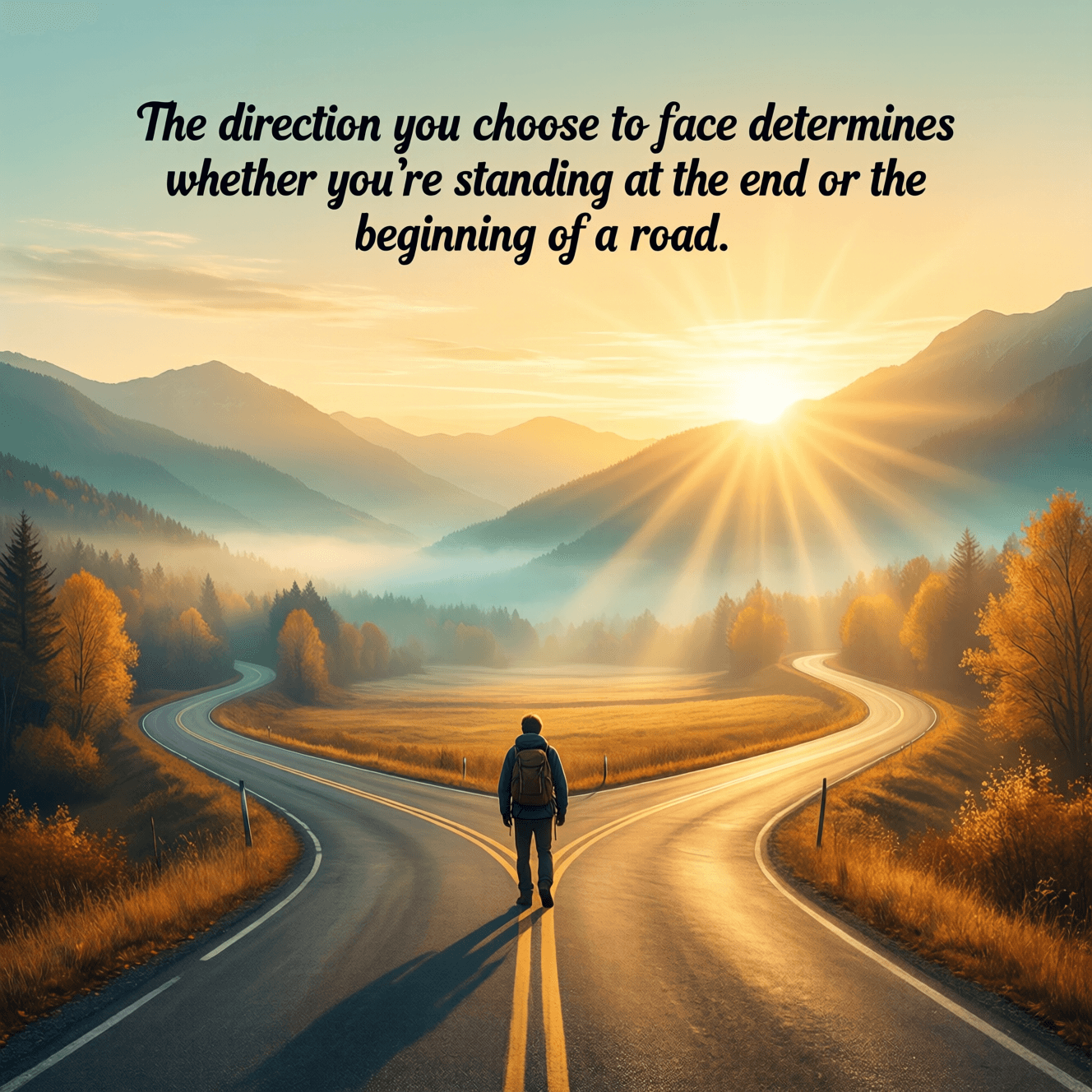
The direction you choose to face determines whether you're standing at the end or the beginning of a road. — Richelle E. Goodrich
—What lingers after this line?
A Road Defined by Where You Stand
Richelle E. Goodrich’s line frames life as a single road that can look like an ending or a beginning depending on where you choose to face. The path itself may be unchanged—same terrain, same distance, same landmarks—yet its meaning shifts the moment you pivot your gaze. In that sense, the quote isn’t denying real hardships or final chapters; it’s highlighting how interpretation shapes experience. From the outset, Goodrich invites a subtle reorientation: rather than asking whether you’ve arrived too late or started too soon, you ask what becomes possible when you decide to look forward.
Endings as a Matter of Orientation
When you face backward, what you see is closure: what’s finished, what can’t be revised, what has already been spent. That view can be truthful and even necessary—grief and reflection help us integrate what happened. Yet, turning that same road into an “end” can also trap you in a permanent postscript. By contrast, facing forward does not erase loss; it simply prevents loss from becoming the only narrative. This transition from retrospection to orientation is the quote’s central move: the road is continuous, but your stance decides which chapter you’re reading.
The Agency Hidden in a Simple Turn
The power in the statement lies in its emphasis on choice: “the direction you choose to face.” Goodrich locates agency not in controlling the road—often we can’t—but in choosing the viewpoint that governs your next step. Even small choices of attention can reframe the day: noticing what remains open, what can still be built, what lesson can be applied. In practical terms, this can look like ending a job and deciding whether the story is “I was rejected” or “I’m now available for a better fit.” The facts are similar, but the posture changes what you attempt next.
Time’s Arrow and the Meaning of Progress
Because time only moves one way, the road inevitably accrues behind you. Still, the quote suggests that progress is not merely movement through time; it’s the meaning you assign to that movement. This resonates with classic reflections on perception and reality—Marcus Aurelius’ *Meditations* (c. 170–180 AD) repeatedly returns to the idea that judgments, more than events, shape inner life. Following that thread, facing the “beginning” is less about optimism and more about alignment with time’s direction: since the next moment must arrive, the question becomes whether you meet it as a continuation or a conclusion.
Memory, Regret, and the Backward Pull
Of course, facing forward can be difficult when memory keeps tugging you back. Regret, nostalgia, and unresolved conflict make the “end of the road” feel like the only honest view. Yet Goodrich’s wording doesn’t demand denial; it implies a deliberate practice—turning toward the future even while carrying the past. A helpful way to see the transition is to treat memory as information rather than destination. You can consult it without inhabiting it. In that middle space, reflection becomes a tool for navigation, not a reason to stop walking.
Choosing a Direction in Real Life
Ultimately, the quote becomes most vivid in moments of change: graduation, divorce, relocation, recovery, retirement. The same doorway can be framed as an exit or an entrance. In Viktor Frankl’s *Man’s Search for Meaning* (1946), he argues that meaning can be found even under constraint; Goodrich’s line complements this by showing that meaning also depends on where you aim your attention once the constraint lifts. In closing, the road does not magically transform when you turn around—but you do. And that shift, repeated consistently, is often how beginnings quietly replace endings.
One-minute reflection
Why might this line matter today, not tomorrow?
Related Quotes
6 selectedWhen something in your life dies—whether it be a job, a hobby, or a dream—I encourage you not to focus on what could have been but instead to look for the new life and the new opportunities that result. — Ryan Hall
Ryan Hall
Ryan Hall frames loss as a kind of death, and that metaphor immediately broadens the quote beyond grief in the literal sense. A job can end, a cherished hobby can fade, and a long-held dream can collapse; yet in each cas...
Read full interpretation →It is a new dawn, it is a new day, it is a new life for me, and I am feeling good. — Nina Simone
Nina Simone
At its core, Nina Simone’s line turns ordinary time—dawn, day, life—into a sequence of renewal. Each phrase builds on the last, moving from the external world to the speaker’s inner state, until the declaration “I am fee...
Read full interpretation →You can start anew at any given moment. Life is just the passage of time and it is up to you to pass it as you please. — Charlotte Eriksson
Charlotte Eriksson
Charlotte Eriksson’s quote begins with a radical reassurance: renewal does not require permission from the past. By saying that you can start anew at any given moment, she shifts attention away from old mistakes and towa...
Read full interpretation →If you want to go somewhere, you have to know where you are. And here is as good a place as any to start. — Katniss Everdeen
Katniss Everdeen
Katniss Everdeen’s line turns a simple truth into practical wisdom: progress begins with honest self-location. Before anyone can chart a path toward change, they must first understand their present condition—emotionally,...
Read full interpretation →There will come a time when you believe everything is finished. That will be the beginning. — Louis L'Amour
Louis L'Amour
At first glance, Louis L'Amour’s line sounds bleak, as though it pauses at the very edge of defeat. Yet the sentence pivots on its final promise: the moment we believe everything is over may actually mark the threshold o...
Read full interpretation →Nature is infinitely creative. It is always producing the possibility of new beginnings. — Marianne Williamson
Marianne Williamson
Marianne Williamson’s reflection begins with a quiet but radical claim: creativity is not rare, accidental, or confined to human artists. Instead, it is built into nature itself.
Read full interpretation →More From Author
More from Richelle E. Goodrich →The most delicious fruit didn't come from a tree that was planted yesterday. Growth is there, even when you're frustrated by its slow speed. — Richelle E. Goodrich
Richelle E. Goodrich compares meaningful growth to fruit that takes time to mature, and the image immediately reframes impatience.
Read full interpretation →The most important form of respect is self-respect. Not only does it show others how to treat themselves, it teaches them how to treat you. — Richelle E. Goodrich
Richelle E. Goodrich begins with a clear hierarchy: before respect can be exchanged outwardly, it must first be established inwardly.
Read full interpretation →When you stand confident in your own worth, respect follows. — Richelle E. Goodrich
Richelle E. Goodrich’s statement begins with a simple but powerful premise: respect often starts from within.
Read full interpretation →Every sunrise is an invitation for us to arise and brighten someone's day. — Richelle E. Goodrich
The quote implies that each sunrise represents a new beginning and offers us a fresh opportunity to have a positive impact on others.
Read full interpretation →