
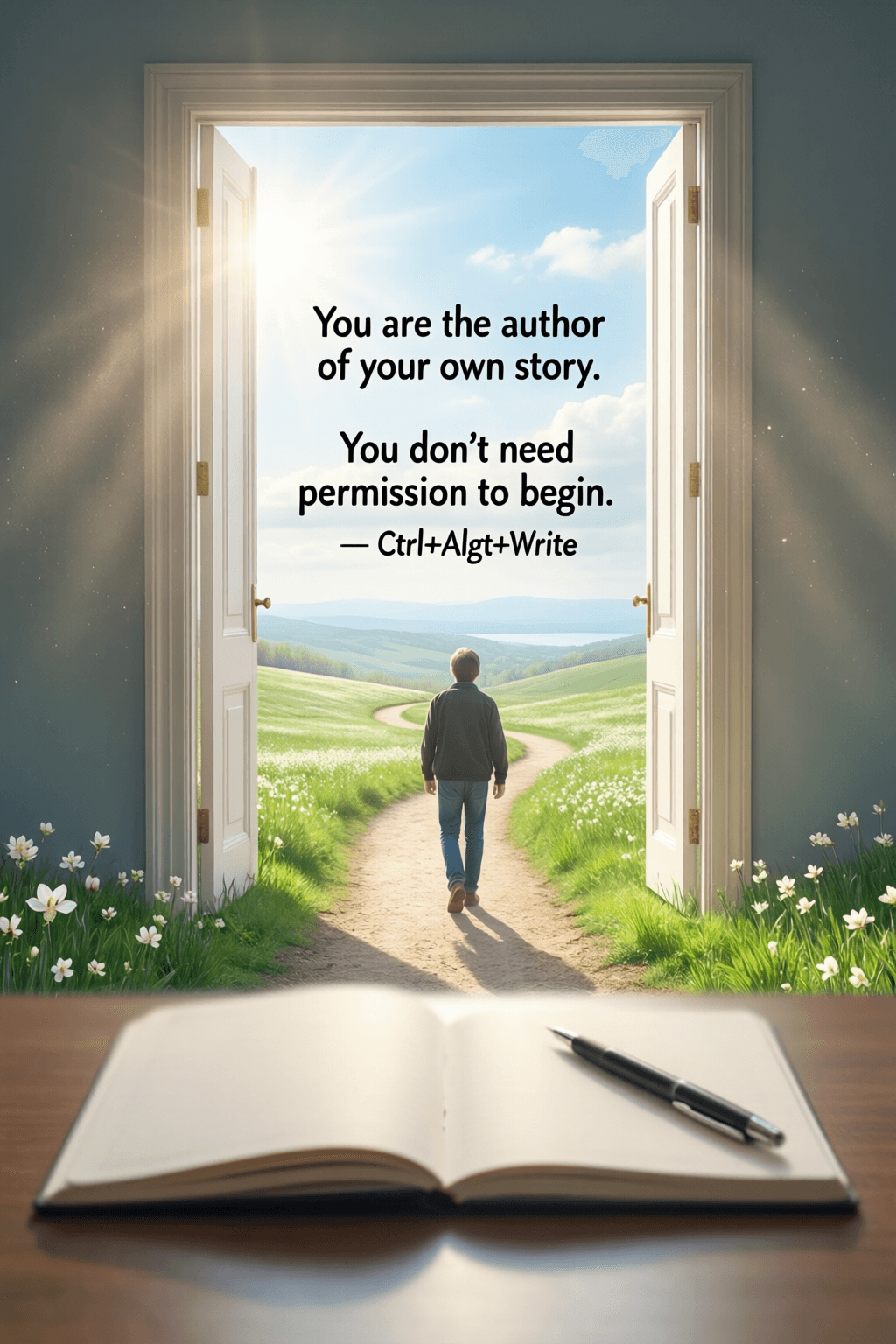
You are the author of your own story. You don't need permission to begin. — Ctrl+Alt+Write
—What lingers after this line?
Reclaiming the Pen
The quote opens with a bracing premise: your life is not merely something that happens to you, but something you shape. By calling you “the author,” it reframes identity from a fixed description into an ongoing draft—revisable, editable, and directed by choice. In that sense, authorship becomes less about talent and more about agency. From there, the line quietly challenges the habit of waiting for an external green light. If you are writing the story, the default posture is initiative, not permission-seeking, and that shift alone can change how you interpret setbacks, delays, and uncertainty.
Permission as a Hidden Plot Device
Yet the quote’s second sentence names a common obstacle: the belief that someone else must approve your beginning. Permission can look like credentials, confidence, the “right time,” or a nod from an authority figure, but it often functions as a convenient pause button. You remain safe from failure so long as you remain “preparing.” In contrast, the quote treats waiting as an optional subplot, not the main narrative. Once you see permission as a psychological device rather than a real requirement, you can start noticing where you’ve outsourced decisions—career moves, creative projects, relationships—to imagined gatekeepers.
Beginnings Are Drafts, Not Declarations
The command to begin can sound grand, but most meaningful beginnings are modest and even messy. A first page is rarely a masterpiece; it is simply evidence that the story has started. This aligns with the pragmatic spirit of Anne Lamott’s “shitty first drafts” in Bird by Bird (1994), which argues that progress depends on allowing early work to be imperfect. With that in mind, the quote implies a gentler truth: you don’t begin because you are ready; you begin to become ready. Momentum, not mastery, is the bridge between intention and identity.
Ctrl+Alt+Write: A Cultural Metaphor for Reset
The attribution “Ctrl+Alt+Write” cleverly echoes “Ctrl+Alt+Del,” the familiar computer shortcut for restarting a stuck system. By swapping “Delete” for “Write,” it suggests a different response to being stuck: not erasing yourself, but re-authoring what comes next. The metaphor makes change feel technical and doable—like a reset sequence rather than a personality transplant. Consequently, the quote positions writing as an action, not merely a metaphor. Whether the “story” is a literal book, a career pivot, or a new habit, the reset happens through concrete output: words on a page, an application sent, a conversation initiated.
Narrative Identity and the Stories You Inherit
At a deeper level, the quote pushes against inherited scripts—the roles assigned by family, culture, or earlier versions of yourself. Psychologist Dan McAdams’ work on narrative identity (e.g., The Stories We Live By, 1993) describes how people make meaning by constructing life stories; changing the story can change the self that inhabits it. Building on that, authorship doesn’t require denying the past; it requires reorganizing it. You can keep the same facts and still alter the arc—turning a failure into an apprenticeship, a detour into a defining chapter, or a loss into a source of values.
Small Acts as Chapter One
Finally, the quote’s real power lies in its practicality: beginning is rarely one dramatic leap, but a series of small, repeated decisions that accumulate into a plotline. A single paragraph each morning, one honest boundary, one new skill practiced for twenty minutes—these are the quiet openings that later read as turning points. And because stories are sustained through revision, the quote also implies permission to rewrite. You can start, learn, adjust, and start again; the authority comes from participation. In that way, the most faithful response to the line is not inspiration, but the next sentence.
One-minute reflection
Where does this idea show up in your life right now?
Related Quotes
6 selectedBe the hero of your own story. — Unknown
Unknown
This quote encourages individuals to take charge of their own lives and decision-making processes. It emphasizes the importance of being proactive in shaping one's destiny.
Read full interpretation →You are the artist of your own life. Don't hand the paintbrush to anyone else. — Unknown
Unknown
This quote emphasizes the importance of personal autonomy, encouraging individuals to take control of their own lives and decisions rather than allowing others to dictate their path.
Read full interpretation →Your life is a story, and you have the power to write your own ending. — Unknown
Unknown
This quote emphasizes the importance of personal agency and the ability to control one's own life. It suggests that individuals have the power to shape their own destinies through the choices they make.
Read full interpretation →You cannot command things, but you can command yourself. — Michael D. Pollock
Michael D. Pollock
At first glance, Michael D. Pollock’s line draws a sharp boundary between the outer world and the inner one.
Read full interpretation →A boundary is not a wall; it is a door with a lock that you control. — Annie Wright
Annie Wright
At first glance, Annie Wright’s quote corrects a common misunderstanding: people often treat boundaries as acts of distance or punishment, when in fact they are tools of intentional relationship. A wall shuts everyone ou...
Read full interpretation →When you feel like you are at a dead end, remember that you are at a place where you can choose a different path. — Haemin Sunim
Haemin Sunim
At first glance, a dead end feels like failure, as though movement itself has been denied. Yet Haemin Sunim’s insight gently reverses that impression: what seems like a wall may actually be a point of decision.
Read full interpretation →More From Author
More from Ctrl+Alt+Write →