
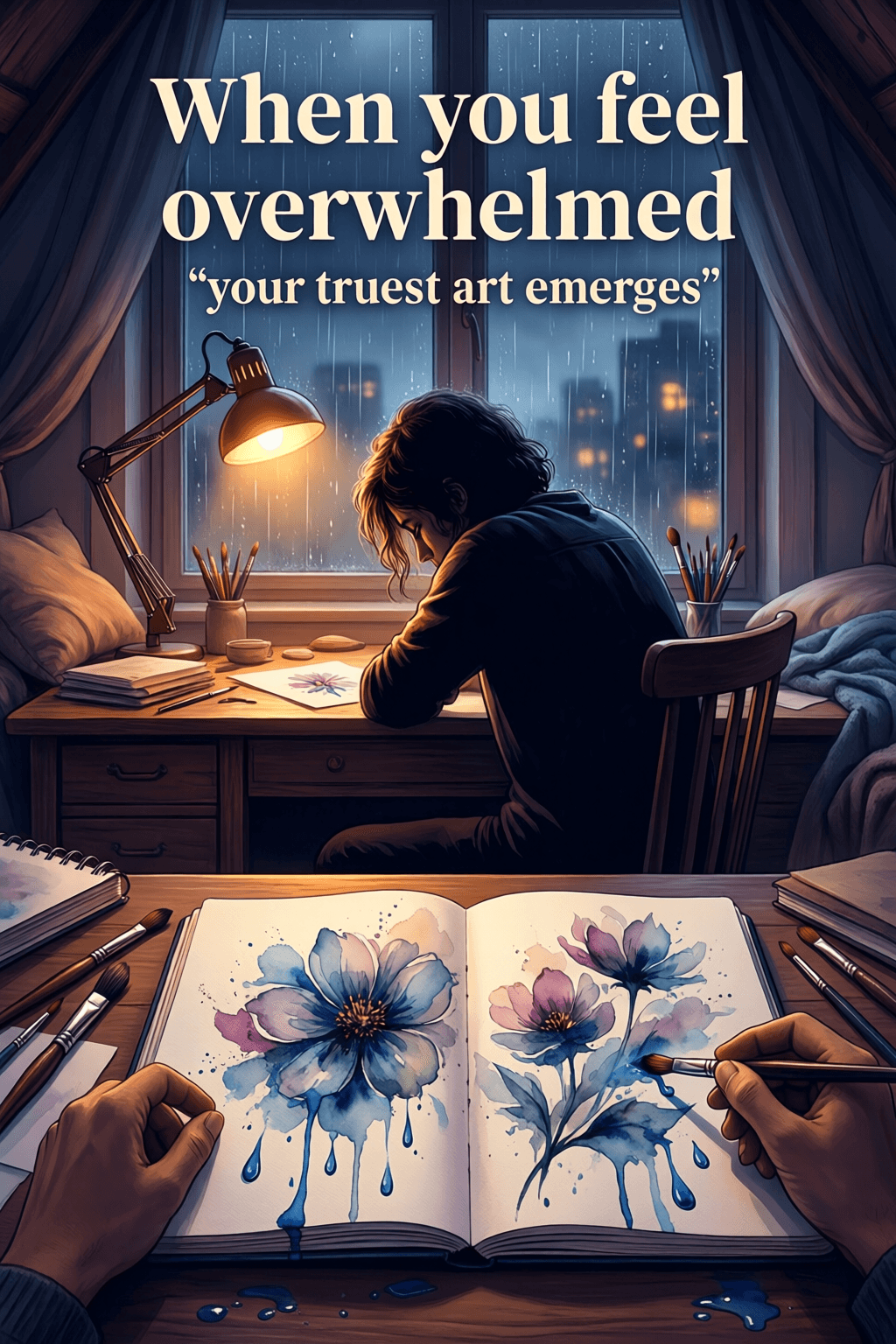
When you feel overwhelmed, remember that your truest art emerges from those moments of vulnerability. — Arastasia
—What lingers after this line?
Overwhelm as a Creative Threshold
Arastasia’s line reframes overwhelm not as a sign of failure, but as a doorway you’re standing in front of. When emotions surge past what feels manageable, they often reveal what matters most—your fears, longings, and truths you normally keep organized and hidden. In that sense, overwhelm can become a threshold moment where the inner life is too loud to ignore. From there, the quote gently suggests a pivot: rather than fighting the feeling into silence, you can treat it as information. If something in you is overflowing, it may be because it needs expression, and art becomes the container that can hold it without reducing it to mere “productivity.”
Why Vulnerability Produces Authentic Work
The heart of the message is that “truest art” comes from vulnerability—states where you’re not performing control. Vulnerability strips away rehearsed answers and forces you into honesty, which is often what audiences recognize as real. In other words, the rawness is not an obstacle to good work; it is frequently the substance of it. This idea echoes how many artists describe their breakthroughs: not when they mastered a technique, but when they stopped hiding. Even in literature, Virginia Woolf’s *A Room of One’s Own* (1929) implies that truthful writing depends on the freedom to tell the unvarnished inner experience—precisely the kind that surfaces when you feel exposed.
Pain Transformed Into Form
Still, vulnerability alone isn’t yet art; it becomes art when it’s shaped. Overwhelm is like weather—intense, shifting, hard to hold—while art is the act of giving that weather a form: a stanza, a sketch, a melody, a scene. The quote’s promise is that what feels chaotic can become coherent through making. This transformation is visible across creative history. Frida Kahlo’s self-portraits, shaped by physical suffering and emotional rupture, show how personal pain can be translated into symbolic clarity rather than mere confession. The work doesn’t deny the wound; it composes it.
The Courage to Be Seen
As the line moves from inner feeling to “truest art,” it implicitly raises the fear that comes next: if the art is true, it may expose you. Vulnerability involves risk—of misunderstanding, rejection, or simply being witnessed too closely. Yet that risk is also what gives the work its force, because it carries stakes. In practice, this can look small rather than dramatic: a songwriter choosing the specific detail they wanted to generalize, or a painter leaving the “imperfect” stroke because it conveys the right emotion. Gradually, the artist learns that being seen is not the same as being harmed, and the work grows braver.
Self-Compassion as a Creative Method
Because overwhelm can be debilitating, the quote also functions as a reminder to treat yourself gently. If vulnerability is the source material, then self-judgment is the solvent that dissolves it before it can become anything. Remembering that art can emerge from these moments invites a kinder posture: not “What’s wrong with me?” but “What is this feeling asking to say?” Modern psychology often links self-compassion with resilience; Kristin Neff’s research on self-compassion (2003) argues that kindness toward the self supports emotional regulation rather than indulgence. That steadier emotional ground makes it more possible to create from vulnerability without being consumed by it.
Turning the Moment Into a Practice
Finally, Arastasia’s reminder becomes most powerful when it’s repeatable. Overwhelm will return, and so can the ritual of translating it: a timed free-write, a voice memo, a rough sketch, a single paragraph that names the sensation without fixing it. The goal isn’t to make something polished in crisis, but to keep a channel open between feeling and form. Over time, this reframes vulnerability from an emergency into a resource. You don’t have to chase suffering to make meaningful work; you simply learn to listen when life naturally makes you tender, and to let that tenderness leave a trace that others can recognize as truth.
One-minute reflection
Why might this line matter today, not tomorrow?
Related Quotes
6 selectedThe creative process is a journey through your own vulnerability. When you stop running from the discomfort of the blank page, you finally start creating from the truth of who you are. — Brené Brown
Brené Brown
Brené Brown’s quote begins with a familiar image: the blank page as both invitation and threat. At first, that emptiness can feel exposing because it offers no place to hide behind polish, certainty, or imitation.
Read full interpretation →Authenticity requires vulnerability, transparency, and integrity. — Janet Louise Stephenson
Janet Louise Stephenson
Authenticity, as Janet Louise Stephenson frames it, is rooted in a harmony of vulnerability, transparency, and integrity. The concept extends beyond simply ‘being oneself’; it invites us to examine how genuinely we expre...
Read full interpretation →Home is the place where one finally allows the armor to drop and the spirit to breathe. — Maya Angelou
Maya Angelou
At its core, Maya Angelou’s reflection defines home not merely as a structure but as a sanctuary of emotional safety. The image of letting “the armor drop” suggests that daily life often requires protection—composure, re...
Read full interpretation →What shames us, what we most fear to tell, does not set us apart from others; it binds us together if only we can take the risk to speak it. — Brené Brown
Brené Brown
At first glance, Brené Brown’s insight appears paradoxical: the very experiences we hide for fear of rejection are often the ones that make us most recognizable to others. Shame convinces people that their pain, failures...
Read full interpretation →The hardest thing about loving someone deeply is letting them see your vulnerabilities. — Catherine Gilbert Murdock
Catherine Gilbert Murdock
At first glance, Murdock’s insight seems to define love as an act of devotion toward another person. Yet the quote quickly turns inward: the hardest part is not simply feeling deeply, but allowing that feeling to expose...
Read full interpretation →To love at all is to be vulnerable. Love anything and your heart will be wrung and possibly broken. If you want to make sure of keeping it intact, you must give it to no one. — C.S. Lewis
C.S. Lewis
C.S. Lewis begins with a stark truth: to love anything at all is to accept vulnerability.
Read full interpretation →More From Author
More from Arastasia →It is never too late to pick up the brush, to start something new, to rekindle the flame of creativity within you. — Arastasia
At its heart, Arastasia’s quote rejects the quiet belief that creativity belongs only to the young or already accomplished. By saying it is never too late to pick up the brush, the line reframes artistic beginnings as ti...
Read full interpretation →The creative process is a mess, but a beautiful one. Embrace the chaos, because that is where your most authentic creations come to life. — Arastasia
At first glance, Arastasia’s quote rejects the tidy myth that meaningful art emerges from perfect planning. Instead, it frames creativity as inherently unruly, full of false starts, contradictions, and unexpected turns.
Read full interpretation →