
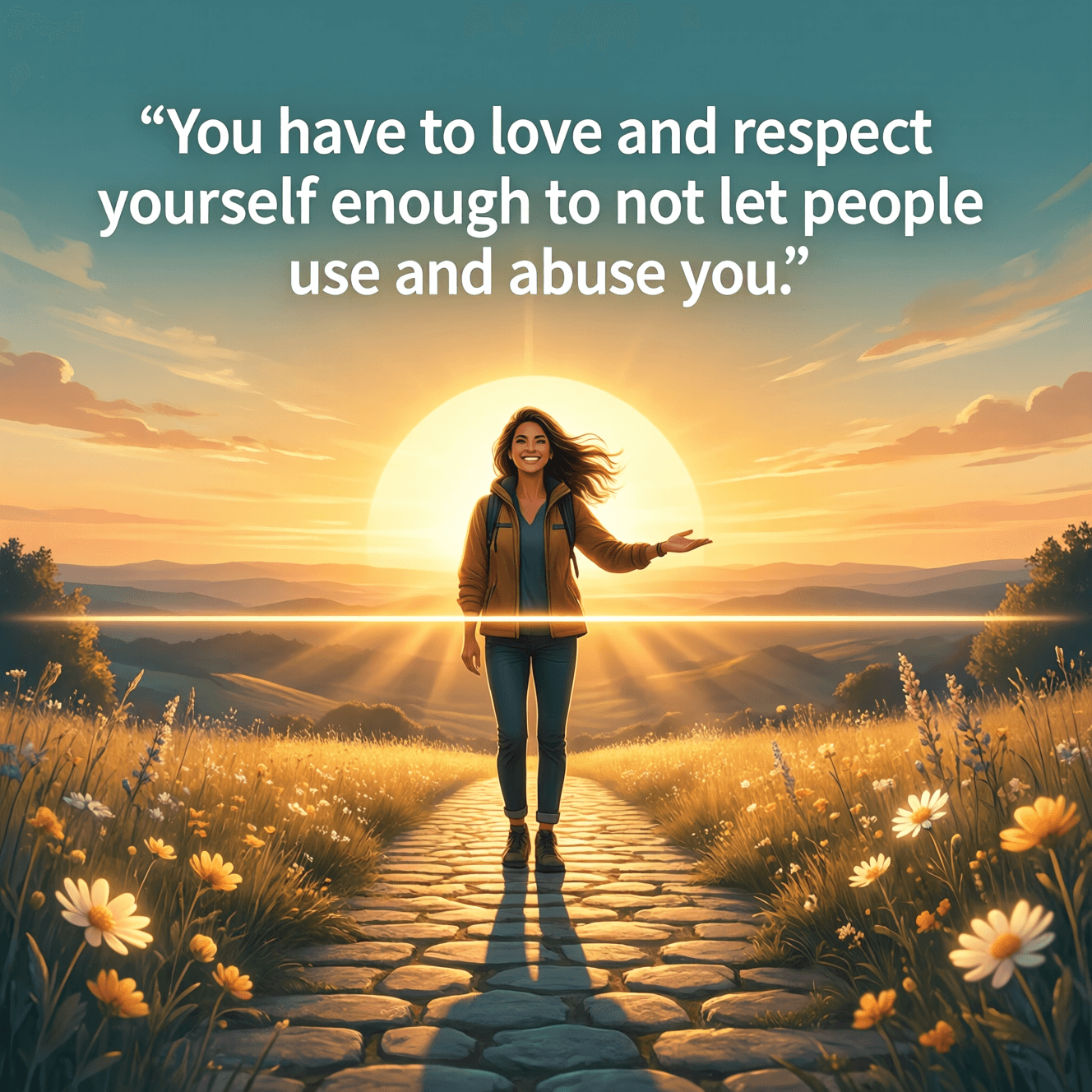
You have to love and respect yourself enough to not let people use and abuse you. Let people clearly know how you won't tolerate being treated. — Jeanette Coron
—What lingers after this line?
The Core Message of Boundaries
Jeanette Coron’s quote begins with a simple but demanding principle: self-love is not merely a feeling, but a standard of treatment. To love and respect yourself means recognizing that kindness, dignity, and fairness are not luxuries you must earn from others. Instead, they form the baseline of what you should expect in any healthy relationship. From that starting point, the quote moves naturally toward boundaries. If self-respect lives inwardly, boundaries express it outwardly. They tell others, clearly and calmly, what behavior you will not accept, transforming private worth into visible action.
Why Self-Respect Must Come First
Before anyone else can be expected to honor your limits, you must first believe those limits matter. That is why the quote places love and respect for oneself at the beginning rather than the end. Without that inner conviction, people often minimize insults, excuse manipulation, or remain in harmful dynamics because they doubt they deserve better. In this way, the statement echoes older ethical traditions. Aristotle’s Nicomachean Ethics (4th century BC) suggests that human flourishing depends on cultivating virtue and proper regard for oneself; similarly, modern therapists often note that low self-worth can make exploitation feel normal rather than unacceptable.
Recognizing Use and Abuse
Once self-respect is established, the quote asks us to identify something many people are trained to overlook: being used. Sometimes abuse is obvious, such as threats, humiliation, or control. Yet just as often it appears in quieter forms—constant emotional draining, one-sided favors, repeated guilt-tripping, or the expectation that your needs should always come last. Consequently, the message is not only about dramatic confrontation but also about discernment. Maya Angelou’s often-cited advice, “When someone shows you who they are, believe them,” captures this same wisdom. Patterns matter more than excuses, and repeated disrespect is rarely accidental.
The Power of Clear Communication
Having recognized harmful treatment, the next step is clarity. Coron does not advise vague resentment or silent endurance; instead, she emphasizes letting people clearly know what you will not tolerate. This is powerful because unspoken boundaries are easily ignored, while spoken ones create accountability and reveal who is willing to respect you. For example, a person might say, “I’m happy to help, but I won’t be spoken to that way,” or “I need honesty if this relationship is going to continue.” Such statements are not cruelty; rather, they are acts of moral self-definition. Brené Brown’s work on vulnerability and boundaries similarly argues that clear is kind, because it replaces confusion with truth.
What Boundaries Reveal About Others
After boundaries are expressed, something important happens: people show their character in response. Respectful individuals may not always agree, but they will listen, adjust, and take your limits seriously. Those who benefit from your silence, however, often react with anger, mockery, or accusations that you are selfish. Ironically, that resistance often confirms why the boundary was necessary. Thus, boundaries do more than protect you; they also clarify relationships. In many memoirs of recovery from toxic family or workplace dynamics, authors describe the same turning point: the moment they said no and finally saw who valued them as a person and who valued only their compliance.
Self-Protection Without Losing Compassion
Finally, the quote does not require hardness of heart. Loving yourself enough to reject abuse does not mean becoming cold, vindictive, or incapable of forgiveness. Rather, it means understanding that compassion without limits can become self-betrayal. You can care about someone’s struggles and still refuse mistreatment. This is where the quote reaches its fullest meaning. Healthy love—whether romantic, familial, or platonic—cannot grow where dignity is repeatedly denied. By naming what you will and will not accept, you create the conditions for relationships based not on fear or convenience, but on mutual respect.
One-minute reflection
Why might this line matter today, not tomorrow?
Related Quotes
6 selectedYou are in control of your life. Set new boundaries by removing all of the toxic people from your inner circle. — Jeanette Coron
Jeanette Coron
Jeanette Coron’s statement begins with a direct reminder: you are not merely reacting to life, but participating in its design. By saying you are in control, the quote shifts attention away from blame and toward agency,...
Read full interpretation →Respect yourself enough to say no to what does not serve you. — Marianne Williamson
Marianne Williamson
Marianne Williamson’s quote begins with a quiet but powerful premise: self-respect is not merely a feeling but a standard for action. To respect yourself enough to say no means recognizing that your time, energy, and dig...
Read full interpretation →I care for myself. The more solitary, the more friendless, the more unsustained I am, the more I will respect myself. — Charlotte Brontë
Charlotte Brontë
Charlotte Brontë’s words begin as a quiet but forceful act of self-possession. Rather than treating loneliness as proof of failure, the speaker transforms it into evidence of resilience.
Read full interpretation →If it costs my peace, it's outside my boundary. — Adam J. Jackson
Adam J. Jackson
At its core, Adam J. Jackson’s line reframes boundaries as more than rules we impose on others; they become protections for our inner life.
Read full interpretation →We can secure other people's approval if we do right and try hard; but our own is worth a hundred of it. — Mark Twain
Mark Twain
At its heart, Mark Twain argues that external approval is attainable through good conduct and honest effort, yet it remains secondary to a deeper judgment: our own. Praise from others can reassure us, but it is often cha...
Read full interpretation →It is not true belonging if you have to betray yourself in order to stay. — Anthon St. Maarten
Anthon St. Maarten
At its heart, Anthon St. Maarten’s line draws a firm boundary between acceptance and self-erasure.
Read full interpretation →More From Author
More from Jeanette Coron →You are in control of your life. Set new boundaries by removing all of the toxic people from your inner circle. — Jeanette Coron
Jeanette Coron’s statement begins with a direct reminder: you are not merely reacting to life, but participating in its design. By saying you are in control, the quote shifts attention away from blame and toward agency,...
Read full interpretation →The more you value yourself, the healthier your boundaries are. — Jeanette Coron
Jeanette Coron’s quote begins with a simple but powerful idea: the way we value ourselves determines what we allow, accept, and refuse. In that sense, boundaries are not merely rules for other people; they are outward ex...
Read full interpretation →