
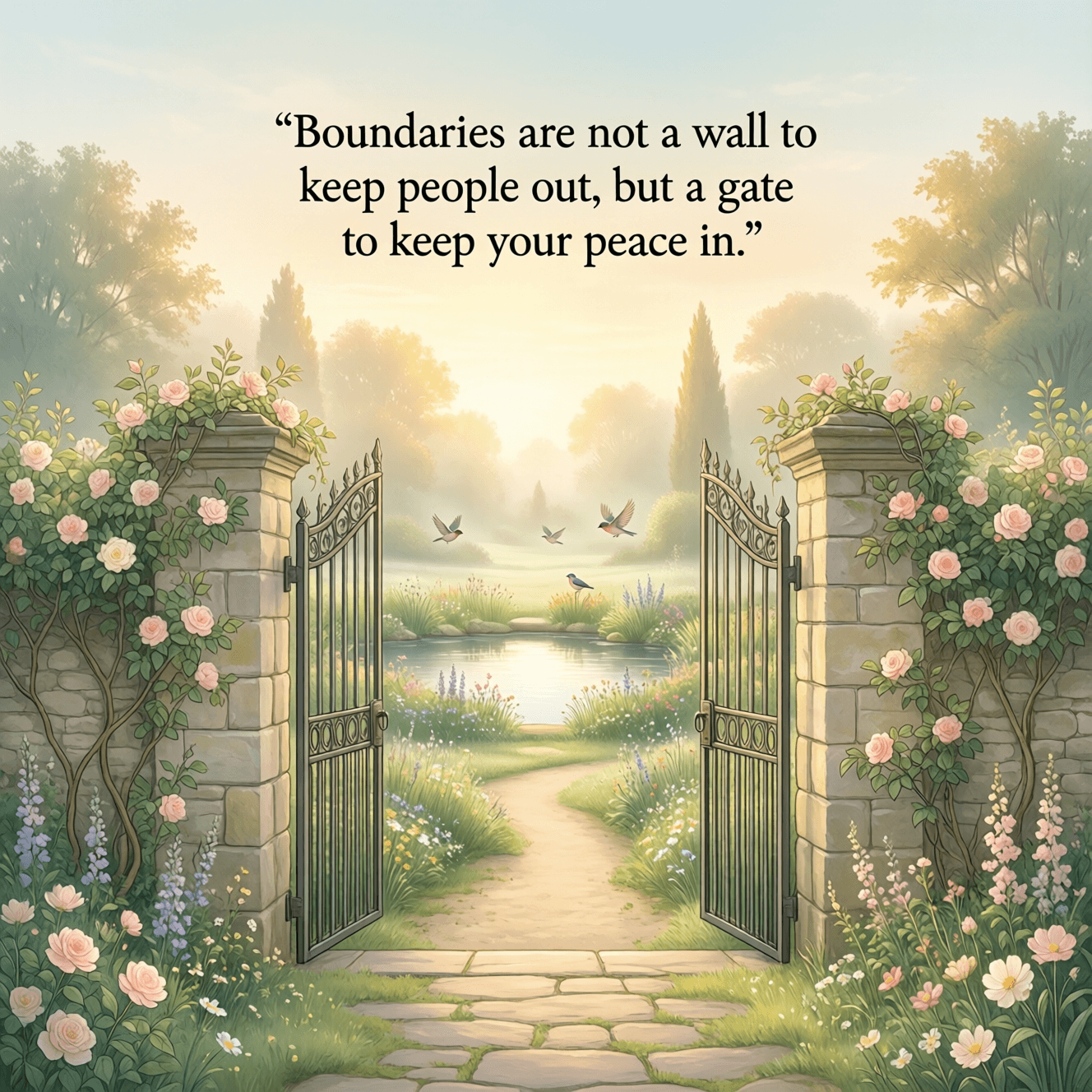
Boundaries are not a wall to keep people out, but a gate to keep your peace in. — Morgan Harper Nichols
—What lingers after this line?
Redefining What Boundaries Mean
At first glance, boundaries are often mistaken for barriers, as if setting limits automatically signals rejection. Morgan Harper Nichols reframes that assumption by describing boundaries as a gate rather than a wall. The image matters: a wall blocks everything, while a gate allows thoughtful entry. In this way, boundaries are not acts of hostility but practices of discernment. This distinction shifts the emotional tone of self-protection. Instead of seeing boundaries as cold or defensive, we begin to understand them as intentional structures that preserve calm, dignity, and emotional clarity. They do not deny connection; rather, they help ensure that connection happens in ways that do not erode one’s well-being.
Why Peace Requires Permission
From that metaphor, a deeper truth emerges: peace does not maintain itself by accident. Without limits, other people’s demands, moods, and expectations can quietly occupy the inner space where rest and stability should live. A gate suggests that access must be considered, which means peace is something we actively protect rather than passively hope to keep. In everyday life, this can be as simple as declining a call when exhausted or refusing a conversation that has become disrespectful. Psychologist Henry Cloud, in Boundaries (1992, with John Townsend), argues that clear limits help people take responsibility for their own lives. Nichols’s line echoes that insight by suggesting that peace survives when we recognize our right to choose what enters our emotional world.
The Difference Between Distance and Care
Even so, many people fear that boundaries will make them seem unkind. This is where the gate metaphor becomes especially generous. A gate can open and close; it is not permanent exile. In other words, boundaries can actually make relationships more sustainable because they replace resentment with clarity. When people know what is welcome and what is harmful, connection becomes steadier and more honest. This idea appears in relational psychology as well. Brené Brown often notes in her talks and writings, including Rising Strong (2015), that clear is kind. That phrase complements Nichols’s quote beautifully: by naming limits, we do not destroy intimacy but create the conditions for healthier closeness. Care without boundaries often becomes depletion, whereas care with boundaries can endure.
A Gentle Form of Self-Respect
As the quote unfolds in practice, it also reveals that boundaries are an expression of self-respect. To guard one’s peace is to acknowledge that the inner life has value. This is not selfishness in the shallow sense; rather, it is the recognition that emotional energy, time, and attention are finite resources. If everything is allowed in, eventually the self becomes crowded out. There is a quiet dignity in saying, “I need space,” or “I cannot carry this right now.” Such statements do not announce superiority; they affirm humanity. Much like Audre Lorde’s reminder in A Burst of Light (1988) that self-preservation can be an act of political warfare, Nichols’s words imply that protecting peace is sometimes a necessary refusal to be consumed by endless obligation.
Boundaries in Everyday Human Experience
Moreover, the quote resonates because it describes something ordinary and universal. Consider the friend who always listens but finally asks not to be texted late at night, or the employee who stops answering work messages during family dinner. These are not dramatic acts of separation. Instead, they are small gates placed around moments of rest, identity, and recovery. Such examples show that boundaries are most powerful when they are practical. They often appear in tone, timing, and consistency rather than grand speeches. By choosing when to engage and when to pause, a person shapes a life in which peace is not constantly negotiated away. Nichols’s insight therefore feels less like a slogan and more like a daily ethic.
Opening Wisely Rather Than Closing Completely
Finally, the image of a gate carries hope because it suggests both protection and possibility. A healthy life is not built by shutting everyone out, but by learning how to welcome others without abandoning oneself. The goal is not isolation; it is wise openness. That is why this quote feels so balanced: it honors connection while insisting that peace must remain at the center. Seen this way, boundaries become a form of hospitality toward the self and, indirectly, toward others as well. When peace is protected, relationships are less likely to be driven by exhaustion, anger, or silent bitterness. The gate opens, but with intention. And in that intention, Nichols offers a vision of love and selfhood that is both tender and strong.
One-minute reflection
What feeling does this quote bring up for you?
Related Quotes
6 selectedBoundaries are not walls to keep others out, but gates to protect your own nervous system. — Nedra Glover Tawwab
Nedra Glover Tawwab
At first glance, boundaries are often mistaken for rejection, distance, or emotional coldness. Yet Nedra Glover Tawwab’s image of gates rather than walls shifts the entire meaning: boundaries are not built to punish othe...
Read full interpretation →You don't set boundaries to keep people out. You set them to keep yourself intact. Because peace doesn't live where you're constantly shrinking. — Intrepid Quips
Intrepid Quips
At first glance, boundaries can seem like walls meant to exclude others, yet this quote reframes them as a form of self-preservation. The point is not rejection but protection: a boundary marks the place where a person c...
Read full interpretation →Inner peace is the key: if you have inner peace, the external world will not affect your deep sense of tranquility. — Akiroq Brost
Akiroq Brost
At its core, Akiroq Brost’s statement argues that peace is not something granted by circumstances but cultivated within. External events may still be noisy, disappointing, or unpredictable, yet they lose the power to sha...
Read full interpretation →The simplification of life is one of the steps to inner peace. — Peace Pilgrim
Peace Pilgrim
Peace Pilgrim’s statement begins with a quiet but demanding insight: inner peace is not only discovered through meditation or belief, but also through the way daily life is arranged. To simplify life is to remove what is...
Read full interpretation →You are in control of your life. Set new boundaries by removing all of the toxic people from your inner circle. — Jeanette Coron
Jeanette Coron
Jeanette Coron’s statement begins with a direct reminder: you are not merely reacting to life, but participating in its design. By saying you are in control, the quote shifts attention away from blame and toward agency,...
Read full interpretation →Breathe in calm, breathe out chaos, and anchor yourself in peace. — Lori Deschene
Lori Deschene
Lori Deschene’s words begin with a simple invitation: return to the breath. In moments of stress, the mind often rushes ahead, but breathing offers an immediate way back to the present.
Read full interpretation →More From Author
More from Morgan Harper Nichols →There is nothing wrong with slowness. All around you in nature, a billion different things move at a slow pace, just as they are supposed to. — Morgan Harper Nichols
Morgan Harper Nichols begins by challenging a common modern anxiety: the fear that moving slowly means falling behind. Her words reframe slowness not as failure, but as a natural and even necessary rhythm.
Read full interpretation →Your body remembers every moment you ignored yourself. Let today be different. — Morgan Harper Nichols
At first glance, Morgan Harper Nichols’s line suggests that the body is more than a physical shell; it is a living archive of our habits, hurts, and silences. Every time a person overrides exhaustion, suppresses grief, o...
Read full interpretation →You are worth the quiet moment. You are worth the deeper breath. You are worth the time it takes to slow down, be still, and rest. — Morgan Harper Nichols
At its core, Morgan Harper Nichols’s reflection challenges the modern habit of treating rest as something earned only after exhaustion. By saying “you are worth” the quiet moment, the deeper breath, and the time to slow...
Read full interpretation →In the middle of the mess, there is still the chance to find the grace. — Morgan Harper Nichols
Morgan Harper Nichols frames grace as something that can be found even when nothing feels resolved. Rather than treating grace as the prize at the end of a hard season, the quote suggests it can appear midstream—while th...
Read full interpretation →