
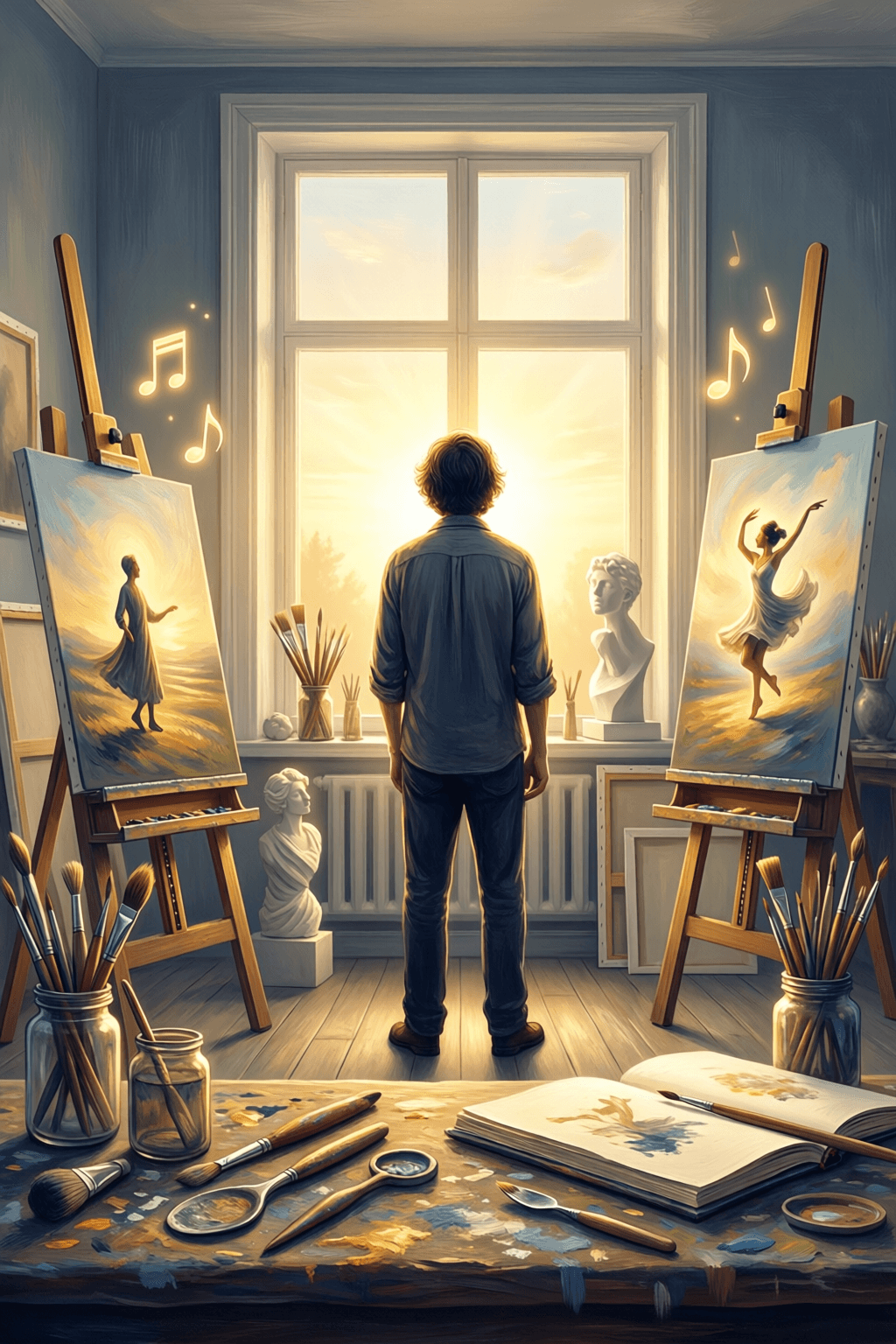
The arts are not a way to make a living. They are a very human way of making life more bearable. — Kurt Vonnegut Jr.
—What lingers after this line?
Art Beyond Income
Vonnegut’s remark begins by rejecting a narrow, economic view of creativity. In saying that the arts are not simply a way to make a living, he shifts attention from profit to purpose. Art, in this sense, is not justified by wages, markets, or status, but by its power to help people endure the weight of ordinary existence. From that starting point, the quote becomes deeply humane. It suggests that painting, music, poetry, dance, and storytelling matter because they soften suffering, organize feeling, and give shape to experiences that would otherwise remain mute. Even when art does not pay, it still gives something essential back.
A Human Need for Expression
Seen this way, the arts are not luxuries reserved for specialists; rather, they are basic forms of human expression. Long before modern professions existed, people painted cave walls, carved figures, sang around fires, and told stories to one another. The prehistoric paintings at Lascaux (c. 17,000 years ago) remind us that artistic creation emerged alongside survival itself, not after it. Therefore, Vonnegut’s words imply that art belongs to everyone. A child drawing in the margin of a notebook or a family singing at home participates in the same impulse as the celebrated artist. What matters is not prestige, but the deeply human act of making meaning.
Making Suffering Speakable
From there, the quote gains emotional depth because art often helps people face pain without being crushed by it. Grief, fear, loneliness, and confusion can feel chaotic when trapped inside, yet a poem, melody, or image can render them visible and shareable. In that transformation, suffering becomes more bearable because it is no longer shapeless. This is why so much great art emerges from hardship. Picasso’s Guernica (1937), for example, does not erase horror, but it gives horror a language. Likewise, countless personal diaries, songs, and sketches made in private moments show that artistic expression can be less about performance than survival.
Connection in a Fragmented World
Just as importantly, the arts relieve isolation by linking one person’s inner life to another’s. A novel can make a stranger’s sorrow feel familiar; a song can persuade listeners that their private heartbreak is shared. In this way, art does not merely decorate life—it builds bridges across difference, time, and silence. Vonnegut’s own fiction illustrates this beautifully. In Slaughterhouse-Five (1969), he turned the trauma of war into a form that could be approached, remembered, and discussed. Consequently, art becomes communal medicine: not a cure for suffering, perhaps, but a way of bearing it together.
Against the Logic of Utility
At the same time, the quotation quietly resists a culture that measures value only by usefulness or income. If every activity must prove its worth in financial terms, then many of life’s richest experiences begin to seem expendable. Vonnegut argues otherwise: the arts matter precisely because they nourish parts of human life that cannot be reduced to efficiency. This idea echoes Oscar Wilde’s defense of art in The Decay of Lying (1889), where he challenged strictly practical standards. Although art may not always produce money, it produces attention, reflection, delight, and resilience. Those outcomes are harder to count, yet they are central to a livable life.
A More Bearable Life
Ultimately, Vonnegut offers a generous definition of why art endures. The arts do not need to promise fame or financial stability to justify themselves. Their real gift is subtler and more universal: they help people endure, interpret, and even cherish a difficult world. Thus the quote leaves us with a quiet but powerful conclusion. To write, draw, sing, dance, or read is to participate in a form of care—for oneself and for others. Art may not always make a living, but it often makes a life feel possible.
Recommended Reading
As an Amazon Associate, we earn from qualifying purchases.
One-minute reflection
What does this quote ask you to notice today?
More From Author
More from Kurt Vonnegut Jr. →