
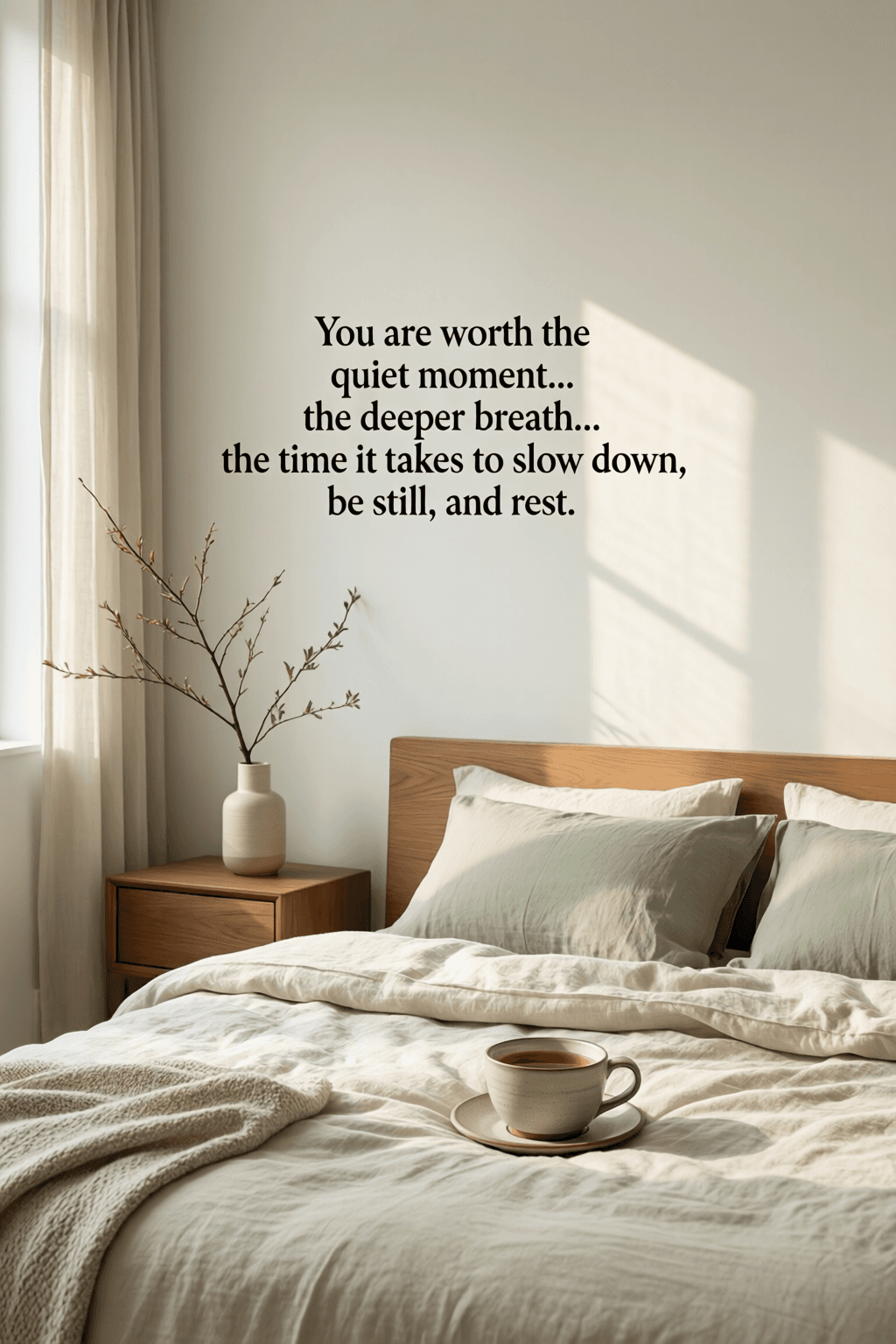
You are worth the quiet moment. You are worth the deeper breath. You are worth the time it takes to slow down, be still, and rest. — Morgan Harper Nichols
—What lingers after this line?
An Affirmation Against Constant Urgency
At its core, Morgan Harper Nichols’s reflection challenges the modern habit of treating rest as something earned only after exhaustion. By saying “you are worth” the quiet moment, the deeper breath, and the time to slow down, she frames rest not as a luxury but as a form of inherent human dignity. The quote gently resists cultures of overwork that measure value by productivity alone. In that sense, the statement becomes more than comfort; it is a correction. Instead of asking people to justify their pause, Nichols assumes their worth from the beginning. That shift matters, because once rest is rooted in worth rather than performance, stillness stops feeling indulgent and begins to feel necessary.
The Quiet Moment as Emotional Shelter
From there, the “quiet moment” can be understood as a small refuge in a noisy world. Daily life often fills every gap with alerts, obligations, and mental rehearsal, leaving little room to notice what we actually feel. Nichols’s language offers quiet not as emptiness but as shelter—a place where a person can return to themselves without needing to explain or produce anything. This idea appears across contemplative traditions. For example, Blaise Pascal’s Pensées (1670) famously observes that much human trouble arises from the inability to sit quietly in a room alone. Nichols updates that insight with tenderness: the quiet moment is not a punishment for stopping, but a gift worthy of being received.
The Deeper Breath and the Body
Just as the quote moves from quiet to breath, it also reminds us that emotional care is inseparable from the body. A deeper breath is a simple act, yet it can signal safety, release, and renewed presence. In stressful moments, people often breathe shallowly without noticing; by contrast, deliberate breathing interrupts that cycle and invites the nervous system to soften. Modern research supports this intuition. Studies summarized by Stanford neuroscientist Andrew Huberman and clinical work on slow breathing practices suggest that lengthening the breath can help regulate stress responses. Nichols’s phrasing is powerful precisely because it stays gentle: she does not command transformation, only a breath deep enough to remember that one’s body, too, deserves kindness.
Slowing Down as Resistance and Care
The quote then expands from a moment and a breath into “the time it takes” to slow down, which acknowledges that restoration rarely happens instantly. True rest often requires unhurried space, and that can feel radical in environments that reward speed. Nichols therefore presents slowness as both self-care and quiet resistance to the pressure to always be available, efficient, and moving forward. This perspective echoes themes in Tricia Hersey’s Rest Is Resistance (2022), which argues that rest is not laziness but a reclaiming of humanity from systems that exploit fatigue. Nichols expresses a similar truth in softer language: to slow down is not to fall behind, but to honor the reality that human beings are not machines.
Stillness as a Way of Listening
As the thought continues, “be still” suggests more than physical inactivity; it implies an inner settling that allows deeper awareness to emerge. In stillness, people may finally hear what constant motion drowns out—grief, gratitude, fear, hope, or the need for change. Nichols’s words make room for that encounter, presenting stillness as a compassionate practice rather than a rigid discipline. This has spiritual and literary resonances as well. Psalm 46:10, “Be still, and know,” has long linked stillness with clarity and trust. Likewise, many writers and artists have described creative insight as arriving only after periods of quiet attention. Nichols stands in that lineage, but her emphasis remains intimate: stillness is valuable because you are.
Rest as a Recognition of Worth
Finally, the repetition of “you are worth” ties the entire message together. The quote does not merely recommend better habits; it redefines rest as a response to personal worth. That distinction is crucial for people who feel guilty whenever they stop. Nichols speaks directly to that guilt by insisting that rest is not a reward waiting at the end of perfection—it is part of what a worthy life already includes. As a result, the message lands with unusual gentleness and force. It invites the reader to believe that peace, breath, slowness, and rest do not need to be defended. They can simply be accepted. And in accepting them, a person may begin to live not as someone endlessly proving their value, but as someone already possessing it.
One-minute reflection
Where does this idea show up in your life right now?
Related Quotes
6 selectedTaking a break isn't quitting; it's giving yourself the space to breathe. — Benjamin Moore
Benjamin Moore
At first glance, Benjamin Moore’s quote challenges a common fear: that stepping back means giving up. Instead, it reframes a break as an intentional act of care, a pause that preserves energy rather than abandons effort.
Read full interpretation →You do not have to earn your right to slow down. — Tessa Trelis
Tessa Trelis
Tessa Trelis’s line begins with a quiet but radical correction: rest is not a prize for productivity, nor is slowing down something we must justify with exhaustion. Instead, the quote frames rest as a basic human need, a...
Read full interpretation →You should feel beautiful, and you should feel safe. — Brené Brown
Brené Brown
Brené Brown’s words begin with a quiet insistence: beauty and safety are not luxuries to be earned, but experiences people should be able to inhabit. By pairing the two, she suggests that feeling beautiful is not merely...
Read full interpretation →The real flex is no longer looking busy; it is protecting your energy instead of constantly proving your worth. — Julee Wilson
Julee Wilson
Julee Wilson’s quote reframes what it means to be impressive in a culture that often rewards exhaustion. Rather than treating busyness as proof of ambition, she suggests that real confidence appears when a person no long...
Read full interpretation →You don't have to reach a certain milestone or work until you're completely burnt out before you grant yourself a break. — Paulo Coelho
Paulo Coelho
Paulo Coelho’s reminder begins with a quiet but radical idea: rest does not need to be earned through suffering. Many people treat breaks as rewards reserved for after the deadline, the promotion, the crisis, or the coll...
Read full interpretation →Stop abandoning yourself to keep pace with a world that never slows down. — Sophia A. Nelson
Sophia A. Nelson
Sophia A. Nelson’s words begin with a quiet but urgent warning: a world that never slows down will gladly take more from us than we can afford to give.
Read full interpretation →More From Author
More from Morgan Harper Nichols →Your body remembers every moment you ignored yourself. Let today be different. — Morgan Harper Nichols
At first glance, Morgan Harper Nichols’s line suggests that the body is more than a physical shell; it is a living archive of our habits, hurts, and silences. Every time a person overrides exhaustion, suppresses grief, o...
Read full interpretation →Boundaries are not a wall to keep people out, but a gate to keep your peace in. — Morgan Harper Nichols
At first glance, boundaries are often mistaken for barriers, as if setting limits automatically signals rejection. Morgan Harper Nichols reframes that assumption by describing boundaries as a gate rather than a wall.
Read full interpretation →In the middle of the mess, there is still the chance to find the grace. — Morgan Harper Nichols
Morgan Harper Nichols frames grace as something that can be found even when nothing feels resolved. Rather than treating grace as the prize at the end of a hard season, the quote suggests it can appear midstream—while th...
Read full interpretation →You do not have to be blooming to be growing. — Morgan Harper Nichols
Morgan Harper Nichols’ line challenges a popular assumption: that growth must be visible, impressive, or immediately rewarding. By separating “blooming” from “growing,” she reframes progress as something that can be real...
Read full interpretation →