
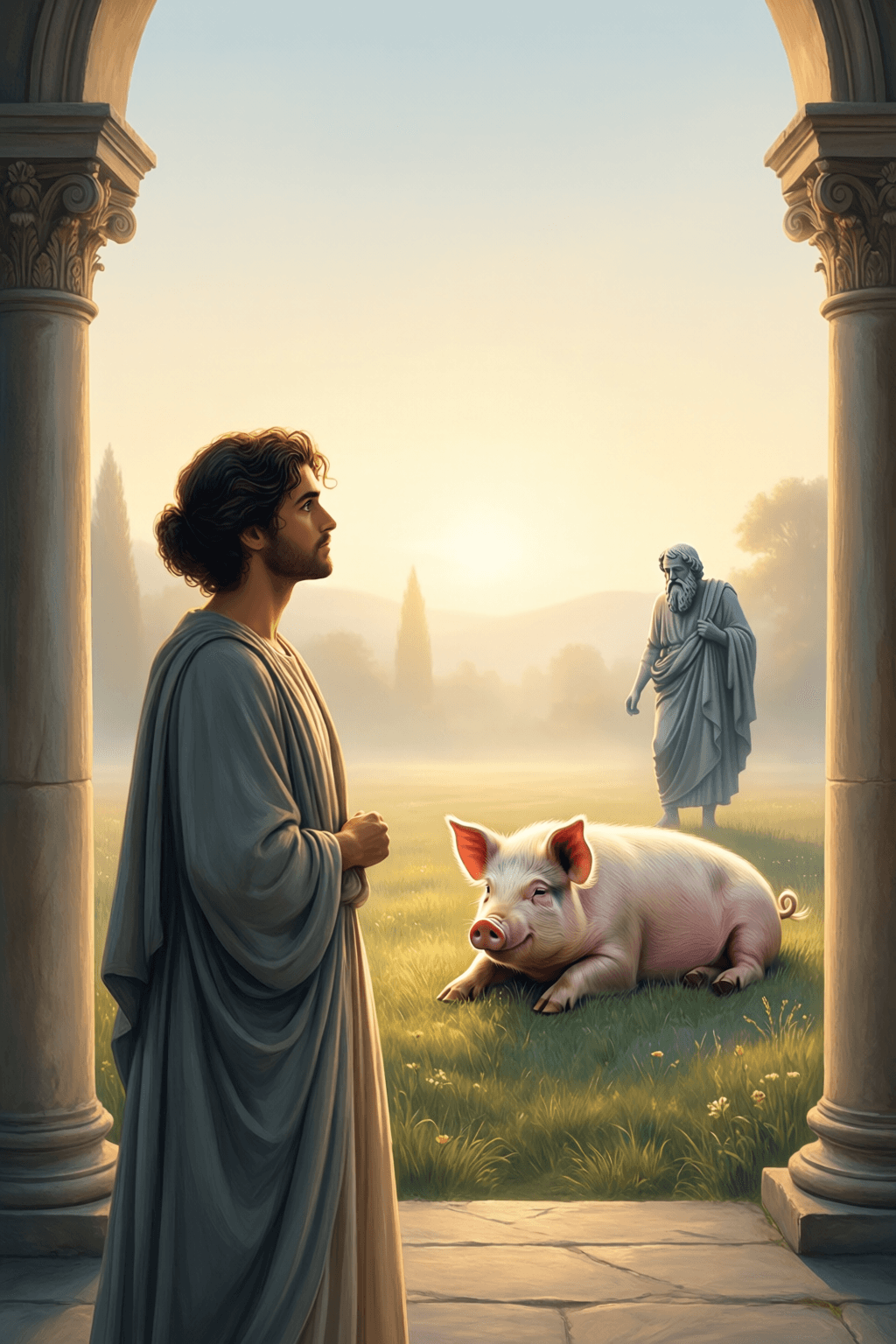
It is better to be a human being dissatisfied than a pig satisfied; better to be Socrates dissatisfied than a fool satisfied. — John Stuart Mill
—What lingers after this line?
Mill’s Hierarchy of Pleasures
At the heart of this remark, John Stuart Mill argues that not all happiness is equal. In Utilitarianism (1863), he distinguishes between lower pleasures tied to bodily comfort and higher pleasures connected to intellect, imagination, and moral awareness. Thus, a dissatisfied human or Socrates still occupies a richer form of life than a contented pig or fool, because the quality of experience matters as much as the quantity. This is why the quotation feels provocative rather than cruel. Mill is not insulting ordinary pleasure; instead, he is insisting that human dignity includes capacities that make life more complex, and often less comfortable. Once those capacities awaken, mere satisfaction can seem too small a goal.
Why Knowledge Complicates Happiness
From there, Mill’s comparison to Socrates sharpens the point: wisdom often brings unrest. The more one understands about injustice, mortality, or one’s own limitations, the harder it becomes to remain simply pleased. Plato’s Apology (c. 399 BC) presents Socrates as a man who preferred difficult truth to easy illusion, and Mill adopts that example to show that an examined life may be troubled yet still superior. In other words, dissatisfaction can be the price of awareness. A fool may feel content because he does not perceive what is missing, while a reflective person suffers precisely because he sees further. For Mill, that suffering does not diminish humanity; it confirms it.
The Moral Weight of Human Dignity
Moreover, the quote carries an ethical claim about what human beings owe themselves. To live only for comfort is, in Mill’s view, to ignore the very faculties that make moral choice possible. Reason, conscience, and imagination may produce anxiety, but they also enable justice, sympathy, and self-respect. As a result, dissatisfaction can accompany a life of principle in a way that simple gratification never can. This idea also reflects Mill’s broader liberal philosophy in On Liberty (1859), where individuality and self-development are treated as essential goods. A fully human life is not measured by ease alone, but by the cultivation of one’s best powers.
A Reply to Simple Hedonism
Seen in context, Mill is answering a classic objection to utilitarianism: if pleasure is the good, why not prefer the easiest pleasures available? His response is that people who have experienced both kinds of enjoyment reliably prefer the higher ones, even when they come mixed with frustration. Reading deeply, creating art, or wrestling with truth may be less soothing than comfort and distraction, yet they satisfy a deeper part of the self. Consequently, Mill reshapes utilitarian thought from within. He keeps the language of happiness, but he refuses to reduce happiness to sensation alone. The best life is not the one with the fewest disturbances, but the one worthy of a being capable of thought.
Modern Relevance in an Age of Comfort
Finally, Mill’s words remain strikingly current in a world that often equates well-being with convenience. Endless entertainment, algorithmic ease, and consumer comfort can keep people satisfied at a shallow level, yet many still feel intellectually or morally undernourished. Mill would likely say that this unrest is not merely a problem to eliminate but a sign that human aspirations reach beyond comfort. For that reason, the quotation endures as both warning and encouragement. It warns against mistaking passive contentment for a fully good life, and it encourages us to accept certain forms of dissatisfaction as evidence of growth. To be troubled by truth, beauty, or justice may be painful, but for Mill it is also a mark of a life lived on a distinctly human plane.
One-minute reflection
What feeling does this quote bring up for you?
Related Quotes
6 selectedI decided very early to love my family, and to see in each of its members something rare and good as well as the miserable and painful things that were obvious. — William Saroyan
William Saroyan
Saroyan begins with a striking idea: love within a family is not merely a feeling that appears on its own, but a conscious decision. By saying he “decided very early,” he frames affection as an act of will, suggesting th...
Read full interpretation →You are not a machine built for constant output; you are a human being meant for meaningful growth. — Maya Angelou
Maya Angelou
At its core, Maya Angelou’s statement challenges a culture that often measures worth by visible productivity alone. By contrasting a machine with a human being, she exposes the danger of treating life as an endless cycle...
Read full interpretation →People, more than things, have to be restored, renewed, revived, reclaimed, and redeemed; never throw out anyone. — Audrey Hepburn
Audrey Hepburn
At its heart, Audrey Hepburn’s line reverses a common habit of modern life: we often repair objects more carefully than we repair relationships. By saying that people must be “restored, renewed, revived, reclaimed, and r...
Read full interpretation →The soul that is within me no man can degrade. — Frederick Douglass
Frederick Douglass
Frederick Douglass’s line insists that there is a core of personhood that cannot be seized, even when everything else is threatened. He points to an inward refuge—“the soul that is within me”—where identity and worth rem...
Read full interpretation →You are a human being to be experienced, not a project to be optimized. — Unknown
Unknown
The quote draws a firm boundary between being and doing: a human life is meant to be lived, felt, and encountered—not managed like a performance dashboard. In a culture that prizes output, it’s easy to treat identity as...
Read full interpretation →Rest is not a reward for our productivity; it is a right for our existence. — Tricia Hersey
Tricia Hersey
Tricia Hersey’s statement flips a familiar cultural script: rest is often treated as something we earn only after proving our usefulness. By insisting it is “a right for our existence,” she places rest in the same moral...
Read full interpretation →More From Author
More from John Stuart Mill →One person with a belief is equal to a force of ninety-nine who have only interests. — John Stuart Mill
This quote highlights the immense strength that comes from unwavering belief. A person driven by deep conviction is often more impactful and determined than a group of people motivated merely by self-interest.
Read full interpretation →A person may cause evil to others not only by his actions but by his inaction, and in either case he is justly accountable to them for the injury. — John Stuart Mill
This quote highlights the idea that people bear moral responsibility not only for their direct actions but also for failing to act when action is necessary. Inaction can be as harmful as wrongful deeds.
Read full interpretation →I have learned to seek my happiness by limiting my desires, rather than in attempting to satisfy them. — John Stuart Mill
John Stuart Mill’s statement encapsulates a transformative approach to personal happiness: rather than attempting to fulfill every desire, he advocates for the conscious limitation of wants. In his own life and writings—...
Read full interpretation →