
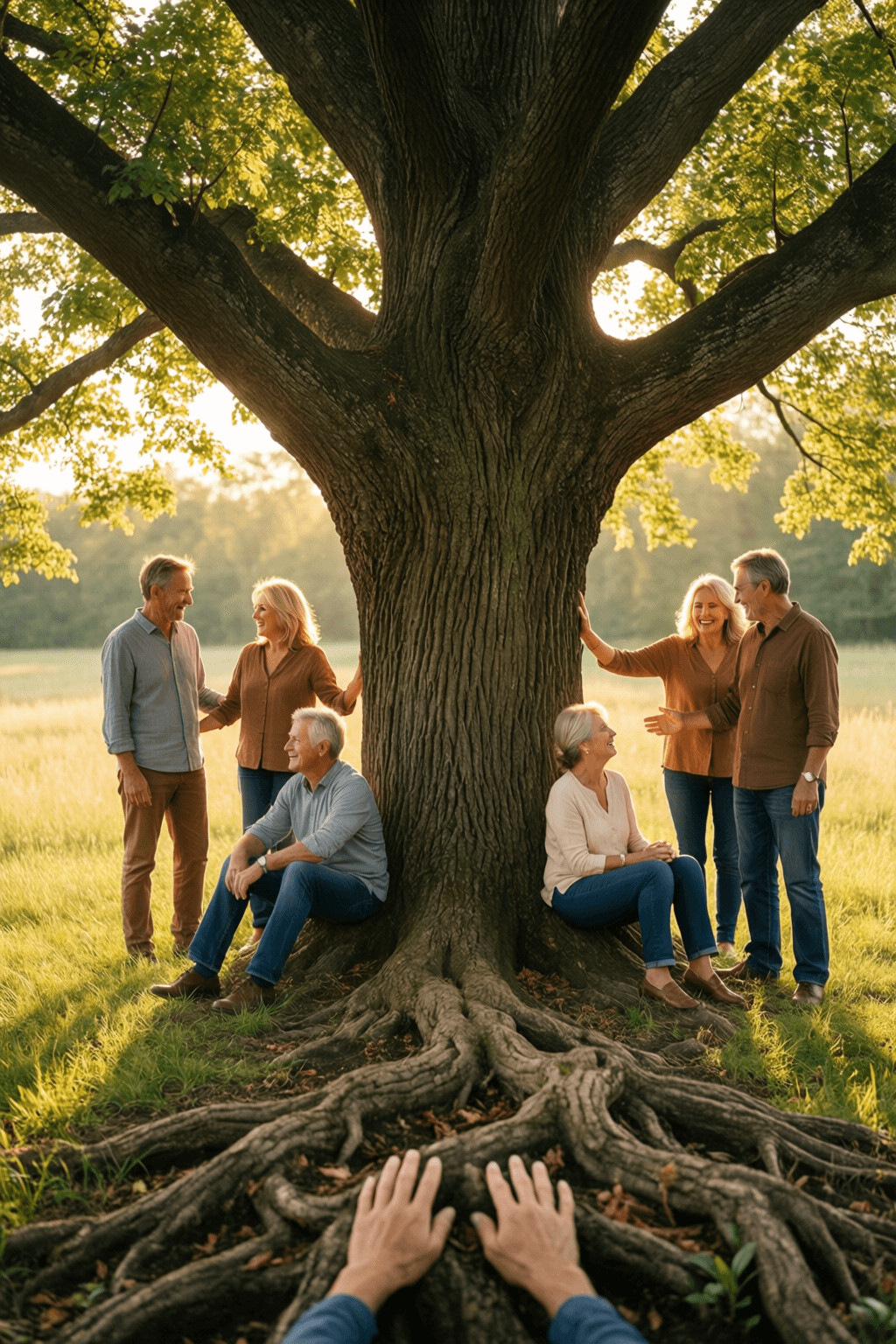
Family is like branches on a tree; we grow in different directions, yet our roots remain as one. — Justin Timberlake
—What lingers after this line?
The Central Image of the Tree
At the heart of Justin Timberlake’s quote is a simple but powerful metaphor: family resembles a tree whose branches spread outward while remaining nourished by the same roots. In this image, difference is not a threat to belonging but a natural sign of growth. Each person develops a distinct shape, reach, and direction, yet all remain connected to a common source. This comparison works so well because trees embody both stability and change. Seasons alter their appearance, storms test their strength, and branches may stretch far apart, but the unseen root system continues to hold everything together. In the same way, families may evolve through distance, disagreement, or changing life paths, while a deeper bond persists beneath the surface.
Individuality Within Belonging
From that metaphor, the quote moves naturally into a larger truth: family does not require uniformity. People raised under the same roof often become strikingly different in temperament, values, ambitions, or lifestyle. One sibling may stay close to home, another may move across the world, and a third may choose a path no one expected. Yet these differences do not erase kinship; rather, they reveal how family can contain variety without losing identity. In this sense, the branch imagery is especially generous. A tree does not demand that every limb grow in the same direction. Likewise, healthy families make room for divergence. They remind us that love is not always proven by sameness, but by the ability to remain connected even when lives unfold differently.
Roots as Shared Memory and Origin
If the branches symbolize individuality, then the roots represent what family members carry in common: shared memories, inherited habits, cultural traditions, and formative experiences. These roots are often invisible in daily life, yet they shape how people think, speak, and understand the world. Even when relatives are separated by geography or time, those early influences continue to nourish identity. For example, Alex Haley’s Roots (1976) explores how ancestry and lineage can remain spiritually powerful across generations. In a quieter everyday sense, the same is true when a certain recipe, phrase, or family story instantly restores a feeling of belonging. Thus, Timberlake’s image suggests that family unity often lives less in constant proximity than in a durable inner inheritance.
Distance Does Not Always Mean Division
Building on that idea, the quote gently challenges the assumption that closeness must always look physical or constant. Branches on a tree can extend far apart, yet they still belong to the same living organism. Similarly, family members may live in different cities, hold opposing views, or speak less often than they once did, while still remaining bound by affection and history. This perspective feels especially relevant in modern life, where migration, career demands, and personal reinvention frequently scatter relatives across continents. The image of shared roots offers reassurance: separation in space does not automatically sever connection in spirit. Indeed, many families discover that what matters most is not daily sameness, but the enduring knowledge that one can still return to a common source of care.
Resilience Through Change
The tree metaphor also carries an important lesson about resilience. Trees survive by bending, adapting, and continuing to draw strength from their roots, and families often endure in much the same way. Illness, conflict, financial strain, marriage, loss, and new generations all change the shape of family life. Still, what holds people together is often a remembered loyalty stronger than any single season of hardship. In this way, Timberlake’s words are not merely sentimental; they are practical. They imply that lasting family connection depends on tending the roots—trust, forgiveness, shared rituals, and mutual support. When these foundations remain alive, the family can withstand periods of strain just as a deep-rooted tree withstands difficult weather.
A Gentle Definition of Unity
Ultimately, the quote offers a mature definition of unity. It does not imagine family as perfect agreement or uninterrupted harmony. Instead, it presents togetherness as an underlying bond that survives difference. That is a more realistic and compassionate vision, because real families are rarely symmetrical; they are shaped by independence as much as by attachment. As a result, Timberlake’s metaphor feels both comforting and honest. It allows people to honor their own direction in life without seeing that independence as betrayal. At the same time, it reminds them that identity is rarely self-made from scratch. However far the branches may reach, the roots still matter, and in that enduring connection lies the quiet strength of family.
One-minute reflection
What feeling does this quote bring up for you?
Related Quotes
6 selectedIf the family were a fruit, it would be an orange, a circle of sections, held together but separable—each segment distinct. — Letty Cottin Pogrebin
Letty Cottin Pogrebin
At first glance, Letty Cottin Pogrebin’s image feels simple, yet it captures family structure with unusual precision. By comparing a family to an orange, she evokes something whole, rounded, and naturally unified.
Read full interpretation →Family is not defined by our genes, it is built and maintained through love. — Unknown (Wait, skipping to) Family is the best thing you could ever wish for. — Michael J. Fox
Michael J. Fox
Taken together, these two quotations broaden the idea of what family means. The first insists that family is not merely a biological fact but a relationship built through care, loyalty, and steady affection.
Read full interpretation →In truth a family is what you make it. — Marge Kennedy
Marge Kennedy
At its core, Marge Kennedy’s line challenges the idea that family is fixed solely by blood or legal ties. By saying that a family is what you make it, she shifts attention from inheritance to intention, suggesting that b...
Read full interpretation →Family is the one thing that never changes in a world of constant shifts; it is the anchor we carry even when we are miles apart. — Maya Angelou
Maya Angelou
At the heart of Maya Angelou’s reflection is a contrast between instability and endurance. The world moves through relocations, losses, ambitions, and reinventions, yet family, in its deepest sense, remains a continuing...
Read full interpretation →Other things may change us, but we start and end with family. — Anthony Brandt
Anthony Brandt
Anthony Brandt’s line begins by admitting a simple truth: life alters us. Careers, friendships, travels, and losses can reshape our habits and beliefs, sometimes so thoroughly that we scarcely recognize our earlier selve...
Read full interpretation →Maybe you are searching among the branches, for what only appears in the roots. — Rumi
Rumi
Rumi’s line opens with a quiet diagnosis: we often look for solutions where they are most visible—among the “branches,” the outward symptoms of a life—rather than where causes actually begin. In practice, this can mean c...
Read full interpretation →More From Author
More from Justin Timberlake →