
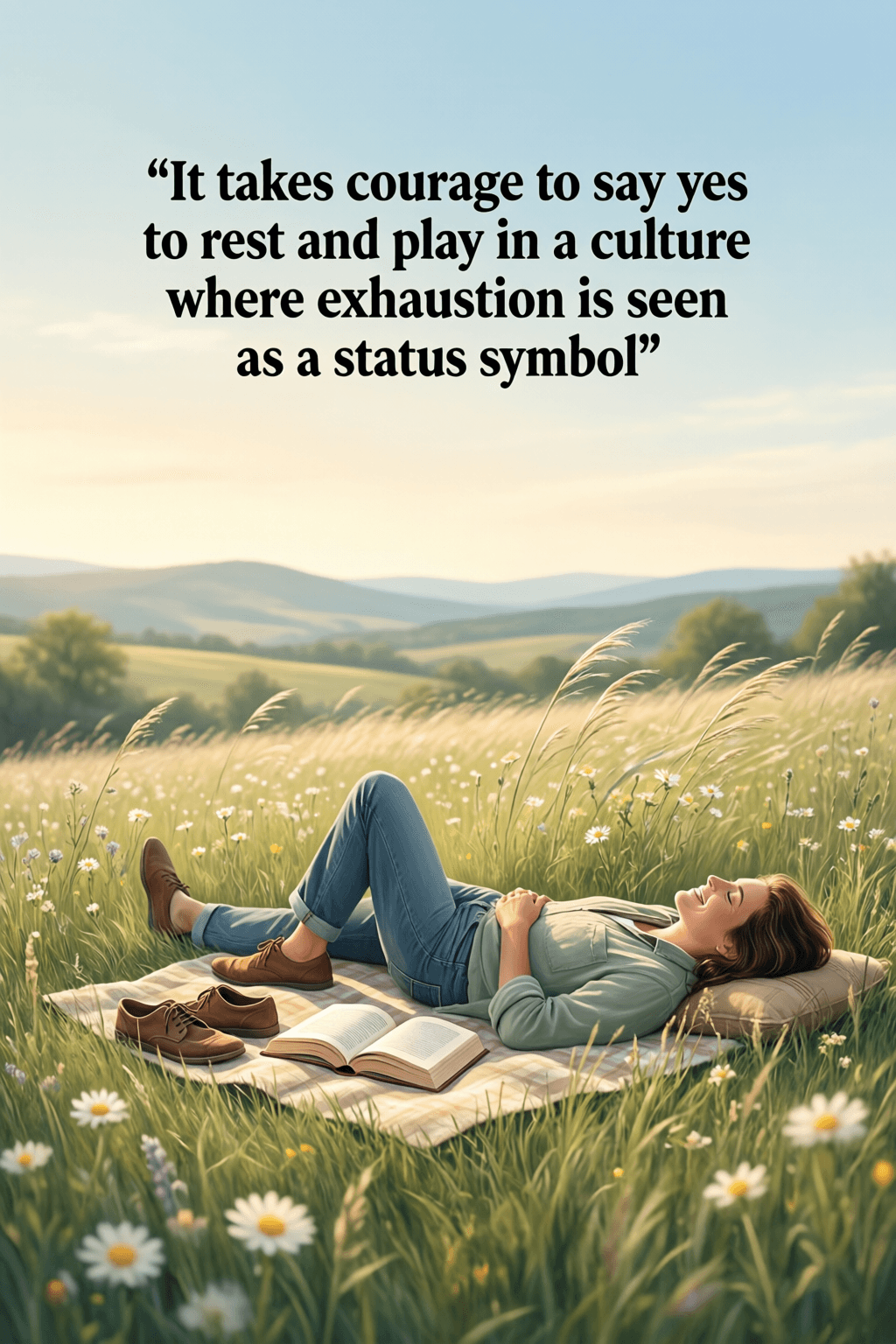
It takes courage to say yes to rest and play in a culture where exhaustion is seen as a status symbol. — Brené Brown
—What lingers after this line?
Rest as a Quiet Act of Courage
At its core, Brené Brown’s quote reframes rest and play not as indulgences, but as brave decisions. In a world that praises busyness, saying yes to downtime can feel almost rebellious, because it resists the pressure to prove worth through constant productivity. Brown suggests that courage is not only found in endurance, but also in the willingness to stop. This matters because many people have been taught to associate rest with laziness or weakness. Yet by choosing recovery, they challenge a deeper social myth: that exhaustion is evidence of importance. In that sense, rest becomes a quiet declaration that human value cannot be measured solely by output.
Why Exhaustion Became a Status Symbol
From there, the quote points to a broader cultural problem: fatigue is often worn like a badge of honor. In many workplaces and social circles, being overbooked signals ambition, relevance, and discipline. The sociologist Thorstein Veblen’s idea of status display in The Theory of the Leisure Class (1899) helps explain this pattern, though modern culture has inverted it—now even overwork can function as a public symbol of prestige. As a result, people may perform exhaustion to show they are needed or successful. Phrases like “I’ve been so slammed” or “I barely slept” often carry an undertone of achievement. Brown’s observation cuts through this performance, exposing how damaging it is when depletion becomes something to admire.
The Human Need for Play
Importantly, Brown does not mention only rest; she also includes play. That choice broadens the message, because play is often dismissed even more quickly than sleep or stillness. Yet thinkers from Plato’s Laws (c. 350 BC) to modern researcher Stuart Brown in Play: How It Shapes the Brain (2009) have argued that play is essential to learning, creativity, resilience, and connection. Seen this way, play is not a distraction from meaningful life but part of what makes life meaningful. Whether it appears as laughter, games, art, or unstructured time with loved ones, play restores emotional flexibility. Thus, Brown’s quote suggests that a healthy life requires not just recovery from work, but joyful experiences beyond it.
Burnout and the Cost of Constant Striving
Once rest is denied and play is treated as frivolous, burnout becomes almost inevitable. The World Health Organization recognized burnout in the ICD-11 as an occupational phenomenon linked to chronic workplace stress that has not been successfully managed. Brown’s quote speaks directly to this reality: cultures that glorify exhaustion often normalize the very habits that leave people emotionally drained and physically depleted. In everyday life, this can look like answering emails late into the night, feeling guilty during vacations, or losing the ability to enjoy free time without anxiety. Over time, relentless striving narrows a person’s identity until they become what they produce. Brown’s insight interrupts that spiral by insisting that restoration is not a reward after life is finished, but a condition for living it well.
Redefining Worth Beyond Productivity
Therefore, the deepest challenge in the quote may be moral rather than practical: it asks people to detach self-worth from performance. Brené Brown’s own work in The Gifts of Imperfection (2010) repeatedly argues that worthiness is not something earned through endless achievement. Rest becomes difficult precisely because it forces people to confront who they are when they are not accomplishing, optimizing, or impressing anyone. That is why choosing rest can feel vulnerable. It exposes the fear that stopping might make one seem replaceable or unremarkable. And yet, by resting anyway, a person begins to build a sturdier identity—one grounded not in exhaustion as proof, but in the simple truth that being human is enough.
A More Sustainable Vision of Life
Finally, Brown’s quote points toward a healthier cultural ideal. Instead of admiring people for how depleted they are, societies could honor balance, presence, and renewal. This shift would not eliminate hard work; rather, it would place effort within a larger rhythm that includes restoration, delight, and limits. Even the biblical Sabbath tradition, formalized in texts like Exodus 20, frames rest as sacred structure rather than optional excess. In this light, saying yes to rest and play becomes an act of both personal healing and cultural resistance. It models a different way of living—one in which energy is protected, joy is legitimate, and exhaustion is no longer mistaken for significance. Brown’s insight endures because it names a truth many feel but rarely say aloud.
Recommended Reading
As an Amazon Associate, we earn from qualifying purchases.
One-minute reflection
What feeling does this quote bring up for you?
Related Quotes
6 selectedIf you are not in the arena also getting your ass kicked, I'm not interested in your feedback. — Brené Brown
Brené Brown
Brené Brown’s blunt image of “the arena” draws a sharp line between spectators and participants. Feedback, she implies, carries real weight when it comes from someone who has also accepted the risks of being seen, judged...
Read full interpretation →Lasting change requires compassion alongside courage, not punishment disguised as self-improvement. — Brené Brown
Brené Brown
Brené Brown’s line challenges the common belief that harshness is the fastest route to transformation. Instead, she argues that durable change is built from two forces working together: the courage to face what must shif...
Read full interpretation →When fear whispers, answer with the list of what you can do. — Brené Brown
Brené Brown
Brené Brown frames fear not as a blaring alarm but as a whisper—subtle, repetitive, and strangely convincing. That detail matters, because whispers slip under the radar: they sound like intuition, realism, or “just being...
Read full interpretation →Rest is a form of resistance against a world that demands your exhaustion. — Tricia Hersey
Tricia Hersey
Tricia Hersey’s line begins by flipping a familiar moral script: instead of praising constant output, it frames rest as a deliberate refusal. In a culture that often treats busyness as proof of worth, exhaustion becomes...
Read full interpretation →Rest is a form of resistance because it asserts our humanity. — Tricia Hersey
Tricia Hersey
Tricia Hersey’s claim begins with a reversal: what looks passive is recast as deliberate opposition. In cultures that equate worth with output, choosing to rest can function like a refusal to be measured only by producti...
Read full interpretation →Rest is a form of resistance — Tricia Hersey
Tricia Hersey
Tricia Hersey’s claim that “Rest is a form of resistance” flips a familiar moral script. Instead of treating exhaustion as proof of virtue and constant productivity as the default measure of worth, she presents rest as a...
Read full interpretation →More From Author
More from Brené Brown →I set boundaries not to offend, but to honor my needs. — Brené Brown
At first glance, boundaries are often mistaken for rejection, yet Brené Brown’s quote gently overturns that assumption. By saying she sets boundaries not to offend but to honor her needs, she reframes limits as an act of...
Read full interpretation →Talk to yourself like you would to someone you love. — Brené Brown
Brené Brown’s line invites a simple but radical shift: to treat our inner voice with the same tenderness we readily offer people we cherish. At first glance, this may sound sentimental, yet it directly challenges the har...
Read full interpretation →The creative process is a journey through your own vulnerability. When you stop running from the discomfort of the blank page, you finally start creating from the truth of who you are. — Brené Brown
Brené Brown’s quote begins with a familiar image: the blank page as both invitation and threat. At first, that emptiness can feel exposing because it offers no place to hide behind polish, certainty, or imitation.
Read full interpretation →Belonging soothes the soul; it is the quiet anchor in a world that never stops moving. — Brené Brown
At its core, Brené Brown’s line suggests that belonging is not a luxury but a form of emotional shelter. In a restless world defined by change, speed, and uncertainty, the experience of being accepted gives the soul a pl...
Read full interpretation →