
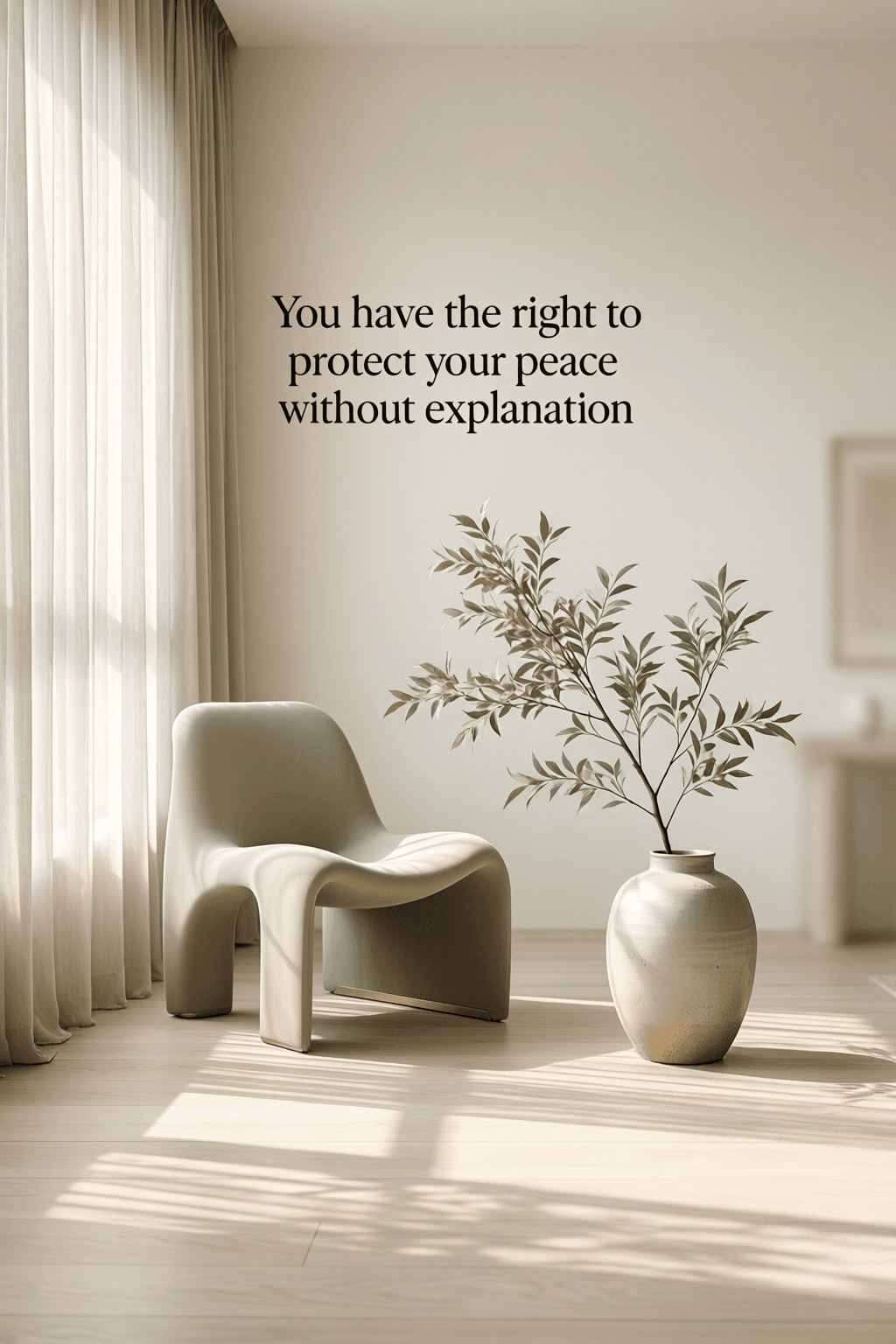
You have the right to protect your peace without explanation. — Minaa B.
—What lingers after this line?
The Core Claim of Boundaries
Minaa B.’s statement begins with a quiet but radical assertion: personal peace does not require public justification. In many social settings, people are taught to explain every limit they set, as if rest, distance, or silence must be earned through a convincing argument. Instead, the quote reframes peace as a right rather than a reward, shifting the focus from others’ approval to inner well-being. From there, the idea naturally expands into the language of boundaries. Saying no, stepping back, or declining access to one’s time can be an act of self-respect rather than hostility. In this sense, protecting peace is not about punishment; it is about preserving the emotional conditions needed to live with clarity and dignity.
Why Explanation Becomes a Burden
At the same time, the pressure to explain often comes from a deeper fear of disappointing others. Many people over-justify themselves because they hope detailed reasoning will soften conflict or secure understanding. Yet repeated explanation can become its own form of emotional labor, especially when the listener is more interested in negotiation than respect. This is why the quote feels liberating: it recognizes that not every decision needs to be made legible to everyone else. As psychologist Nedra Glover Tawwab argues in Set Boundaries, Find Peace (2021), boundaries are about what we will and will not allow, not about persuading others to agree. The more a person accepts that truth, the lighter their inner life can become.
Peace as an Act of Self-Trust
Once explanation is no longer the standard, self-trust becomes essential. Protecting peace without explanation means believing that your discomfort, exhaustion, or intuition is valid even when it cannot be neatly summarized. Often, the body and mind register harm before language catches up, which is why a person may know they need distance long before they can fully articulate why. In that way, the quote also challenges the modern demand for constant transparency. Not every emotional process is ready for public consumption. Much like Audre Lorde’s reflections in A Burst of Light (1988), where caring for oneself is framed as preservation rather than indulgence, Minaa B.’s line suggests that honoring inner knowledge is a necessary discipline.
The Difference Between Privacy and Cruelty
Still, protecting your peace does not mean abandoning kindness. There is an important distinction between withholding unnecessary explanation and using silence as a weapon. A brief, respectful statement—such as ‘I’m unavailable’ or ‘I need space’—can communicate a boundary without inviting debate. In other words, privacy can be firm without becoming cruel. This distinction matters because many people confuse access with intimacy. Yet healthy relationships allow room for limits, and mature connection does not demand endless disclosure. As a result, the quote encourages a more balanced ethic: one can be compassionate toward others while still refusing to sacrifice mental and emotional stability for their comfort.
Cultural Pressure to Over-Explain
Furthermore, the need to justify peace is not evenly distributed. Women, caregivers, and people from marginalized communities are often socially conditioned to prioritize harmony over personal well-being. In such contexts, saying no without a full defense can be judged as selfish, cold, or disrespectful, even when the boundary is reasonable. Seen this way, Minaa B.’s words carry social as well as personal weight. They resist the expectation that some people must always remain emotionally accessible. Much as bell hooks in All About Love (2000) insists that love cannot exist without care and responsibility, this quote implies that genuine care must include care for oneself, not just endless availability to others.
A Practice of Quiet Freedom
Ultimately, the quote points toward a quieter kind of freedom: the ability to choose peace without performing pain for an audience. That freedom may look ordinary—leaving a draining conversation, declining an invitation, muting a message thread—but its emotional significance is profound. Each small act reinforces the belief that one’s well-being is inherently worth protecting. By the end, the message is not one of isolation but of integrity. A peaceful life is built not only through what we welcome, but also through what we gently refuse. In that sense, Minaa B. offers more than reassurance; she offers permission to let boundaries stand on their own.
One-minute reflection
What does this quote ask you to notice today?
Related Quotes
6 selectedSometimes, protecting your peace is the better choice. — Marcus Aurelius
Marcus Aurelius
At first glance, the saying frames peace not as passivity but as discipline. To protect one’s peace is to recognize that not every conflict deserves entry into the mind.
Read full interpretation →You don't need permission to protect yourself. Self-protection is natural. — Gooltik
Gooltik
At its heart, Gooltik’s statement rejects the idea that self-defense must be justified to others before it becomes valid. By saying self-protection is natural, the quote frames personal safety not as selfishness or aggre...
Read full interpretation →Protecting your peace is not an act of selfishness, but a necessary act of survival. — Pema Chödrön
Pema Chödrön
At first glance, guarding one’s inner calm can seem like withdrawal from others, yet Pema Chödrön reframes it as a basic necessity. Her statement challenges the moral pressure many people feel to be endlessly available,...
Read full interpretation →Peace comes from within. Do not seek it without. — Buddha
Buddha
This quote emphasizes that true peace is a state of mind and heart, originating from within oneself. It encourages individuals to find tranquility by cultivating inner harmony rather than searching for it in external cir...
Read full interpretation →If it costs my peace, it's outside my boundary. — Adam J. Jackson
Adam J. Jackson
At its core, Adam J. Jackson’s line reframes boundaries as more than rules we impose on others; they become protections for our inner life.
Read full interpretation →Like water which can clearly mirror the sky and the trees only so long as its surface is undisturbed, the mind can only reflect the true image of the Self when it is tranquil and wholly relaxed. — Indra Devi
Indra Devi
Indra Devi begins with a simple natural image: calm water reflects the sky and trees only when its surface is still. In the same way, she suggests that the mind reveals truth not through strain or agitation, but through...
Read full interpretation →More From Author
More from Minaa B. →You cannot build intimacy on a schedule that only allows for convenience. — Minaa B.
At its core, Minaa B.’s quote argues that intimacy cannot grow in the leftover spaces of life. When connection is offered only when it suits one person’s schedule, emotional closeness begins to feel conditional rather th...
Read full interpretation →You don't need to earn rest, peace, or space—you just need to claim it. — Minaa B.
At its core, Minaa B.’s quote rejects the idea that human value must be proven through constant effort. In many cultures, rest is treated like a reward for exhaustion, as though peace must be purchased with burnout.
Read full interpretation →Your personal space is a foundation for self-care. — Minaa B.
Minaa B.’s statement begins with a simple but powerful premise: personal space is not a luxury, but a base layer of health. In this sense, self-care becomes more than candles, routines, or occasional rest; it starts with...
Read full interpretation →